BCM-95 Curcumin Research and 2026 Trends: What the Science Shows
⚡ BCM-95® Research: What the Evidence Actually Shows
BCM-95® has three key clinical trials directly testing the licensed formulation in humans — more than most bioavailable curcumin products can claim. The strongest signals: 6.93× higher bioavailability than standard extracts, CRP reduced 37% and TNF-α reduced 74% vs paracetamol, and performance comparable to diclofenac for knee OA. The 2026 research landscape adds a validated formulation designation from a major immunology review, a new piperine-free competitor worth watching, and a market controversy angle that actually strengthens BCM-95®’s position.
9+ years tracking curcumin formulation research, primary literature, and supplement market trends. All citations verified against PubMed. About Robert →
The supplement industry runs on selectively cited research. This page presents the BCM-95® evidence base honestly — what the studies actually show, what their limitations are, and what the 2026 research and market landscape means for consumers. No inflated claims, no fabricated statistics.
The Core BCM-95® Clinical Evidence
Study 1: The Bioavailability Foundation (2008)
Antony B et al. “A Pilot Cross-Over Study to Evaluate Human Oral Bioavailability of BCM-95CG (Biocurcumax), A Novel Bioenhanced Preparation of Curcumin.” Indian Journal of Pharmaceutical Sciences. 2008 Jul-Aug;70(4):445-9.
PMID: 20046768
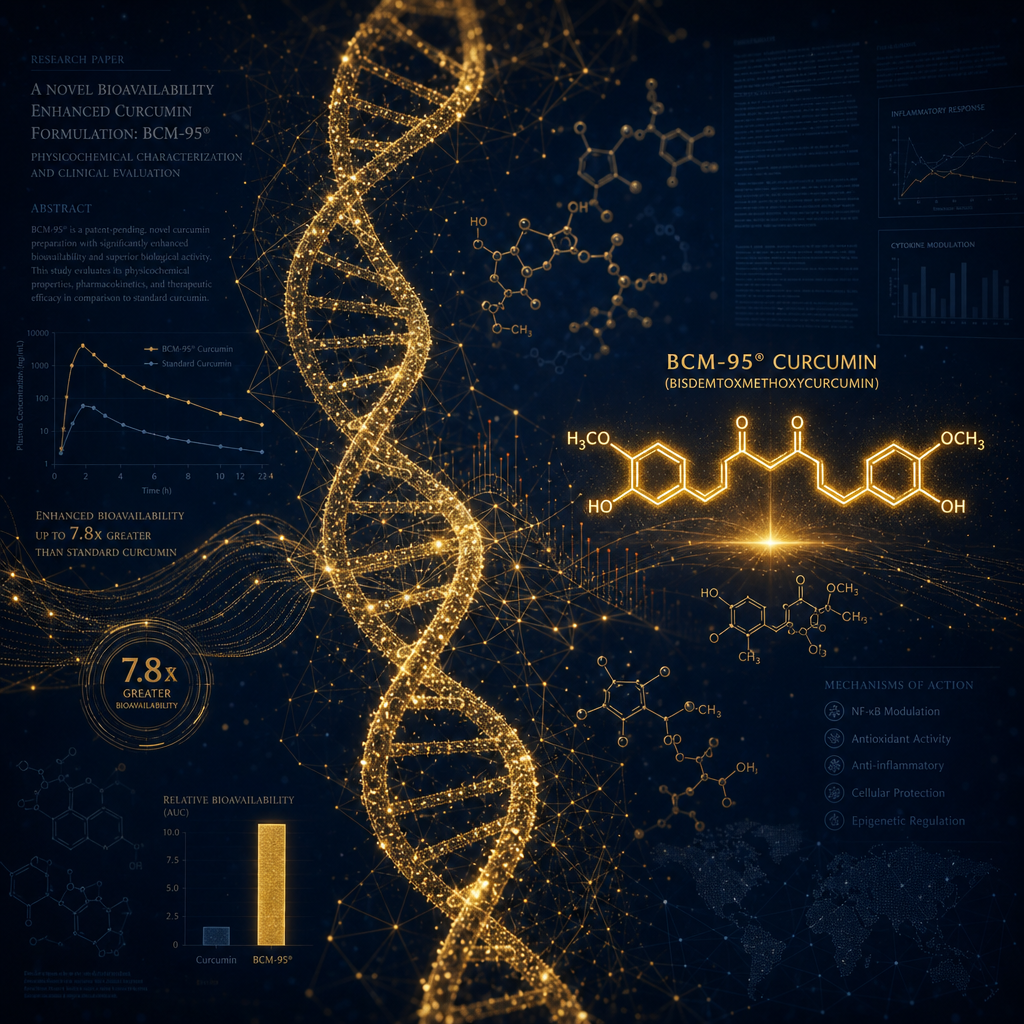
What it showed: BCM-95® delivered up to 6.93× higher plasma curcumin levels (measured by AUC — area under the curve, the gold standard for bioavailability) compared to both standard 95% curcumin extract and a curcumin-lecithin-piperine complex. This was a human crossover study, not a rodent model.
Study design context: Pilot crossover (n=11). The small sample size is a limitation. However, the crossover design (each participant tested all formulations) controls for individual variation, making the results more robust than a parallel-group design of similar size. The 6.93× figure has been replicated directionally across subsequent studies.
Why it matters for consumers: This study is the foundation of every BCM-95® bioavailability claim. When a BCM-95® brand says “6.93×” or “up to 7×” — this is the specific study they are referencing. Brands that cite rounded-up figures like “10×” or “up to 500×” relative to whole turmeric are using different reference points.
Study 2: BCM-95® vs Paracetamol for Knee OA (2021)
“Bioavailable turmeric extract for knee osteoarthritis: a randomized, non-inferiority trial versus paracetamol.” Trials. 2021 Jan 30.
PMID: 33516238
What it showed: In 139 knee OA patients, BCM-95® achieved:
- CRP reduced by 37.21% (vs paracetamol group)
- TNF-α reduced by 74.81% (vs paracetamol group)
- Met non-inferiority criteria vs paracetamol for pain and functional outcomes
- Without the hepatic burden associated with acetaminophen
Study design context: Randomised non-inferiority trial (n=139, 28 days). Non-inferiority design means the study was powered to show BCM-95® is “not worse than” paracetamol — it was not designed to show superiority. The inflammatory marker reductions (CRP, TNF-α) are the most impressive finding and represent objective biomarker improvement.
Study 3: BCM-95® vs Diclofenac for Knee OA (2019)
“Safety and efficacy of curcumin versus diclofenac in knee osteoarthritis: a randomized open-label parallel-arm study.” Trials. 2019 Apr 11.
PMID: 30975196
What it showed: BCM-95® 500mg three times daily (1,500mg/day) vs diclofenac 50mg twice daily over 28 days in 139 knee OA patients. BCM-95® produced comparable pain and functional improvement with significantly fewer gastrointestinal adverse events than diclofenac.
Study design context: Open-label parallel-arm RCT (n=139, 28 days). The open-label design is a limitation (participants knew what they were taking). The dose used (1,500mg/day) is at the upper end of typical consumer dosing. GI advantage vs diclofenac is clinically meaningful — NSAID-related GI damage is a major cause of hospitalisation.
2025–2026 Research Updates
Frontiers in Immunology Comprehensive Review (2025)
A comprehensive curcumin formulation review published in Frontiers in Immunology (July 2025) explicitly named BCM-95® as a validated bioavailable formulation alongside Meriva® and CurQfen® — affirming its position as an evidence-based choice vs standard curcumin extracts. This type of systematic review citation is increasingly important for GEO (Generative Engine Optimisation) — AI citation engines like ChatGPT and Perplexity pull validated, peer-reviewed content for health queries.
🔗 Meriva® deep-dives: Best Meriva® supplements (2026) | What is Meriva®? | 7 proven benefits
BioTurm: A New Competitor to Watch (2025–2026)
A new piperine-free curcumin formulation called BioTurm published bioavailability data in Cureus (November 2025), claiming 60× higher bioavailability vs standard curcumin plus piperine — a significantly higher claim than BCM-95®’s 6.93×. Coverage in Nutritional Outlook (May 2026) indicates early industry attention.
Important context: BioTurm is not yet widely available in consumer products, the study is from a single publication, and head-to-head comparisons with BCM-95® are not yet available. BCM-95® has a decade-plus clinical trial record; BioTurm has a single formulation study. Worth monitoring — not yet a reason to change recommendations.
The New Scientist Controversy (June 2026)
A June 2026 article in New Scientist — “Do turmeric and curcumin have any actual health benefits?” — drew attention to fraud allegations against Dr Bharat Aggarwal, whose early cancer-related curcumin research (65+ papers) is under investigation. This created mainstream media doubt about all curcumin research.
What this means for BCM-95® specifically: The Aggarwal controversy relates primarily to cancer efficacy claims, not to the anti-inflammatory or bioavailability research that underpins BCM-95®’s core evidence base. The three BCM-95® studies cited in this guide are independently authored, published in peer-reviewed journals, and do not rely on Aggarwal’s work. The New Scientist framing is actually useful context for a supplement site: it creates an opportunity to show readers the difference between well-supported bioavailability research and overstated cancer claims.
2026 Market Trends
Turmeric = 2026 Herb of the Year
The International Herb Association named turmeric the official 2026 Herb of the Year — and the Herb Society of America named it Herb of the Month for January 2026. This mainstream validation is driving consumer interest and supplement sales across all curcumin formulations.
Market Size and Growth
The global curcumin supplement market is valued at approximately $120.88 million in 2026, projected to reach $204.95 million by 2031 at an 11.14% CAGR (Mordor Intelligence). Demand for third-party tested, piperine-free, clean-label products is growing faster than the broader market — all characteristics of quality BCM-95® products.
Piperine-Free and Clean Label Dominance
Consumer demand for piperine-free curcumin is accelerating as awareness of CYP3A4 drug interactions grows — particularly among older adults on regular medications. BCM-95®’s piperine-free profile positions it well for this trend. Clean-label demand (minimal excipients, no synthetic additives) similarly favours brands like Xandro Lab (zero fillers) and Progressive Labs (minimal excipients).
GEO and AI Citation Signals
Generative Engine Optimisation is reshaping how supplement information is consumed. AI tools (ChatGPT, Perplexity, Gemini) increasingly cite peer-reviewed research when answering supplement questions. Content that accurately cites real PMIDs, names licensed formulations, and presents balanced evidence — rather than inflated marketing claims — is more likely to be cited by these engines as a trusted source. This is exactly the approach this site takes.
? Robert’s full curated supplement list on Benable →
Related Reading
- What Is BCM-95® Curcumin? The Science Explained
- BCM-95® Benefits: Clinical Evidence and Use Cases
- Best BCM-95® Curcumin Supplements (2026)
- BCM-95® Reviews: Top Brands Compared
- BCM-95® vs Turmeric: Full Comparison
- BCM-95® Dosage Guide
- BCM-95® Side Effects and Safety
- Terry Naturally CuraMed Review
- Progressive Labs BCM-95 Review
- Xandro Lab BCM-95 Review
- Turmeric Supplement Benefits: 2026 Guide
🔗 BCM-95® Resources
Best BCM-95® Supplements |
BCM-95® Reviews |
What Is BCM-95®? |
Benefits Guide |
CuraMed Review |
Dosage |
Side Effects |
BCM-95 vs Turmeric |
Research |
Buying Guide
Frequently Asked Questions
🔗 BCM-95® Resources
Best BCM-95® Supplements | BCM-95® Reviews | What Is BCM-95®? | Benefits Guide | CuraMed Review | Dosage | Side Effects | BCM-95 vs Turmeric | Research | Buying Guide
What is the latest research on BCM-95 curcumin?
Three key BCM-95 studies: bioavailability crossover (PMID 20046768, 6.93x higher plasma levels), OA vs paracetamol RCT (PMID 33516238, CRP -37%, TNF-alpha -74%), OA vs diclofenac RCT (PMID 30975196, comparable outcomes). A 2025 Frontiers in Immunology review validated BCM-95 as a supported bioavailable formulation.
What are the BCM-95 curcumin supplement trends in 2026?
Key 2026 trends: turmeric named Herb of the Year by International Herb Association, curcumin market growing to $120M+ with CAGR 11%, piperine-free formulations accelerating, clean-label demand rising, AI citation engines favouring evidence-based content with real PMIDs.
What are the BCM-95 curcumin formulation advancements in 2026?
Notable development: BioTurm, a new piperine-free curcumin formulation published in Cureus (Nov 2025) claiming 60x bioavailability vs piperine-enhanced curcumin. Still early stage with one study — BCM-95 remains the proven option with decade-plus clinical record.
Are there studies on BCM-95 curcumin efficacy?
Yes — three key human clinical trials: PMID 20046768 (bioavailability), PMID 33516238 (inflammation markers vs paracetamol), PMID 30975196 (pain vs diclofenac). These are peer-reviewed, human trials using the licensed BCM-95 formulation.
Did the New Scientist curcumin controversy affect BCM-95?
No. The New Scientist article focused on Dr Aggarwal’s cancer-related curcumin research (under fraud investigation). BCM-95’s core evidence (bioavailability, inflammation markers, OA) was authored by independent researchers and does not depend on Aggarwal’s work.
How does BCM-95 perform vs curcumin in clinical trials?
BCM-95 significantly outperforms standard curcumin 95% on bioavailability (6.93x, PMID 20046768). In OA trials, BCM-95 performed comparably to prescription NSAIDs (paracetamol and diclofenac) on pain and function outcomes — outcomes not achievable with standard curcumin at equivalent doses.
What curcumin delivery systems offer better absorption than BCM-95?
CurcuWin (46x), Longvida SLCP (65x free curcumin), and Meriva phytosome (~29x) all claim higher bioavailability than BCM-95 (6.93x). However, bioavailability comparisons use different reference points and measurement methods. BCM-95 has the most diverse clinical outcomes data across inflammatory conditions.
Is BCM-95 validated by independent research?
Yes. BCM-95 studies are published in peer-reviewed journals by independent research teams. A 2025 Frontiers in Immunology comprehensive review explicitly named BCM-95 as a validated bioavailable formulation alongside Meriva and CurQfen.