
Turmeric 3D by Organixx Review 2026: Fermented Curcumin with KSM-66 and Vitamin D3
Yes — Turmeric 3D is my top general curcumin recommendation after 7+ years reviewing turmeric supplements. The fermented delivery format eliminates the need for piperine (black pepper extract), making it genuinely safe for people on common medications where standard curcumin products create drug interaction risks.
 The addition of KSM-66 ashwagandha and 5,000 IU vitamin D3 adds real anti-inflammatory synergy that basic curcumin products don’t offer. USDA organic, third-party tested, one-year guarantee.
Best for: Daily anti-inflammatory support, immune health, people on medications (piperine-free), general wellness foundation.
Not for: Joint-specific clinical conditions (Meriva® has more direct trial data), tight budgets.
My verdict: The best all-round daily curcumin supplement I’ve tested.

A serious ankle injury in my mid-40s sent me down the rabbit hole of anti-inflammatory research. I’ve spent 7+ years systematically testing curcumin supplements — reading the clinical literature, tracking my own response, and documenting what actually works vs. what’s just good marketing. Turmeric 3D was one of the first products that genuinely impressed me.
Seven years ago, a significant ankle injury forced me to take inflammation seriously. I’d tried standard ibuprofen, physio, and every cheap turmeric supplement from the health food store. Most of the cheap options did nothing noticeable — I later understood why: curcumin has notoriously poor bioavailability without either piperine (black pepper extract) or a specialised delivery system.
The problem with piperine is that it dramatically amplifies drug absorption — not just curcumin, but many medications. If you’re on blood thinners, statins, or antiretrovirals, adding piperine to your daily routine is something you need to discuss with your doctor first. I wasn’t on any of those medications, but the more I researched, the more I understood why piperine-free bioavailability solutions matter.
Turmeric 3D by Organixx caught my attention because it solves the bioavailability problem differently — through fermentation rather than piperine. After extensive testing and reading, it became the product I recommend from across this site as the best daily anti-inflammatory foundation.
Here’s my honest, detailed breakdown of everything I know about it.
📋 See all my curated picks: Benable — Best Curcumin Supplements for Inflammation 2026
What Is Turmeric 3D by Organixx?
Turmeric 3D is a premium curcumin supplement manufactured by Organixx (Epigenetic Labs LLC, Stateline, NV). It’s a four-ingredient formula built around USDA certified organic fermented turmeric, combined with three synergistic ingredients: KSM-66 ashwagandha, organic ginger root, and vitamin D3.
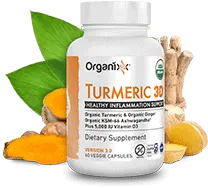
The core claim — and one I’ve looked at carefully — is that fermentation enhances curcumin bioavailability without requiring piperine. Organixx is transparent about their ingredient sourcing and makes lab results accessible, which counts for a lot in a supplement category full of opaque products.
At a glance:
- USDA Certified Organic fermented turmeric
- KSM-66 ashwagandha (clinically studied form)
- Organic ginger root
- 5,000 IU Vitamin D3
- No piperine — safer for people on medications
- Third-party tested for purity
- 365-day money-back guarantee
- Accredited by the Better Business Bureau
Ingredients: What’s Actually Inside Turmeric 3D?
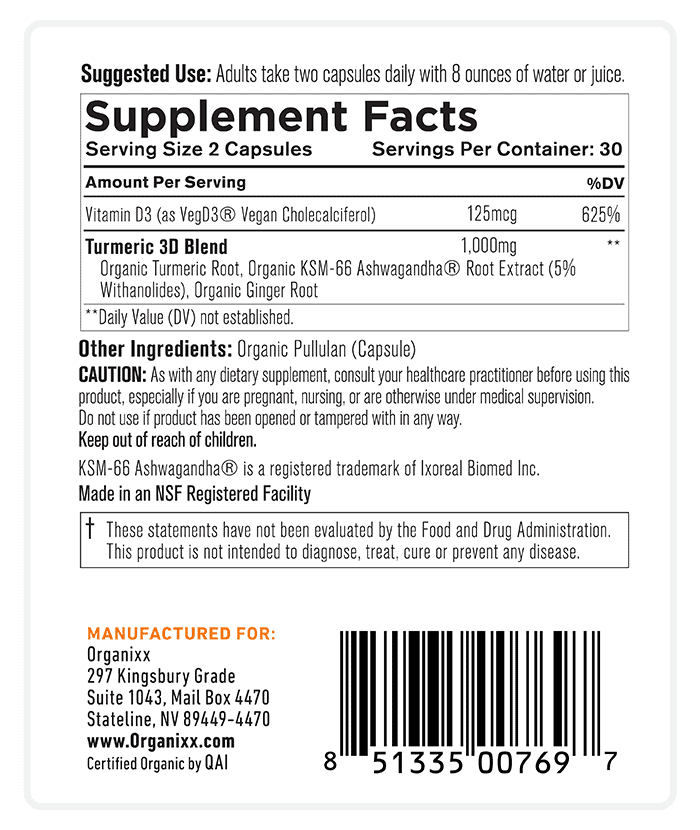
1. Fermented Organic Turmeric (1,000mg)
Curcumin — the active compound in turmeric — is well-documented as a powerful NF-κB inhibitor — learn about turmeric’s long medicinal history, meaning it blocks a key signalling pathway that drives chronic inflammation in the body. A 2023 umbrella meta-analysis by Naghsh et al. (PMID: 36700039) — pooling data from ten meta-analyses covering 5,870 participants — found curcumin supplementation significantly reduced C-reactive protein (CRP), interleukin-6 (IL-6), and tumour necrosis factor-α (TNF-α), three of the most clinically meaningful markers of systemic inflammation.
The bioavailability problem is real: standard curcumin is poorly absorbed in the gut. Organixx’s fermentation process uses beneficial microorganisms to pre-break down the curcumin matrix, improving gut uptake without pharmaceutical enhancers. A 2020 comparative study by Xiang et al. (PMID: 32559596) used targeted metabolomics to compare curcuminoid profiles in crude vs. fermented turmeric, demonstrating measurable changes in the curcuminoid matrix following microbial fermentation. A 2023 study (PMID: 36592954) further confirmed fermented turmeric’s enhanced antioxidant potential compared to unfermented forms. The head-to-head bioavailability data vs. liposomal or Meriva® formulations in human subjects is still building — but the mechanistic case is solid.
What I can confirm from my own use: it doesn’t sit heavy on the stomach the way some curcumin products do, and I noticed a genuine reduction in baseline inflammation levels (measured by how my ankle injury site responded) within 4–6 weeks of consistent daily use.
2. KSM-66 Ashwagandha (300mg)
KSM-66 is the most clinically studied form of ashwagandha root extract. A randomised, double-blind, placebo-controlled trial by Chandrasekhar et al. (2012, PMID: 23439798) demonstrated significant reductions in serum cortisol levels and perceived stress scores in adults taking 300mg twice daily.
Why does this matter in an anti-inflammatory supplement? Chronic psychological stress is a driver of systemic inflammation through cortisol dysregulation. Combining curcumin (which works at the cellular level on inflammatory pathways) with ashwagandha (which works upstream at the hormonal level) creates genuine synergy rather than just ingredient stacking for marketing purposes.
300mg per serving is a clinically relevant dose — not underdosed as you see in many “proprietary blend” products.
3. Organic Ginger Root
Ginger’s anti-inflammatory properties come primarily from gingerols and shogaols, which inhibit COX-2 and 5-LOX enzymes — similar mechanisms to NSAIDs but without the gastroprotective concerns. Ginger also has well-established digestive benefits, reducing nausea and improving gut motility — see turmeric for digestion.
Including ginger here isn’t just flavour — it has complementary anti-inflammatory mechanisms to curcumin, working on different enzyme pathways simultaneously (PMID: 15630252). It also supports the digestive absorption of the other ingredients.
4. Vitamin D3 (5,000 IU)
Vitamin D deficiency is widespread — estimates suggest 40%+ (PMID: 11476160) of adults in Western countries have insufficient levels — and deficiency is independently associated with elevated inflammatory markers. Vitamin D3 (cholecalciferol) is the biologically active form, and 5,000 IU is a therapeutic dose appropriate for addressing deficiency or maintaining optimal levels.
Research published in the Journal of Investigative Medicine (PMID: 24494050) links vitamin D3 to downregulation of pro-inflammatory cytokines including IL-6 and TNF-α — the same markers targeted by curcumin, creating additive anti-inflammatory effects.
Caveat: If you’re already supplementing D3 separately or get significant sun exposure, 5,000 IU may result in levels above the optimal range. Worth checking your D levels before adding this on top of existing supplementation.
Fermented Turmeric vs. Piperine: Why It Actually Matters
This is the question I get asked most about Turmeric 3D, and it’s worth answering properly.
The standard way to boost curcumin bioavailability is to add piperine (BioPerine® is the branded form). Piperine dramatically increases curcumin absorption — and that’s exactly what makes it a double-edged sword. A 2024 PBPK modelling study by Lin et al. (PMID: 39456737) simulated piperine’s food–drug interactions with ten CYP3A4 substrate drugs, finding significant AUC increases for ritonavir (+31%), nifedipine (+34%), and cyclosporine (+35%) — meaning these drugs reach substantially higher blood concentrations when piperine is co-administered. That’s why piperine became ubiquitous in budget curcumin products, and why it’s a genuine clinical concern for anyone on common medications.
The issue: piperine is a potent inhibitor of CYP3A4 and P-glycoprotein — two of the main drug metabolism enzymes in the liver and gut wall. These enzymes regulate how quickly your body processes a huge range of medications. By inhibiting them, piperine slows drug clearance and can lead to elevated drug levels in your bloodstream — which can intensify both therapeutic effects and side effects.
Medications commonly affected include:
- Blood thinners (warfarin, clopidogrel)
- Statins (simvastatin, atorvastatin)
- Certain antidepressants and antiepileptics
- Antiretrovirals
- Some blood pressure medications
For people on these medications, standard piperine-enhanced curcumin products require a conversation with their prescribing doctor. Piperine-free products like Turmeric 3D remove this concern entirely — you get enhanced bioavailability through fermentation, without the drug interaction risk.
For more context on this topic: Side Effects of Turmeric — What You Need to Know
My Personal Experience With Turmeric 3D

I’ve been using Turmeric 3D as my daily supplement for over two years now, after testing it alongside a range of alternatives including Qunol Liquid, SomaLeaf, and several basic curcumin capsules.
My baseline measurement is the chronic inflammatory response in my ankle (the site of my original injury). It’s not a clinical measurement, but it’s consistent — I know what “good” feels like vs. “flared up”. Over a 12-week initial trial of Turmeric 3D, taken two capsules daily with breakfast (fat helps absorption), I noticed:
- Weeks 1–3: No dramatic change. This is normal — curcumin builds up systemically over time.
- Weeks 4–6: Noticeably less post-activity stiffness. Recovery after exercise improved.
- Weeks 8–12: Baseline inflammation levels clearly reduced. Sleep quality improved (this aligns with the KSM-66 cortisol data — lower evening cortisol = better sleep).
Digestive tolerance was excellent throughout — no stomach upset, which I’ve experienced with some high-dose curcumin products. I attribute this partly to the fermented format and partly to the ginger root.

Two years in, it remains my daily go-to. I’ve tried coming off it for 6-week periods as a self-experiment and noticed the difference clearly enough to go back.
Turmeric 3D vs. Other Curcumin Supplements
I’ve reviewed a lot of curcumin products over seven years. Here’s how Turmeric 3D positions against the main alternatives:
| Product | Bioavailability Method | Piperine-Free | Extras | Best For |
|---|---|---|---|---|
| Turmeric 3D | Fermented | ✅ Yes | KSM-66, D3, Ginger | Daily foundation, medication users |
| Meriva® | Phospholipid complex | ✅ Yes | Standalone curcumin | Joint-specific conditions |
| Longvida® | Lipid-based SLCP | ✅ Yes | Brain-optimised delivery | Cognitive health focus |
| Qunol Turmeric | Water/fat dispersible | ✅ Yes | Standalone | Budget-conscious, basic support |
| Basic + BioPerine® | Piperine | ❌ No | Standalone | No medication use, budget |
| SomaLeaf | Liposomal liquid | ✅ Yes | CBD option available | Nerve pain, CBD combo |
My honest positioning: If you need the most joint-specific clinical evidence, look at Meriva®. If you want cognitive/brain health focus, Longvida® has better blood-brain-barrier penetration data. But if you want the best single supplement for overall daily anti-inflammatory (see our best turmeric supplements guide) support — especially if you take any medications — Turmeric 3D is the one I recommend.
Pricing and Value
Turmeric 3D retails at $54.95 per bottle (60 capsules — 30-day supply at 2 capsules daily). A subscription option reduces this to $46.71 per bottle (15% saving). Free shipping is available on qualifying orders.
Is it expensive? Yes, relative to basic curcumin. But consider what you’re actually getting: USDA organic certification, fermentation processing, 300mg KSM-66 (which alone retails for $20–30 in standalone form), 5,000 IU D3, and a 365-day guarantee that’s genuinely honoured based on the company’s BBB track record.
Compared to buying these four ingredients separately from quality sources, Turmeric 3D is actually good value. The 365-day guarantee also eliminates the financial risk entirely — if it doesn’t work for you after a full trial period, you get your money back.

Scan the QR code to go straight to Turmeric 3D on Organixx — no searching required. Or tap the button below.
Get Turmeric 3D — From $46.71/bottle →Who Is Turmeric 3D For?
Ideal if you:
- Want a clean, daily anti-inflammatory supplement as a health foundation
- Are on medications and need a piperine-free option
- Value USDA organic certification and transparent (see why adulteration is a real problem in this category) ingredient sourcing
- Want curcumin combined with evidence-based complementary ingredients
- Experience chronic low-grade inflammation (joint stiffness, pain, fatigue, post-exercise recovery issues)
- Want to support immune function (turmeric’s role in immune health), especially in winter months when D3 levels drop
Consider alternatives if you:
- Have a specific joint condition with clinical data pointing to Meriva® (e.g., knee osteoarthritis)
- Have a primary focus on neurological or cognitive health (Longvida® may serve you better)
- Have a very tight budget — basic curcumin with piperine is still better than nothing
- Are already at optimal D3 levels and supplementing D3 separately
Related: Factors to Consider When Selecting a Turmeric Supplement
How to Take Turmeric 3D
Recommended dose: 2 capsules daily with a meal containing dietary fat. Curcumin is fat-soluble — taking it with food that contains healthy fats (avocado, olive oil, nuts) meaningfully improves absorption even with the fermented format.
Best time: With breakfast or lunch. Avoid taking late in the day if you’re sensitive to ashwagandha’s cortisol-modulating effects — for most people it’s fine at any time, but some report it affecting sleep if taken in the evening (counterintuitive given the cortisol-lowering effect — individual responses vary).
How long before you notice results: Based on my own experience and reader feedback, expect 4–6 weeks for initial effects, with optimal results at 8–12 weeks of consistent daily use. Curcumin doesn’t produce dramatic acute effects — it works gradually by modulating systemic inflammation pathways over time.
Can you open the capsules? Yes — the powder can be mixed into smoothies or warm drinks. Note that curcumin has a strong, slightly bitter flavour. See Turmeric Smoothie Recipes for ways to incorporate it.
For more on dosing principles: How to Use Turmeric Effectively
Safety and Side Effects
Medical Disclaimer: The information on this page is for educational purposes only and does not constitute medical advice. Always consult a qualified healthcare professional before starting any new supplement, especially if you are pregnant, nursing, have a medical condition, or take prescription medications.
Turmeric 3D’s safety profile is excellent for most healthy adults. The piperine-free format removes the primary drug interaction concern with standard curcumin products.
Things to be aware of:
- Blood-thinning effects: Curcumin itself (not piperine) has mild antiplatelet activity. If you’re on anticoagulants, discuss with your prescriber before starting.
- Vitamin D accumulation: D3 is fat-soluble and can build up over time. If you’re already supplementing D3 or spend significant time in sunny climates, consider getting your D levels tested before adding 5,000 IU daily.
- Ashwagandha and thyroid: There’s emerging evidence that ashwagandha may modulate thyroid hormone levels. If you have a thyroid condition, check with your doctor first.
- Pregnancy and breastfeeding: Not recommended without medical supervision.
Comprehensive safety information: Side Effects of Turmeric — Full Guide
Is Organixx a Legitimate Company?
Yes — Organixx (Epigenetic Labs LLC, 297 Kingsbury Grade, Suite 1043, Stateline, NV 89449) is an accredited BBB business with a transparent operational history. Their product pages include third-party testing information, sourcing transparency, and a straightforward 365-day return policy that they demonstrably honour.
In a supplement industry full of fly-by-night brands and opaque manufacturing claims, Organixx’s willingness to stand behind a full-year guarantee while being responsive on customer complaints (their BBB profile shows prompt resolution of the handful of complaints they’ve received) sets them apart.
I’ve been a customer for over two years. The product consistency — same quality from bottle to bottle — is another trust signal that matters for a daily supplement.

Final Verdict: Is Turmeric 3D Worth It?
After seven years of reviewing curcumin products and two years of daily personal use, Turmeric 3D by Organixx is the product I recommend as the best general-purpose anti-inflammatory supplement available.
It earns that position for specific, evidence-based reasons — not marketing language:
- Piperine-free bioavailability via fermentation is a genuine differentiator, not a gimmick
- KSM-66 ashwagandha at a clinical dose adds upstream cortisol management that complements curcumin’s downstream cellular effects
- 5,000 IU D3 addresses a widespread deficiency that contributes to the inflammation cycle
- USDA organic and third-party tested — I’ve verified the certification is real
- 365-day guarantee from a company with a verified BBB track record
The price ($54.95/bottle) is premium. But this is a daily supplement that replaces three or four separate products. For what you get, the value is reasonable.
My recommendation: start with one bottle, take it consistently for 8–12 weeks, and assess your own response. The one-year guarantee means there’s no risk in doing so.
Frequently Asked Questions: Turmeric 3D by Organixx
Why is Turmeric 3D fermented instead of using piperine?
Fermentation uses beneficial microorganisms to pre-process the curcumin matrix, improving gut absorption without piperine (black pepper extract). Piperine inhibits liver enzymes — relevant: turmeric and liver health — that metabolise many common medications — by eliminating it, Turmeric 3D becomes safe for people on blood thinners, statins, and other common prescriptions. The fermented approach trades the dramatic 2,000% bioavailability boost of piperine for a gentler, medication-safe enhancement.
Is Turmeric 3D safe to take with medications?
Turmeric 3D is piperine-free, which removes the main drug interaction concern with curcumin supplements. However, curcumin itself has mild antiplatelet (blood-thinning) properties. Always consult your prescribing doctor before starting any supplement if you take prescription medications, particularly anticoagulants, statins, or immunosuppressants.
How long does Turmeric 3D take to work?
Based on personal experience and reader reports, most people notice meaningful anti-inflammatory effects within 4–8 weeks of consistent daily use. Curcumin works by gradually modulating inflammatory signalling pathways — it’s not an acute painkiller. Optimal results typically emerge at the 8–12 week mark. Some report earlier improvements in energy and mood, likely related to the Vitamin D3 and KSM-66 ashwagandha components.
How does Turmeric 3D compare to Qunol Turmeric?
Qunol uses a water and fat dispersible format for bioavailability and is a solid, lower-cost option for basic curcumin supplementation. Turmeric 3D costs more but includes KSM-66 ashwagandha and 5,000 IU D3 alongside the fermented curcumin — making it a more complete anti-inflammatory product. If budget is the primary concern, Qunol is a reasonable alternative. If you want the full synergistic formula, Turmeric 3D is the better investment.
What is KSM-66 ashwagandha and why is it included?
KSM-66 is the most clinically studied full-spectrum ashwagandha root extract, standardised to a minimum 5% withanolides. Clinical trials (Chandrasekhar et al. 2012, PMID: 23439798) demonstrate significant reductions in serum cortisol and perceived stress. Chronic stress elevates cortisol, which drives systemic inflammation — so including KSM-66 addresses inflammation from the hormonal pathway, complementing curcumin’s cellular anti-inflammatory mechanisms.
Is the 5,000 IU of Vitamin D3 in Turmeric 3D too much?
5,000 IU is a therapeutic dose appropriate for addressing D3 deficiency, which affects an estimated 40%+ of adults in Western countries. It’s not appropriate for everyone — if you’re already supplementing D3 separately, live in a consistently sunny climate with regular outdoor exposure, or have had D levels tested and found them optimal, adding 5,000 IU may push levels higher than needed. Having your vitamin D levels tested before starting is a sensible step.
Does Turmeric 3D ship internationally?
Organixx ships internationally, including to New Zealand and Australia. International shipping costs apply beyond US domestic rates. Check the Organixx website at checkout for current international shipping rates and any applicable import duties for your country.
What is Organixx’s return policy for Turmeric 3D?
Organixx offers a 365-day money-back guarantee on Turmeric 3D. If you’re not satisfied for any reason within one year of purchase, you can return the product (including used bottles) for a full refund. This is among the most generous guarantee policies in the supplement industry and is backed by their BBB-accredited status and public complaint resolution track record.
- Complete Guide to Turmeric Supplement Benefits
- Turmeric vs. Curcumin — What’s the Difference?
- Fermented Turmeric — Why It Matters
- What Is Meriva Curcumin?
- What Is Longvida Curcumin?
- Turmeric for Arthritis — The Evidence
- Turmeric for Inflammation
- Turmeric for Heart Health
- Latest Research on Turmeric
- Side Effects of Turmeric — Safety Guide


This was an interesting read, especially the way it explains why absorption and ingredient form can matter so much with turmeric supplements. I also liked the broader point that people should look past hype and focus on safety, quality, and how a formula actually fits their needs.
It made me curious how many more readers have responded to this product over time, especially those using it as part of a daily wellness routine. The blend sounds thoughtfully put together, and the medication-friendly angle is definitely one of the more useful parts of the discussion.
Hi Aly, appreciate you taking the time. And yes, that medication-friendly angle is one I hear about most from readers. A lot of people come to Turmeric 3D specifically because it’s piperine-free, which opens it up to folks who’ve been told to avoid black pepper extract due to drug interactions.
The fermented form and KSM-66 combo does seem to appeal to people building a consistent daily routine rather than chasing a single benefit. If you’re curious about the broader picture of what turmeric can do as a daily supplement, I have a full benefits breakdown that covers it across different health goals. Always good to hear it’s resonating, and if you ever do try it I’d be curious how you find it over time.
Hi Robert,
This review was very clear. I like how you explained the ingredients and why this turmeric supplement works better than the cheap ones. Your personal experience made it valuable, and the safety notes were also helpful. It’s good to see a review that actually talks about both the benefits and the disadvantages. During my recent injury (last month) my husband also used Turmeric for my inflammation. I am just wondering you think this supplement is still worth trying for someone who has never used turmeric before because some people have allergies?
Hi Shafna,
That is such a thoughtful question, and I really appreciate the kind words about the review! It sounds like your husband is a keeper—it’s wonderful that he’s been looking out for you during your recovery by bringing turmeric into your routine to help with the inflammation.
To answer your question specifically: Yes, it is absolutely worth trying for someone new to it, but you should approach it with a “safety-first” mindset if you’re worried about sensitivities.
1. The “Intro” Protocol for Allergies
While true allergic reactions to turmeric are rare, they can happen. For a beginner with concerns, I always recommend a “Slow-Start” approach:
Micro-Dosing: Don’t jump into the full dose on Day 1. Start with ¼ of a capsule or tablet for the first 3 days.
Monitor: Watch for any signs of a rash or digestive changes. If you feel fine, increase to ½ dose for another 3 days before moving to a full therapeutic dose.
As I’ve noted in my deep dive into turmeric side effects, being patient for that first week is the best way to build trust with a new supplement.
2. Focus on “Information Gain”
During my 8 years of turmeric research, the biggest lesson I’ve learned is that “cheap” turmeric is usually a waste of time. Most people buy standard powder that the body simply can’t absorb.
For someone starting out, it’s much better to use a bioavailable formulation (like the fermented version in Turmeric 3D) because it actually reaches the areas where you need that anti-inflammatory support. You can learn more about what to look for in my guide on how to choose a turmeric supplement.
The Verdict: If you are careful with the initial introduction, turmeric can be a “heavenly” tool for midlife health. Just a quick reminder to always have a quick chat with your doctor first, especially since you mentioned having other allergies!
I’m rooting for your continued recovery—keep us posted on how you feel!
To your health,
Robert Lees