
What Is Turmeric Ginger? The Science Behind the Golden Twins
? Quick Answer
Turmeric ginger is the combination of two related rhizomes from the Zingiberaceae plant family — turmeric (Curcuma longa) and ginger (Zingiber officinale). They’re botanical cousins, and science is now confirming what traditional medicine knew for millennia: their active compounds (curcumin and gingerols) work through complementary anti-inflammatory pathways, making them more effective together than alone. Look for a supplement with 95% standardised curcuminoids, organic ginger, and a bioavailability enhancer like BioPerine.
Affiliate Disclosure: This page contains affiliate links. If you purchase through our links, we may earn a small commission at no extra cost to you. This helps us maintain our independent research. All recommendations are based on our own evaluation. Full disclosure here.
? In This Guide
- What Is Turmeric? (Curcuma longa)
- What Is Ginger? (Zingiber officinale)
- The Zingiberaceae Connection: Why They’re Botanical Twins
- How They Work Together: The Synergy Science
- Key Benefits of Turmeric Ginger Supplements
- What to Look for in a Supplement
- Our Recommended Pick: Nature’s Nutrition
- Who Should Consider It?
- How to Take It
- Frequently Asked Questions
If you’ve ever stood in the supplement aisle staring at a turmeric ginger bottle and wondered why these two are always paired together — there’s a deeper reason than marketing. These aren’t just two random ingredients someone decided to combine. They’re literally from the same plant family, with overlapping but complementary biological mechanisms that make them significantly more effective together than apart.
I’ve spent the better part of seven years researching turmeric and curcumin supplements after a 2018 ankle injury pushed me into the world of natural anti-inflammatories. What I found with the turmeric-ginger combination genuinely surprised me — this isn’t just clever product marketing. The science is real. Let me break it all down.
Robert Lees — Health Researcher
9+ years researching turmeric and curcumin supplementation. After a serious ankle injury in 2018, I turned to evidence-based natural anti-inflammatories. I’ve tested dozens of formulations and I only recommend products I’d take myself. Not a doctor — but I read the actual studies so you don’t have to. Learn more about my research approach.
Ready to try the twins? Our top pick — 95% curcuminoids + organic ginger + BioPerine, 240 caps, vegan & non-GMO.
What Is Turmeric? (Curcuma longa)
Turmeric is a flowering plant whose underground rhizome (root-like stem) has been used for over 4,000 years in Ayurvedic medicine, traditional Chinese medicine, and as a culinary spice across South and Southeast Asia. The deep golden-orange colour comes from its primary active compounds: curcuminoids, of which curcumin is the most studied.
Curcumin (chemically: (1E,6E)-1,7-bis(4-hydroxy-3-methoxyphenyl)-1,6-heptadiene-3,5-dione) works primarily through:
- NF-κB pathway inhibition — blocking a key molecular “switch” that triggers inflammation in the body
- COX-2 enzyme suppression — the same target as many NSAIDs like ibuprofen, but without the gastrointestinal side effects
- Antioxidant activity — neutralising free radicals that accelerate cellular ageing and chronic disease
- Cytokine modulation — reducing pro-inflammatory signalling molecules like IL-6 and TNF-α
The one historic frustration with turmeric is bioavailability: curcumin is poorly absorbed when taken on its own. This is why modern turmeric supplements pair it with bioavailability enhancers — the most common being BioPerine (piperine from black pepper), which has been shown to increase curcumin absorption by up to 2,000% in human trials. (Shoba G et al., Planta Med. 1998 May;64(4):353-6. PMID: 9619120)
For a full breakdown of what turmeric does in the body, see our guide: The Complete Guide to Turmeric Supplement Benefits.
What Is Ginger? (Zingiber officinale)
Ginger is another ancient medicinal rhizome — used for over 5,000 years and documented in Sanskrit texts, Chinese medical manuscripts, and Greek botanical records. Its characteristic warmth and spice comes from gingerols (in fresh ginger) and shogaols (more concentrated in dried ginger), which are the primary bioactive compounds.
Gingerols and shogaols act on the body through:
- COX-2 and LOX inhibition — suppressing both cyclooxygenase and lipoxygenase pathways that drive joint inflammation
- Prostaglandin reduction — lowering PGE2 levels, which reduces pain signalling
- Digestive and anti-nausea effects — stimulating gastric motility, bile production, and directly antagonising serotonin receptors in the gut responsible for nausea
- Antioxidant activity — ginger ranks among the top antioxidant-rich foods measured by ORAC score
One practical advantage of ginger over turmeric: it tends to act faster. Digestive effects can appear within days; anti-inflammatory benefits often emerge within 1–2 weeks, compared to the 4–8 weeks typically required for curcumin. This makes ginger excellent as a “quick start” while curcumin builds its longer-term effect.
The Zingiberaceae Connection: Why Turmeric and Ginger Are Botanical Twins
Here’s what most supplement brands won’t tell you — and what makes the turmeric-ginger pairing genuinely fascinating from a botanical and biochemical perspective.
Turmeric and ginger are not just complementary. They’re family.
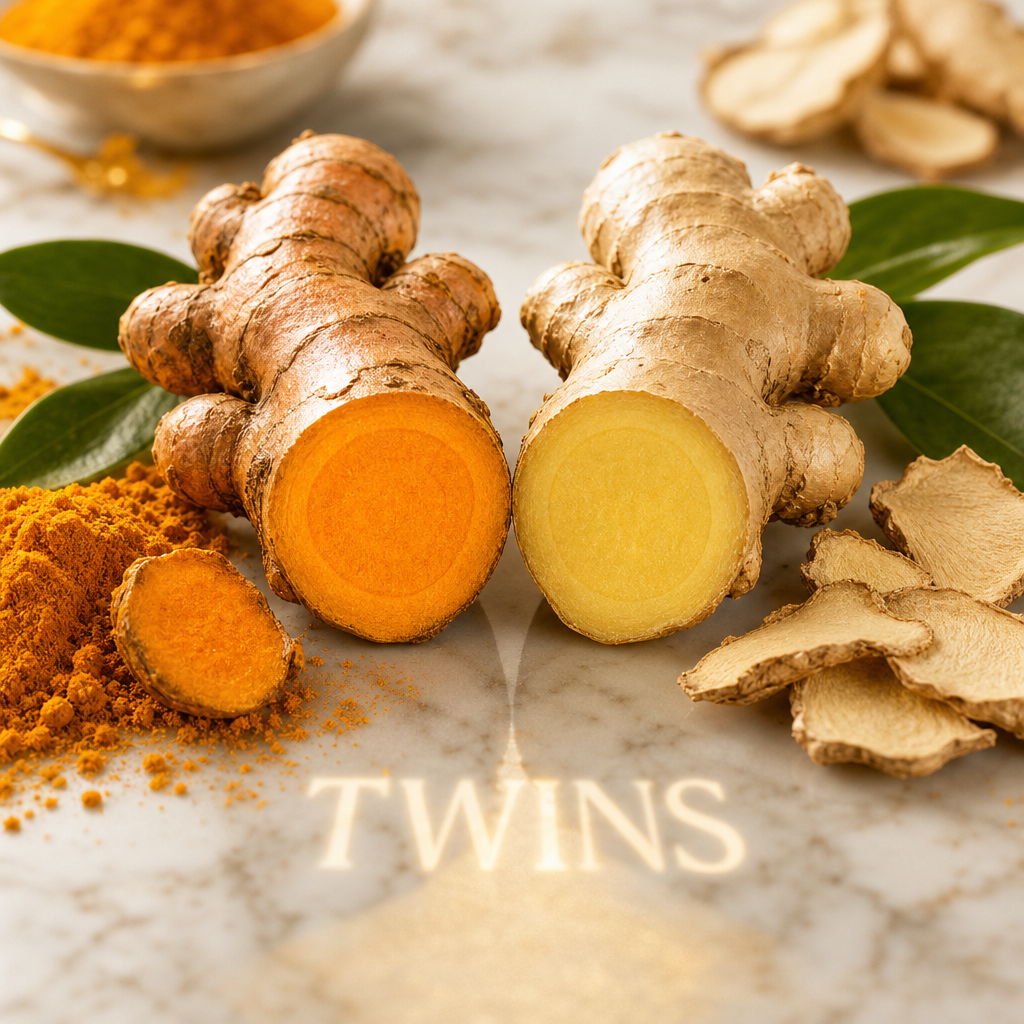
Both belong to the Zingiberaceae family — the ginger family — which encompasses over 1,600 species of aromatic, rhizomatous plants. Within this family, Curcuma longa (turmeric) and Zingiber officinale (ginger) are two of the most bioactive and widely studied members. They share:
- Rhizome structure — both grow as underground horizontal stems (rhizomes) rather than true roots
- Terpenoid biosynthesis pathways — they share significant genetic machinery for producing their bioactive terpenoid and phenylpropanoid compounds (Zerbe P et al., Plant Cell 2013; PMID: 23272109)
- Shared gene expression patterns — a 2013 genomic study identified genes common to both species specifically for rhizome development and secondary metabolite biosynthesis, including the precursor pathways that lead to both curcuminoids and gingerols (PMID: 23410187)
- Traditional co-use — virtually every traditional medicine system that used turmeric also used ginger, often in the same preparations
A 2022 review published in Molecules examining bioactive compounds from the Zingiberaceae family found that ginger and turmeric not only share structural similarities in their anti-inflammatory mechanisms but also exhibit complementary activity across different inflammatory pathways — turmeric stronger on the NF-κB axis, ginger more potent on the arachidonic acid/COX pathway. (PMC9311506)
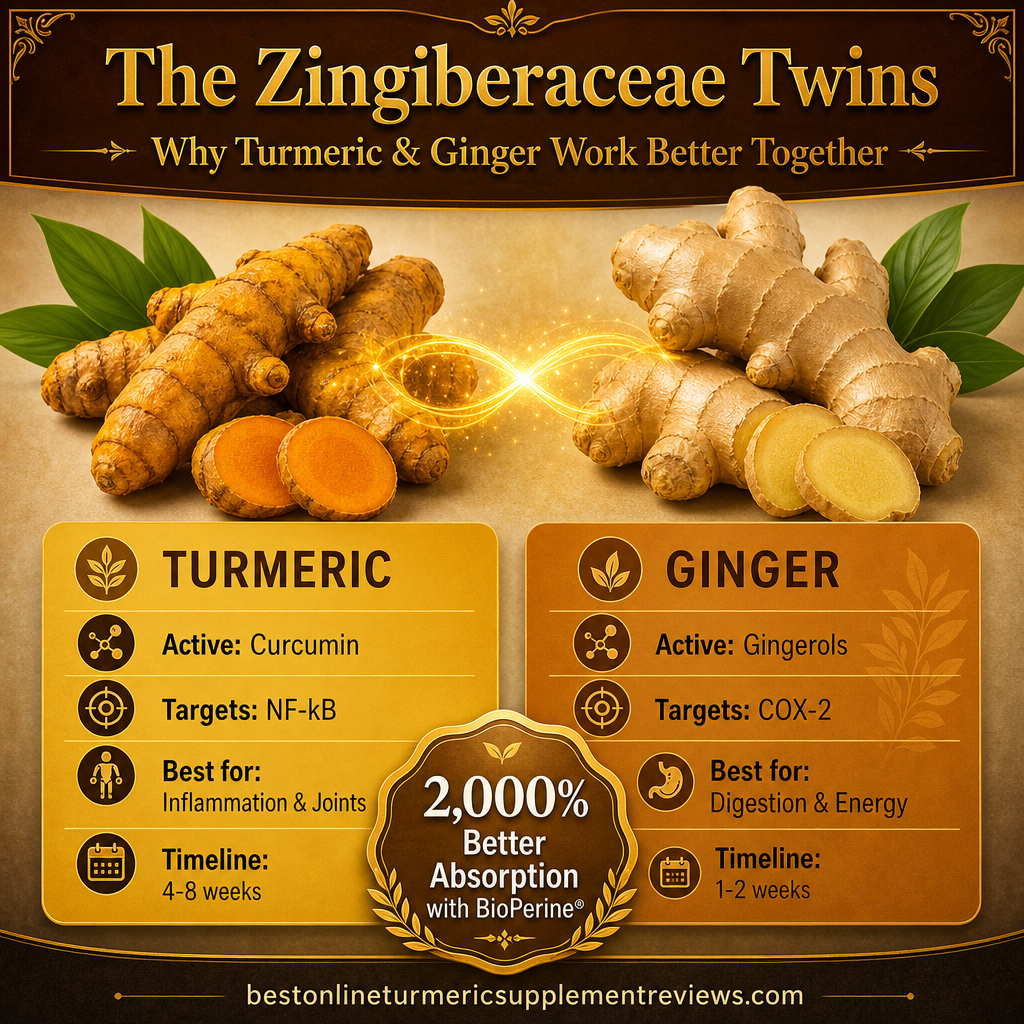
Think of it this way: nature spent millions of years developing two anti-inflammatory systems in the same plant family that — whether by design or coincidence — cover each other’s blind spots beautifully.
? The Twins at a Glance
| Feature | Turmeric (Curcuma longa) | Ginger (Zingiber officinale) |
|---|---|---|
| Plant family | Zingiberaceae | Zingiberaceae |
| Key bioactives | Curcuminoids (curcumin) | Gingerols, shogaols |
| Primary mechanism | NF-κB inhibition | COX-2 / PGE2 suppression |
| Speed of action | 4–8 weeks | 1–2 weeks |
| Best for | Chronic inflammation, joints, antioxidant | Digestion, nausea, fast-acting relief |
| Absorption challenge | Needs BioPerine or fat | Generally well absorbed |
How Turmeric and Ginger Work Together: The Synergy Science
Combining turmeric and ginger isn’t just about stacking two good things — their mechanisms are genuinely complementary and synergistic:
1. Multi-pathway inflammation suppression
Curcumin primarily blocks inflammation at the NF-κB level — essentially stopping the “master switch” that activates hundreds of inflammatory genes. Gingerols work more directly on COX-2 and the arachidonic acid cascade, reducing the production of prostaglandins (pain and inflammation mediators). Together, they interrupt inflammation at multiple points in the cascade — a more complete suppression than either achieves alone.
2. Digestive support combination
Curcumin supports liver health and bile secretion (important for fat digestion and detoxification). Ginger directly aids gastric motility, reduces bloating, and is one of the most effective natural anti-nausea agents studied. The combination addresses both upper GI (ginger) and liver/biliary (turmeric) aspects of digestion.
3. Antioxidant stacking
Both curcumin and gingerols are potent antioxidants that neutralise different classes of free radicals. Used together, they provide broader-spectrum oxidative stress protection than either alone — relevant for ageing, cardiovascular health, and cellular protection.
4. Bioavailability synergy
Interestingly, some research suggests that certain compounds in ginger may also modestly enhance curcumin absorption, though the primary bioavailability solution in modern supplements remains piperine (BioPerine). When all three are combined — turmeric extract, ginger, and BioPerine — you get the most practically bioavailable standard-formulation turmeric ginger supplement available.
Key Benefits of Turmeric Ginger Supplements
Based on the current evidence base, here’s where the turmeric-ginger combination has the strongest research support:
1. Joint Comfort and Mobility
This is the headline benefit and the most studied application. Curcumin has been compared to NSAIDs in clinical trials for osteoarthritis management. Ginger has demonstrated meaningful pain reduction in knee osteoarthritis studies. The combination targets multiple inflammatory pathways simultaneously — relevant for anyone dealing with chronic joint issues, whether from arthritis, sport, or ageing.
See our in-depth guide: Turmeric for Arthritis: What the Research Shows
2. Digestive Health and Gut Support
Ginger is arguably the most well-evidenced natural digestive remedy available. It supports gastric emptying, reduces bloating, eases nausea (including morning sickness and chemotherapy-induced nausea), and improves motility. Turmeric supports the upper digestive tract via its effects on bile production and gut lining health. Together, they make a comprehensive digestive support formula. More on this: Turmeric for Digestive Health
3. Systemic Inflammation Management
Chronic low-grade inflammation underlies virtually every major modern disease — cardiovascular disease, type 2 diabetes, metabolic syndrome, neurodegenerative conditions. Both curcumin and gingerols have demonstrated reductions in key inflammatory biomarkers (CRP, IL-6, TNF-α) in clinical research. This is the area where consistent, long-term supplementation matters most. See: Turmeric for Inflammation: The Evidence
4. Antioxidant Protection
Both compounds independently rank among the most potent natural antioxidants studied. Oxidative stress is a key driver of cellular ageing, cardiovascular disease, and neurodegeneration. Regular supplementation with curcumin has been associated with upregulation of the body’s own antioxidant enzymes (superoxide dismutase, catalase) — not just direct radical scavenging.
5. Metabolic and Cardiovascular Support
Multiple studies have examined curcumin’s effect on blood lipids, blood sugar regulation, and vascular function. Ginger has shown benefits for fasting blood glucose and insulin sensitivity in some trials. For people managing metabolic health, this combination may offer complementary support alongside diet and lifestyle. Related: Turmeric and Blood Sugar Management
? Our Curated Supplement Picks
Browse our full list of recommended turmeric formulations (updated 2026): Best Turmeric Supplements for Inflammation →
What to Look for in a Turmeric Ginger Supplement
Not all turmeric ginger supplements are equal. Here’s the honest checklist I apply to every product I evaluate:
- Standardised curcuminoid content — look for “95% curcuminoids” on the label. Generic “turmeric root powder” may contain as little as 2–5% curcumin. Standardised extracts guarantee consistent potency.
- Bioavailability enhancer — curcumin is poorly absorbed without help. BioPerine (piperine) is the most proven option. Advanced formulations like CurcuWin®, BCM-95®, or liposomal delivery offer even higher absorption (see our guide to CurcuWin and BCM-95).
- Organic ginger source — ginger is a rhizome that can accumulate pesticides. Organic matters more here than with some other ingredients.
- GMP-certified manufacture — ensures consistent quality control, accurate dosing, and absence of contaminants.
- Piperine caveat — BioPerine (piperine) significantly increases the absorption of many compounds, including some medications. If you take prescription drugs, particularly blood thinners, immunosuppressants, or certain cardiac medications, check with your doctor before using any supplement containing piperine.
- Transparent labelling — avoid proprietary blends that hide individual ingredient amounts. You should know exactly what you’re taking.
Our Recommended Pick: Nature’s Nutrition Turmeric Curcumin Supplement
For anyone looking for a straightforward, solid-value turmeric ginger supplement that covers all the essentials, Nature’s Nutrition Turmeric Curcumin is the product I’d recommend as a starting point.
Nature’s Nutrition Turmeric Curcumin Supplement
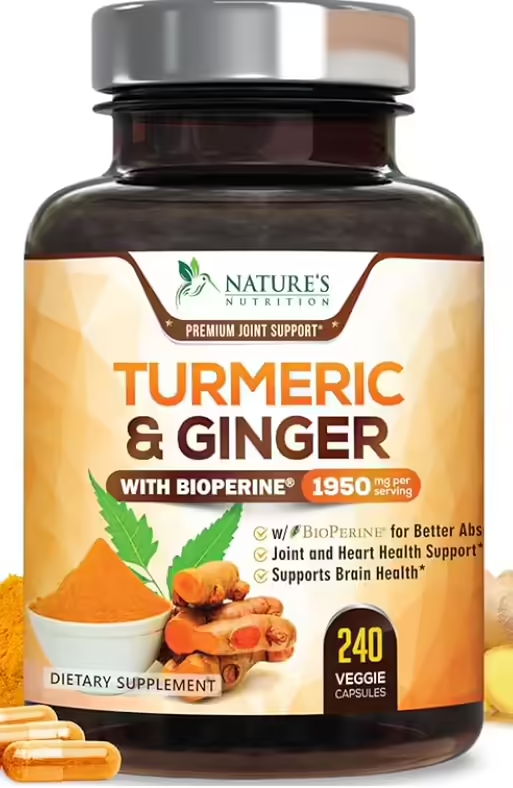 95% Curcuminoids · Organic Turmeric & Ginger · BioPerine · 240 Capsules · Vegan · Non-GMO · Bottled in USA
- ✅ 95% standardised curcuminoids — meaningful extract, not just turmeric powder
- ✅ Organic turmeric AND organic ginger — the full twins combination in one capsule
- ✅ BioPerine included — proven piperine for enhanced absorption (PMID: 9619120)
- ✅ 240 capsules — excellent value, 4-month supply at typical dosing
- ✅ Vegan, non-GMO, USA-bottled — clean, accessible formula
- ⚠️ Piperine note: If you take blood thinners or prescription medications, check with your doctor before use
Why this pick? It hits the three essentials — standardised curcuminoids, organic ginger, and BioPerine — at an accessible price point with a generous 240-capsule count. It’s the clean, entry-level benchmark for the turmeric-ginger category: no proprietary blends hiding the dosing, no filler-heavy formula, no inflated claims.
If you want advanced bioavailability (for chronic joint issues or serious inflammation), you’ll want to look at formulations using CurcuWin® (46× more bioavailable) or BCM-95® (up to 7×) — but those come at a higher price point. For most people starting with turmeric ginger supplementation, Nature’s Nutrition is exactly where I’d begin.
Who Should Consider Turmeric Ginger Supplements?
- People with joint discomfort or arthritis — the combination targets multiple joint inflammation pathways
- Anyone managing digestive issues — ginger is particularly strong here; the combination supports both gut motility and liver health
- People over 40 managing general inflammation — chronic low-grade inflammation increases with age; consistent supplementation can be meaningful
- Active people and athletes — exercise-induced inflammation and recovery
- People with metabolic health concerns — blood sugar support, cardiovascular health
Who should be cautious: Anyone on blood thinners, anticoagulants, or immunosuppressants should consult a doctor before supplementing. Both compounds have mild anticoagulant properties, and piperine (BioPerine) can increase the absorption — and therefore effect — of various medications. Pregnant women should avoid therapeutic doses of ginger beyond culinary use.
How to Take a Turmeric Ginger Supplement
- Timing: Take with food — ideally a meal containing some fat, as curcumin is fat-soluble. Breakfast or lunch works well; avoid taking on an empty stomach.
- Consistency: This is not a one-week supplement. Give it 4–8 weeks minimum for anti-inflammatory effects. Ginger’s digestive benefits can appear sooner.
- Dosing: Follow label directions. For most standardised 95% curcuminoid supplements, 2 capsules daily with food is the typical effective dose.
- Hydration: Stay well hydrated — both compounds are cleared through the kidneys and adequate hydration supports their metabolism.
- Don’t double up: If you’re already taking another curcumin supplement, don’t add a separate turmeric ginger supplement on top without checking the total piperine dose — high piperine intake can cause GI irritation in some people.
Frequently Asked Questions
How do I take turmeric and ginger for energy?
Take 2 capsules with your morning meal. Ginger stimulates circulation and digestive efficiency, which can improve energy extraction from food — benefits can appear within 1–2 weeks. Curcumin’s anti-inflammatory action reduces the “metabolic tax” chronic inflammation places on cellular energy production, with deeper effects over 4–8 weeks. For sustained energy, the full curcumin+ginger+BioPerine combination is the better choice. For a fast energy lift, fresh ginger shots or strong ginger tea act more quickly.
How do I use turmeric and ginger for immune support?
Take a standardised turmeric ginger supplement with BioPerine daily with food. Curcumin modulates NF-κB, a master regulator of immune gene expression, helping calibrate (not just stimulate) the immune response. Ginger powerfully supports gut health — where approximately 70% of immune function resides — and has direct antimicrobial properties. Consistent daily use for 4–6 weeks produces the most meaningful immune support. During cold & flu season, the combined anti-inflammatory and gut-supporting effects make this a strong foundation supplement.
How do I incorporate turmeric and ginger into my daily routine?
Simplest approach: take a standardised supplement with breakfast (with food containing some fat for better curcumin absorption). Set a daily reminder for the first few weeks until it becomes habit. Culinary options — adding ground turmeric and fresh ginger to smoothies, teas, and golden milk — are great complements, but won’t deliver therapeutic curcuminoid levels. Use food as the flavour layer; the supplement as your consistent daily dose.
What are the best ways to take turmeric and ginger together?
Most effective: a standardised capsule supplement with 95% curcuminoids, organic ginger, and BioPerine — taken with a meal containing some fat. Other good options: golden milk (warm turmeric + ginger + black pepper + nut milk), fresh juice shots (1-inch each of turmeric and ginger root), or smoothie additions. For therapeutic anti-inflammatory or digestive effects, capsule supplements consistently outperform food sources because curcuminoid content in whole spice varies widely and is usually far below effective doses.
How do I use turmeric and ginger for skincare benefits?
Internally (most effective): Daily supplementation delivers systemic anti-inflammatory and antioxidant effects that directly support skin. Curcumin has been studied for inflammatory skin conditions including psoriasis, eczema, and acne. Ginger’s circulatory benefits can improve skin tone and radiance over time. Externally: Turmeric face masks (mixed with honey or yoghurt) are popular for brightening and soothing effects, but may temporarily stain. For consistent, deeper skin results, oral supplementation is more reliable.
How do I use turmeric and ginger for an energy boost?
For immediate energy: fresh ginger (juice shots or strong ginger tea) works faster than capsules — its thermogenic properties stimulate circulation and metabolism quickly. For a supplement, take a high-ginger formula with a light breakfast. The deeper, longer-term energy benefit comes from curcumin reducing chronic inflammation — one of the biggest drains on cellular energy. This effect builds over weeks, not days. Combine with adequate sleep, hydration, and whole-food nutrition for best results.
Why does turmeric and ginger improve overall wellness?
The combination addresses root drivers of poor health, not isolated symptoms. Chronic low-grade inflammation underlies most major modern diseases. Oxidative stress accelerates cellular ageing. Poor gut function affects immunity, mood, and nutrient absorption. By targeting all three — inflammation (curcumin + gingerols), oxidative stress (both are potent antioxidants), and gut health (ginger’s motility support + turmeric’s hepatic effects) — the combination creates a genuine wellness foundation.
Why does turmeric and ginger enhance focus and mental clarity?
Curcumin has demonstrated neuroprotective properties and effects on BDNF (brain-derived neurotrophic factor) — a key protein for neuroplasticity and cognitive function. Brain fog often correlates with systemic inflammation; reducing it through consistent supplementation can improve mental clarity as a secondary benefit. Ginger’s antioxidant and anti-inflammatory effects also extend to brain tissue. These are supporting effects that build over time, not an acute cognitive stimulant.
Final Thoughts: The Golden Twins
The more I’ve researched this combination, the more I appreciate what nature put together here. Turmeric and ginger aren’t paired because someone ran a marketing focus group. They’re paired because they share a botanical lineage, evolved complementary anti-inflammatory chemistry, and in combination genuinely cover more ground than either alone.
Named the 2026 Herb of the Year by the International Herb Association, turmeric is having a well-deserved moment in mainstream health research. And ginger — its quieter twin — deserves equal credit. Together, as a daily supplement with proper bioavailability support, they represent one of the most well-evidenced natural anti-inflammatory combinations available.
For a solid, accessible starting point: Nature’s Nutrition Turmeric Curcumin on Amazon →
For advanced formulations and deeper reviews, explore these related guides:
- The Complete Guide to Turmeric Supplement Benefits (2026)
- What Is CurcuWin®? 46× More Bioavailable Turmeric
- What Is BCM-95®? Up to 7× Bioavailability
- Turmeric 3D Review — Our Top-Rated Fermented Formula
- Qunol Turmeric Review
- Turmeric for Inflammation: The Evidence
- Turmeric for Arthritis: Clinical Research Review
- Turmeric Adulteration: What to Watch Out For
- Turmeric Latest News & Research 2026