
Combining CBD and Turmeric for Pain Relief: The Evidence-Based Protocol (2026)
Medical Disclaimer: The information on this site is not intended to be a substitute for professional medical advice, diagnosis, or treatment. CBD and curcumin may interact with medications. Consult a licensed healthcare professional before starting any new supplement regimen. This content is for informational purposes only.
⚡ Quick Answer: Does Combining CBD and Turmeric Actually Work?
Yes — and the mechanism is more interesting than most supplement stacks. Turmeric’s curcumin suppresses NF-κB, the master switch that produces inflammatory cytokines. CBD modulates CB1 and CB2 receptors in the endocannabinoid system, dampening pain signals and neuroinflammation. Two different pathways. Same underlying problem. That’s not redundancy — that’s a genuine multiplier effect.
- Best for: Chronic joint pain, post-exercise recovery, wear-and-tear inflammation, neuropathy
- The non-negotiable: Both are fat-soluble. Take with a meal containing fat or you’re wasting both compounds
- Realistic timeline: CBD can take the edge off within hours; curcumin’s full anti-inflammatory effect builds over 4–8 weeks
 I found this combination through necessity, not curiosity. Years of joint damage from sport and physical work — the kind that painkillers masked but never fixed. Testing curcumin and CBD systematically over several years changed that. I’m not going to oversell it. It’s not magic. It’s mechanics. And the mechanics are actually worth understanding. See my testing protocol and about page.
The “Wear and Tear” Tax — Why This Combination Found Me
If you’ve spent your life on the sports field, the job site, or the golf course, you know the tax. It doesn’t show up in your 30s. It shows up in your late 40s and 50s as a low-grade background hum of stiffness, inflammation, and joints that protest things they used to do without complaint.
Standard painkillers manage the symptom. They don’t touch the underlying inflammatory load — and long-term NSAID use carries its own cardiovascular and GI costs. I was looking for something that actually worked downstream on the cause, not just the signal.
Curcumin — specifically, a properly bioavailable form — was the first piece. The clinical evidence for joint inflammation is solid: Kuptniratsaikul et al. (2014, PMID 24672232) found curcumin equalled ibuprofen for knee OA pain with fewer GI side effects. That caught my attention. CBD was the second piece — specifically for the nerve-signal component of chronic pain that pure anti-inflammatories don’t address.
The combination got me back on the golf course. That’s anecdotal. The mechanisms explaining why it worked are not.
The Science: Two Pathways, One Problem
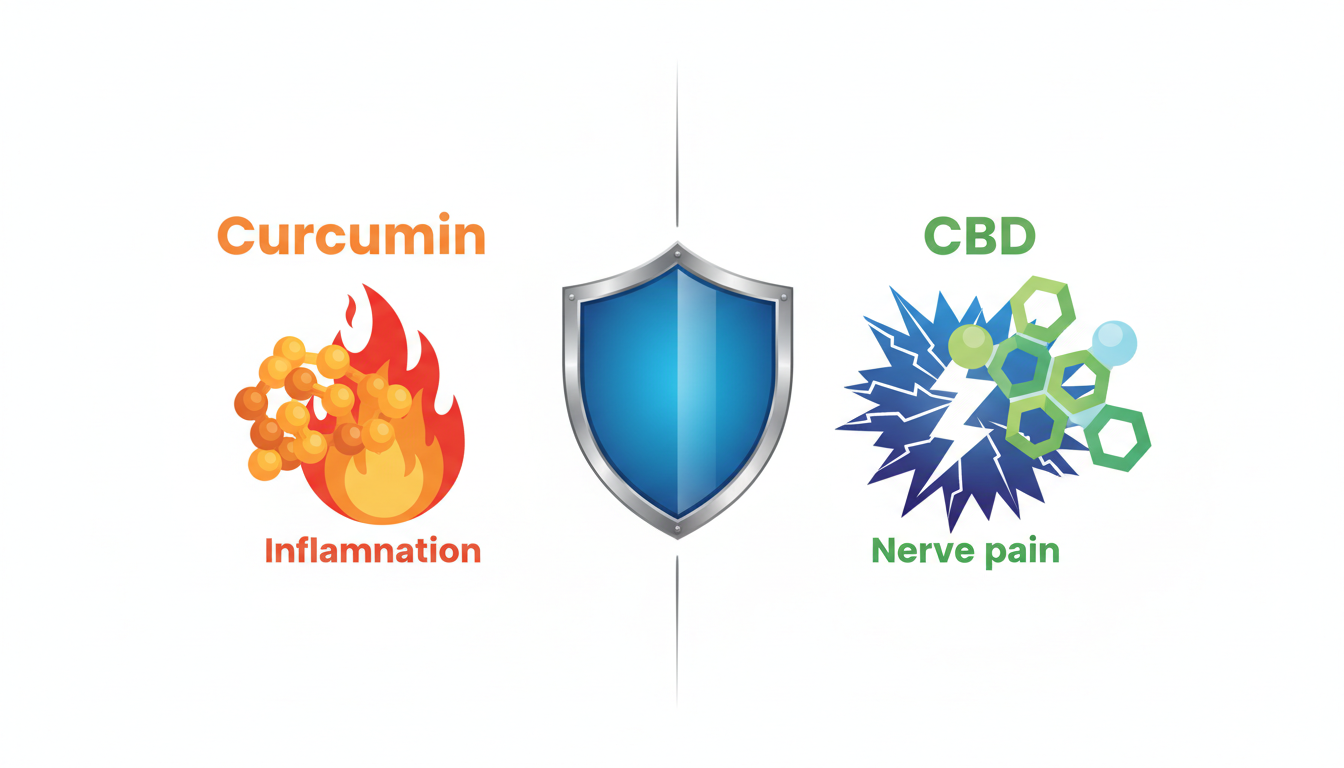
Curcumin and CBD target inflammation from different ends — one at the gene expression level, one at the receptor signalling level
Curcumin’s mechanism: NF-κB inhibition. This transcription factor controls the genes that produce TNF-α, IL-1β, and IL-6 — the cytokines responsible for chronic inflammatory states. Suppress NF-κB, and you turn down the volume on inflammatory gene expression at the source. This is why curcumin works for arthritis, gout, and systemic inflammation.
CBD’s mechanism: Endocannabinoid system modulation. CB2 receptor activation suppresses immune cell activity and microglial neuroinflammation. CB1 receptor activity in the central nervous system modulates pain perception and central sensitisation — the mechanism behind neuropathic pain and chronic pain amplification. This is the pathway that curcumin alone doesn’t reach.
Together: curcumin addresses the inflammatory cause upstream; CBD addresses the pain signalling downstream. They don’t cancel each other out — they cover ground the other can’t.
For the full science breakdown, see our CBD and curcumin hub guide.
Where the Combination Performs Best
Joint pain and arthritis: The most evidence-backed application. Curcumin’s COX-2 inhibition addresses the inflammatory driver; CBD’s peripheral CB2 activity adds pain modulation at the joint level. For arthritis sufferers who’ve hit the ceiling on anti-inflammatories alone, this combination is worth a serious trial.
Post-exercise and physical recovery: Exercise-induced inflammation is normal — excessive, prolonged inflammation is where recovery stalls. Curcumin reduces DOMS-driving cytokines; CBD reduces the neurological stress component of hard training. Take both post-workout with a fat-containing meal.
Neuropathy and nerve pain: The combination specifically designed for this is TurmeriCBD by Prosper Wellness, which has a dedicated neuropathy formula. The logic is sound: curcumin reduces neuroinflammatory cytokines; CBD modulates central pain sensitisation.
Midlife systemic inflammation: The accumulated inflammatory load of decades — metabolic, dietary, stress-driven — responds well to the dual-pathway approach. Not a quick fix. A daily maintenance protocol that addresses the underlying fire rather than masking it.
Recipe: CBD Turmeric Tea — Worth Making Correctly
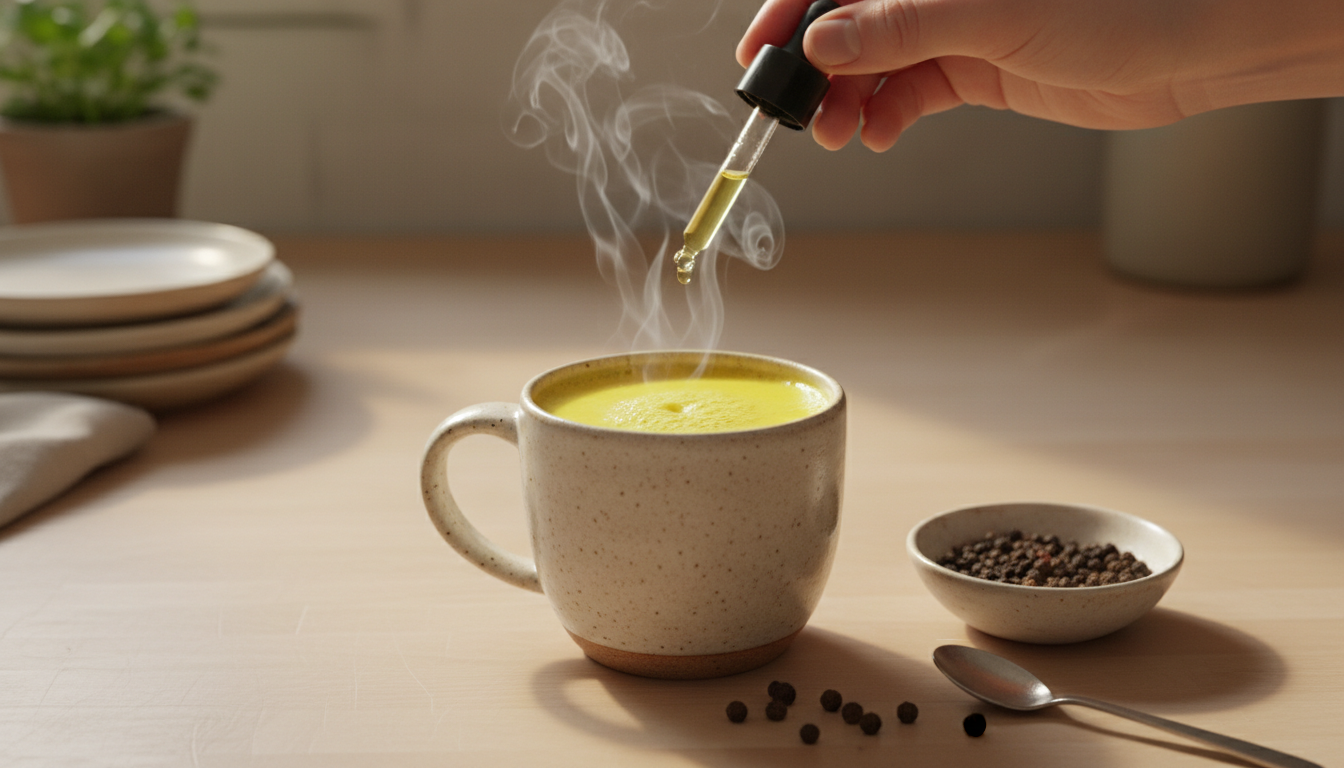
This recipe gets results because it solves the bioavailability problem that makes most people’s curcumin supplementation ineffective. Both curcumin and CBD are fat-soluble — without a fat carrier, absorption drops dramatically.
- 1 cup full-fat milk or oat milk (the fat matters)
- 1 tsp turmeric powder or ½ tsp curcumin extract
- ¼ tsp black pepper (only if your supplement doesn’t already contain piperine — skip if on medications)
- 1 tsp coconut oil or ghee
- Your CBD oil dose (add after heating, never boil CBD)
- Optional: ginger, cinnamon, honey to taste
Method: Warm milk gently (don’t boil). Whisk in turmeric, fat, and spices. Remove from heat, wait 30 seconds, add CBD oil. Stir and drink immediately.
Why this works: The fat carrier solves the lipophilicity problem for both compounds simultaneously. Serving them together in a fat matrix is mechanistically correct, not just traditional.
Dosage Protocol: What Actually Works
Curcumin: 500–1,000mg of curcumin extract daily (not whole turmeric powder — the extract is standardised and consistent). With enhanced-bioavailability formats (liposomal, Meriva, BCM-95), lower doses deliver comparable results. See turmeric vs curcumin for why the formulation decision matters.
🔗 Meriva® phytosome: Best Meriva® supplements (2026) | What is Meriva®? | 7 proven benefits
CBD: Start at 20–25mg daily. Assess over 4 weeks. Most people find their effective dose between 20–75mg for anti-inflammatory and pain management purposes. Don’t chase a high dose early — the dose-response for CBD is not simply linear.
Timing: Together, with a fatty meal. The synergy isn’t just biochemical — it’s practical. Taking them simultaneously with food containing fat optimises absorption of both compounds with minimal friction.
Consistency beats intensity: The curcumin anti-inflammatory effect is cumulative. Missing a week undermines the inflammatory load reduction you’ve built. Treat it like a daily commitment, not a symptom intervention.
Safety and Who Should Be Cautious
Both compounds use CYP450 liver enzymes for metabolism — the same pathways used by many common medications. This creates real interaction potential. For a full interaction guide, see can you take CBD and turmeric together and our side effects guide.
Consult your doctor first if you take: blood thinners, immunosuppressants, SSRIs, or diabetes medications. Non-negotiable.
Piperine note: Black pepper (piperine) dramatically increases curcumin absorption — but it also increases absorption of many drugs. If you’re on medications, choose a piperine-free enhanced-bioavailability format (liposomal, Meriva) rather than adding black pepper.
Which Products to Use
Not all CBD+curcumin products are built the same. Bioavailability is the deciding variable.
- SomaLeaf — Liposomal liquid. Highest bioavailability. Best for brain health, mood, and systemic inflammation.
- TurmeriCBD — Capsules with a dedicated neuropathy formula. Best for nerve pain and chronic joint pain.
- Joy Organics CBD + Turmeric — Broad-spectrum softgels. Clean, reliable, good for everyday wellness.
Full comparison: CBD and curcumin guide | turmeric vs CBD
Also see Robert’s curated picks on Benable.
? CBD + Turmeric Cluster
- CBD and Curcumin: Science-Backed Guide — Full hub: mechanisms, bioavailability, products
- Can You Take CBD and Turmeric Together? — Safety, drug interactions, who should be cautious
- CBD & Turmeric for Mental Health — Mood, anxiety, and brain resilience
- Turmeric vs CBD — Evidence-based comparison
- What Is Turmeric Good For? — Full health application hub