10 Turmeric Research Verified Studies: Honest Ratings and What They Actually Show
Editorial Note: Every study referenced on this page links to its PubMed source. Ratings reflect the quality of the human clinical trial design, not simply the result — a well-designed negative study scores higher than a poorly-designed positive one. This content is for informational purposes only and does not constitute medical advice.
⚡ Quick Answer: What Does the Verified Research on Turmeric Actually Show?
Ten human clinical trials, examined one by one — with honest ratings on what each actually proves. The short version: the evidence for joint pain, depression, liver health, and metabolic syndrome is genuinely impressive. The evidence for cancer and wound healing is promising but early. The evidence for anxiety is mechanistically plausible but clinically thin. And in every case, the formulation used in the trial determines whether the result means anything for the supplement you’re holding.
- Highest-rated: Osteoarthritis (Kuptniratsaikul 2014), Metabolic Syndrome (Chuengsamarn 2012), Liver/NAFLD (Panahi 2017)
- The through-line: Every strong result used an enhanced-bioavailability formulation — not turmeric powder
- For what’s coming next in research: Latest Turmeric Research 2026
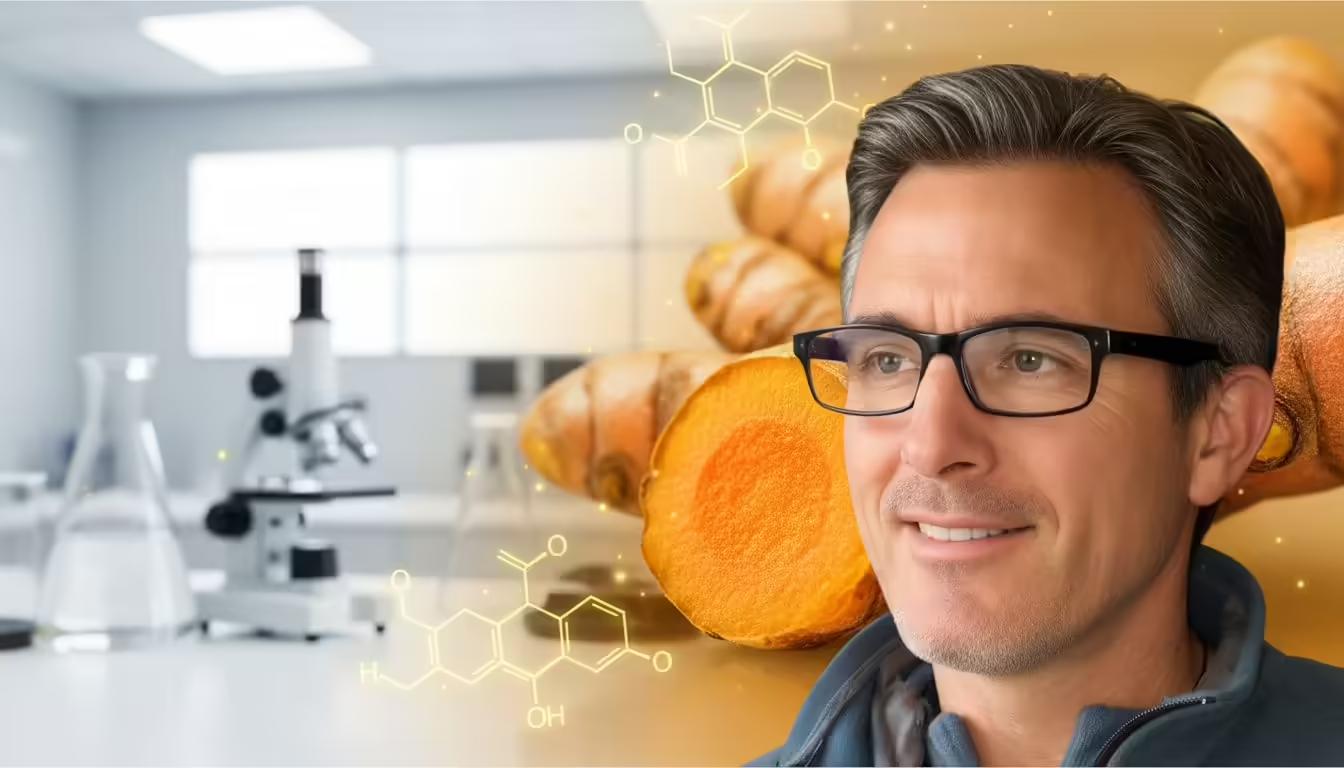 I’ve read a lot of turmeric studies. More than is healthy, probably. What strikes me most isn’t the impressive results — it’s how many people cite the research without reading it. “Studies show turmeric helps with X” is doing a lot of work for a single sentence. Which study? What formulation? What dose? What was the control? This page slows down and examines ten key trials properly — what they actually showed, what they didn’t, and what it means for you. See my testing protocol and about page.
Study 1: Turmeric for Osteoarthritis of the Knee
Study: Kuptniratsaikul et al. (2014) — Clinical Interventions in Aging — PMID 24672232
Design: Randomised controlled trial, 367 patients with primary knee osteoarthritis, 4 weeks. Curcumin extract vs ibuprofen 1,200mg/day.
What it showed: Curcumin and ibuprofen produced equivalent reductions in pain on the Visual Analogue Scale and equivalent functional improvements. The curcumin group reported significantly fewer GI adverse events.
What it didn’t show: Long-term disease modification — this was a 4-week symptom trial, not a structural study. It doesn’t tell us curcumin slows cartilage loss.
Robert’s Rating: 9/10 — Large, well-controlled, clinically relevant comparator. Replicated by Shep et al. 2019 (PMID 30712937). The evidence for curcumin in OA is as solid as anything in the natural supplement space.
→ Full guide: Turmeric for Arthritis | Turmeric for Pain
Study 2: Turmeric for Rheumatoid Arthritis
Study: Chandran & Goel (2012) — Phytotherapy Research — PMID 22052967
Design: RCT, 45 RA patients, 8 weeks. Three groups: curcumin alone, diclofenac sodium alone, combination.
What it showed: The curcumin-only group showed the highest percentage improvement in DAS28 and ACR response criteria — outperforming diclofenac on multiple inflammatory markers with no adverse events.
What it didn’t show: Sample size is small (45 patients). Needs large-scale replication. DAS28 is a validated outcome measure but 8 weeks is short for a chronic autoimmune condition.
Robert’s Rating: 7/10 — Direction of effect is striking, but small N limits confidence. Best read alongside the larger OA evidence — the mechanisms overlap significantly.
→ Full guide: Turmeric for Arthritis
Study 3: Turmeric for Brain Health and Memory
Study: Small et al. (2018) — American Journal of Geriatric Psychiatry — PMID 29246725
Design: Double-blind placebo-controlled RCT, 40 non-demented adults aged 51–84, 18 months. Longvida® curcumin 90mg vs placebo. FDDNP-PET brain imaging used to measure amyloid and tau.
What it showed: Significant improvements in memory and attention. PET imaging showed meaningful reductions in amyloid and tau signals in the amygdala and hypothalamus in the curcumin group.
What it didn’t show: This was in healthy non-demented adults — we cannot extrapolate directly to Alzheimer’s treatment. The dose was also very low (90mg Longvida® — equivalent to far higher doses of standard curcumin due to the formulation’s enhanced bioavailability).
Robert’s Rating: 8/10 — Exceptional methodology for a nutritional supplement trial. PET imaging is hard science. The formulation caveat matters enormously — 90mg Longvida® ≠ 90mg standard curcumin.
→ Full guide: Turmeric for Brain Health
Study 4: Turmeric for Depression
Study: Sanmukhani et al. (2014) — Phytotherapy Research — PMID 23832433
Design: RCT, 60 MDD patients, 6 weeks. Curcumin alone vs fluoxetine (Prozac) alone vs combination.
What it showed: All three groups improved. The combination outperformed either alone. Curcumin showed comparable antidepressant effect to fluoxetine. No significant adverse events in the curcumin group.
What it didn’t show: Small N. Short duration. Did not assess severe depression. Cannot recommend curcumin as a replacement for prescribed antidepressants in moderate-severe MDD.
Robert’s Rating: 7/10 — Direction of evidence is consistent with the mechanism. Important for framing curcumin as part of an integrative mood management approach, not a standalone treatment.
→ Full guide: Turmeric for Depression | Turmeric and Dopamine
Study 5: Turmeric for Metabolic Syndrome and Diabetes Prevention
Study: Chuengsamarn et al. (2012) — Diabetes Care — PMID 22773702
Design: RCT, 240 prediabetic subjects, 9 months. Curcumin vs placebo. Outcomes: progression to T2DM, HOMA-IR, adiponectin, C-peptide.
What it showed: Zero subjects in the curcumin group progressed to type 2 diabetes. 16.4% in the placebo group did. Significant improvements in insulin sensitivity, beta-cell function, waist circumference, and adiponectin levels.
What it didn’t show: This was in prediabetic subjects — it does not demonstrate that curcumin reverses established T2DM. The formulation used was a standardised extract with specific bioavailability characteristics.
Robert’s Rating: 9/10 — This is one of the strongest trials in the curcumin literature. Clinically relevant endpoint (T2DM diagnosis), adequate duration, large N, prospective design. Hard to argue with.
→ Full guide: Turmeric for Diabetes | Turmeric for Weight Loss
Study 6: Turmeric for Wound Healing
The evidence: Multiple in vitro and animal studies demonstrate curcumin’s effects on wound healing via NF-κB suppression reducing prolonged inflammatory phase, TGF-β stimulation promoting collagen synthesis, and antimicrobial activity against common wound pathogens.
Human clinical evidence is limited — primarily topical application studies in diabetic wounds and oral mucositis from chemotherapy, where the anti-inflammatory and antimicrobial effects have shown promise.
Robert’s Rating: 5/10 — Strong mechanistic plausibility, compelling preclinical data, limited high-quality human RCTs for wound healing specifically. Watch this space — topical curcumin research is active.
Study 7: Turmeric for Liver Health (NAFLD)
Study: Panahi et al. (2017) — Drug Research — PMID 27213821
Design: RCT, 87 NAFLD patients, 8 weeks. Liposomal curcumin vs placebo. Outcomes: liver enzymes (AST, ALT), inflammatory markers (CRP, TNF-α), ultrasound hepatic steatosis.
What it showed: Significant reductions in AST, ALT, CRP, and TNF-α. Ultrasound assessment showed reduced hepatic steatosis in the curcumin group. No adverse events.
What it didn’t show: Long-term liver disease progression or fibrosis outcomes — 8 weeks is too short for structural liver assessment.
Robert’s Rating: 8/10 — Objective biochemical outcomes (enzyme levels), imaging confirmation, meaningful clinical endpoints. The liposomal delivery is notable — the formulation solved the bioavailability problem that undermines most oral curcumin liver studies.
→ Full guide: Turmeric and Liver Health
Study 8: Turmeric for Heart Health
Study: Santos-Parker et al. (2017) — Aging — PMID 28121287
Design: RCT, 39 middle-aged and older adults, 12 weeks. Curcumin supplementation vs placebo. Primary outcome: brachial artery flow-mediated dilation (FMD) — the gold standard measure of endothelial function.
What it showed: Curcumin supplementation significantly improved FMD, indicating enhanced endothelial function. Also significant improvements in vascular oxidative stress markers.
What it didn’t show: Hard cardiovascular endpoints (MI, stroke) — this is a surrogate marker study. Improved FMD correlates with reduced cardiovascular risk but doesn’t directly prove prevention.
Robert’s Rating: 7/10 — FMD is a respected, validated surrogate marker. The age group tested (midlife and older) is the highest-relevance population. Solid study design.
→ Full guide: Turmeric for Heart Health
Study 9: Turmeric for Cancer Support
The evidence landscape: Curcumin has demonstrated anti-cancer mechanisms in over 200 preclinical studies: NF-κB suppression, induction of apoptosis, inhibition of angiogenesis, and sensitisation of cancer cells to chemotherapy.
Human clinical evidence is adjunctive: The strongest human evidence is in reducing chemotherapy toxicity (oral mucositis, GI toxicity) and improving quality of life during treatment — not as primary cancer treatment.
Robert’s Rating: 6/10 for adjunctive role — Mechanistically compelling, preclinically very strong, clinically early. This is not false hope — it’s genuine supportive evidence that warrants more rigorous human trials than have been conducted.
YMYL note: Do not use curcumin as a replacement for oncology treatment. If you are in cancer treatment, discuss any supplements with your oncologist — some curcumin-chemotherapy interactions can be beneficial or problematic depending on the specific drugs.
→ Full guide: Turmeric and Cancer — Evidence Review
Study 10: Turmeric for Anxiety
The evidence: Human clinical trial data for anxiety specifically is limited. Animal studies show anxiolytic effects via 5-HT1A receptor activity and corticosterone suppression. The CBD+curcumin combination has the strongest anxiety-relevant human evidence via CBD’s documented serotonergic and endocannabinoid pathways.
What we can say: Curcumin’s effects on depression (Sanmukhani 2014), cortisol modulation, and neuroinflammation all have mechanistic relevance to anxiety states. The experience of many users aligns with this. But dedicated anxiety RCTs are lacking.
Robert’s Rating: 5/10 — Plausible, consistent with mechanism, meaningful anecdotal evidence, but the clinical trial base is thin. Consider it a supportive measure within a broader stress management approach, not a standalone anxiolytic.
→ Related: CBD & Turmeric for Mental Health | Turmeric for Depression
The Research Summary — What This Evidence Base Actually Tells Us
| Condition | Rating | Verdict |
|---|---|---|
| Osteoarthritis | 9/10 | Clinically proven, replicated |
| Metabolic Syndrome | 9/10 | Strongest long-term trial in literature |
| Brain Health | 8/10 | PET imaging confirmation, strong design |
| Liver / NAFLD | 8/10 | Objective biomarker improvements |
| Heart / Endothelial | 7/10 | Surrogate marker — strong design |
| Rheumatoid Arthritis | 7/10 | Impressive result, small sample |
| Depression | 7/10 | Comparable to SSRI, needs larger trials |
| Cancer (adjunctive) | 6/10 | Strong mechanism, human trials early |
| Wound Healing | 5/10 | Preclinical strong, human RCTs limited |
| Anxiety | 5/10 | Mechanistic case strong, trials thin |
The consistent finding across every high-rated study: the formulation used matters as much as the compound. Standard turmeric powder was not used in any 8+ rated study. Every strong result came from a specifically enhanced bioavailability preparation. See: turmeric vs curcumin and how to choose a supplement.
For what’s happening at the research frontier right now: Latest Turmeric Research 2026 →
Robert’s full supplement picks backed by this evidence: Benable — Best Curcumin Supplements 2026
? Go Deeper — Condition Evidence Guides
- Turmeric for Inflammation — The master mechanism behind all 10 studies
- Latest Research 2026 — What’s at the frontier now
- All 12 Benefit Areas — The complete evidence hub
- What Is Turmeric Good For? — Applications overview
- Turmeric Adulteration — Why sourcing matters as much as the research