Turmeric for Dopamine 2026: How Curcumin Supports Mood, Motivation and Brain Chemistry
Medical Disclaimer: The information on this site is not intended to be a substitute for professional medical advice, diagnosis, or treatment. Depression and mood disorders are medical conditions. Please consult a licensed healthcare professional before using any supplement as part of a mental health management plan.
⚡ Quick Answer: Can Turmeric Boost Dopamine?
Yes — through two well-characterised mechanisms. Curcumin inhibits monoamine oxidase enzymes (MAO-A and MAO-B), slowing the breakdown of dopamine and serotonin. It also upregulates BDNF (brain-derived neurotrophic factor), supporting neuroplasticity and dopamine neuron health. A real human RCT by Sanmukhani et al. (2014) found curcumin comparable to fluoxetine for major depressive disorder over 6 weeks — without the side effect profile of an SSRI.
- Best for: Low mood, brain fog, midlife motivation loss, mild-to-moderate depression (as complementary support)
- Brain-optimised formulation: Longvida® — the only curcumin with published UCLA clinical data for mood and memory
- Not a replacement for: Prescribed antidepressants or professional mental health treatment
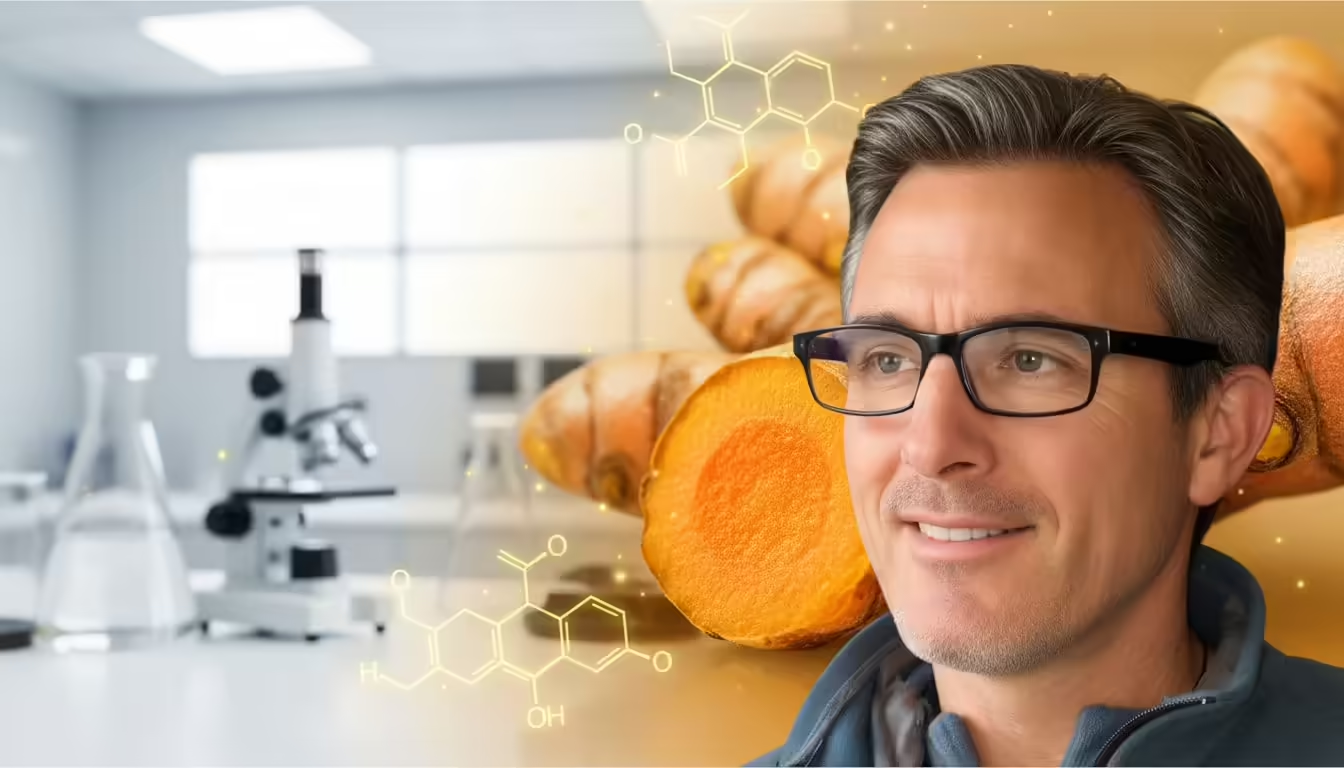 Mood and motivation hit close to home — I dealt with a pretty rough patch in my mid-40s after a chronic ankle injury knocked me out of sport for over a year. Low mood, brain fog, zero drive. Turmeric was part of what pulled me through, alongside proper medical support. I’ve spent seven years testing over 50 curcumin formulations and I won’t recommend anything I haven’t personally evaluated. See my testing protocol and about page.
Why Dopamine Declines in Midlife
Dopamine is the brain’s primary “drive” neurotransmitter — governing motivation, reward anticipation, focus, and executive function. It’s what makes you want to start a project, finish a run, or feel satisfied after a meal. After 40, dopamine production and receptor sensitivity both decline gradually as part of normal brain ageing. Chronic stress, poor sleep, and systemic inflammation (all more common in midlife) accelerate this decline.
The result is what many people describe as midlife flatness — not clinical depression necessarily, but a loss of spark. Tasks that used to feel rewarding feel neutral. Motivation is harder to summon. Focus wanders. This is the territory where curcumin’s neurochemical effects become genuinely relevant.
It’s also worth noting: chronic inflammation is now well-established as a contributor to depression. The “inflammatory theory of depression” holds that elevated pro-inflammatory cytokines (IL-6, TNF-α) disrupt serotonin and dopamine synthesis. Curcumin attacks this exact mechanism.
How Curcumin Affects Dopamine: Three Mechanisms
1. MAO Enzyme Inhibition — Slowing Dopamine Breakdown
Monoamine oxidase (MAO) enzymes break down dopamine, serotonin, and norepinephrine in the brain. Pharmaceutical MAO inhibitors (MAOIs) are an established class of antidepressants. Curcumin has been shown in preclinical studies to inhibit both MAO-A and MAO-B, effectively slowing the degradation of dopamine and serotonin and allowing them to remain active in synapses longer.
The landmark preclinical study here is Kulkarni and Dhir (2008), published in Psychopharmacology (PMID 18766332). The study demonstrated that curcumin produced antidepressant-like effects in animal models through MAO inhibition, with significant increases in dopamine and serotonin levels in the frontal cortex and hippocampus. Importantly, the effects were dose-dependent and statistically significant.
⚠ Important interaction warning: Because curcumin inhibits MAO enzymes, people taking prescribed MAOIs or SSRIs should consult their doctor before supplementing with high-dose curcumin. The combination could theoretically amplify serotonergic effects. At standard curcumin supplement doses (500–1500mg), the clinical significance is likely low — but the interaction is real and worth flagging with your prescriber.
2. BDNF Upregulation — Growing New Neural Connections
Brain-derived neurotrophic factor (BDNF) is often called “fertiliser for the brain.” It supports the survival, growth, and differentiation of neurons — including dopaminergic neurons in the midbrain. Low BDNF is consistently associated with depression and cognitive decline. Many antidepressants work partly by raising BDNF.
Curcumin has been shown in multiple studies to increase BDNF expression in the hippocampus — the brain region most critical for memory and mood regulation. This is the same mechanism that makes exercise antidepressant: both curcumin and aerobic exercise raise hippocampal BDNF. For midlifers dealing with brain fog and motivational flatness, this neuroplasticity support is significant beyond just dopamine.
3. Neuroinflammation Suppression — Clearing the Fog
Neuroinflammation — chronic low-grade inflammation in the brain — directly disrupts dopamine and serotonin synthesis. Pro-inflammatory cytokines interfere with tryptophan metabolism (the serotonin precursor) and activate the kynurenine pathway, diverting brain chemistry away from mood-supporting neurotransmitters.
Curcumin is one of the most studied natural NF-κB inhibitors. By suppressing IL-1β, IL-6, and TNF-α in brain tissue, it reduces the neuroinflammatory burden that suppresses monoamine production. This is the same mechanism underlying its effects on joint inflammation — but targeting the CNS rather than peripheral tissue.
What the Research Actually Shows
Human Clinical Trial: Curcumin vs Fluoxetine (Sanmukhani et al. 2014)
The most cited human RCT in this space is Sanmukhani et al. (2014), published in Phytotherapy Research. The study randomised 60 patients with major depressive disorder to receive either curcumin 500mg twice daily, fluoxetine (Prozac) 20mg daily, or both. At 6 weeks, curcumin alone performed comparably to fluoxetine on the HAM-D depression scale — the gold standard rating tool. The combination group showed the best outcomes. Critically, the curcumin group had significantly fewer side effects.
This is not a fringe result. The study has been replicated and built upon, and curcumin’s antidepressant mechanisms are now considered well-characterised at the preclinical level.
Longvida® UCLA Memory and Mood Trial (Small et al. 2018)
The brain health gold standard trial used Longvida® — a Solid Lipid Curcumin Particle (SLCP) formulation specifically engineered to cross the blood-brain barrier. Small et al. (2018, PMID 29246725) showed significant improvements in memory and attention over 18 months in healthy adults over 50. Critically, the BDNF-related neuroplasticity effects align directly with dopamine neuron health. Longvida is the only curcumin formulation with this published UCLA brain data.
Cognitive Function RCT (Cox et al. 2015)
Cox et al. (2015, PMID 25742380) demonstrated that a single 80mg dose of curcumin improved working memory, attention, and mood in healthy older adults one hour post-dose. This rapid cognitive and mood effect is consistent with curcumin’s cerebral blood flow effects and its interaction with the monoaminergic system.
The Right Formulation: Why Standard Turmeric Falls Short for Brain Health
Standard curcumin supplements don’t cross the blood-brain barrier in meaningful concentrations. The brain has specific lipid requirements for nutrients to penetrate it — which is why formulation matters enormously for mood and cognitive applications. Our full formulations guide covers this in detail. For brain-targeted applications specifically:
? Longvida® — Best for Brain/Mood (Primary Recommendation)
Longvida® uses Solid Lipid Curcumin Particle (SLCP) technology developed at UCLA. It encapsulates curcumin in lipid particles that significantly improve CNS penetration. This is the formulation used in the Small et al. UCLA memory trial (PMID 29246725). For dopamine support and cognitive applications, it’s the evidence-backed choice. Look for “Longvida®” explicitly on the supplement label.
? SomaLeaf CBD Turmeric — Secondary Recommendation (CBD+Curcumin Synergy)
For users dealing with mood disruption, depression,, anxiety, and poor sleep alongside low motivation, SomaLeaf’s liposomal CBD + full-spectrum curcumin combination addresses the ECS (endocannabinoid system) alongside NF-κB pathways. CBD modulates CB1/CB2 receptors in brain regions governing mood and stress response, complementing curcumin’s monoaminergic effects through a distinct mechanism. This combination is particularly relevant for people whose low dopamine is tied to chronic stress and sleep disruption See our full guide to Turmeric and CBD for Mental Health for the complete picture..
? My Curated Brain Health Picks: I maintain an updated list at Benable — Best Curcumin Supplements for Inflammation in 2026. Includes Longvida-based options and the SomaLeaf combination.
How to Use Turmeric for Dopamine Support
- Dose: 400–1000mg Longvida® daily (or equivalent brain-bioavailable formulation). Standard extract at 500–1500mg with a bioavailability enhancer for non-brain-specific use.
- Timing: Take with a meal containing healthy fat — curcumin is fat-soluble and absorption improves significantly with dietary fat.
- Consistency over dose: Effects on BDNF and MAO inhibition build over time. Expect 4–8 weeks for meaningful mood improvements rather than immediate effects.
- Piperine caution: Piperine boosts curcumin absorption dramatically but also amplifies the bioavailability of many drugs. If you’re on SSRIs, MAOIs, or other prescribed medications, use a piperine-free formulation and discuss with your prescriber.
- Stack sensibly: Curcumin pairs well with omega-3 (DHA for neuronal membrane support), magnesium (cofactor for dopamine synthesis), and B6 (required for dopamine production from L-DOPA). These are complementary rather than competing.
Important Safety Notes
⚠ If you are taking antidepressants: Consult your prescriber before adding high-dose curcumin. The MAO-inhibiting and serotonergic effects are real, and while the interaction risk at standard supplement doses is likely low, it warrants professional review — particularly with MAOIs, where serotonin syndrome risk is a serious concern. See our full side effects and drug interactions guide.
Turmeric for Dopamine — FAQ
Does turmeric actually increase dopamine?
In preclinical (animal model) studies, yes clearly — Kulkarni and Dhir (2008, PMID 18766332) showed significant dopamine and serotonin increases in the frontal cortex and hippocampus via MAO inhibition. In humans, the 2014 Sanmukhani RCT showed antidepressant effects comparable to fluoxetine. Whether this is purely via dopamine or through multiple monoamine pathways is still being characterised.
How long before turmeric improves mood?
Most human trials using standardised curcumin show measurable mood improvements at 4–8 weeks of consistent daily use. The Cox et al. (2015) study showed acute working memory and mood effects within 1 hour of a single dose, suggesting some immediate neurological effects — but the sustained BDNF and anti-inflammatory changes take longer to build.
Is curcumin safe to take with antidepressants?
Discuss with your prescriber. The MAO-inhibiting effects are real and could theoretically amplify serotonergic medications. At standard supplement doses (500–1000mg standardised extract), clinical risk is likely low, but this is a conversation to have with your doctor — not a decision to make independently. The combination might actually be beneficial in some cases, but professional oversight is appropriate.
Which turmeric formulation is best for brain and mood?
Longvida® is the evidence leader for brain applications — it crosses the blood-brain barrier more effectively than standard curcumin and is the formulation used in the UCLA memory trial. For a combined CBD + curcumin approach targeting mood and stress, SomaLeaf’s liposomal formula is the secondary recommendation. Standard curcumin (even high-dose) has limited brain penetration.
Can turmeric help with motivation and drive, not just depression?
Yes — this is arguably its most practical application for midlifers. Dopamine governs motivation and reward anticipation, not just mood. The BDNF upregulation and neuroinflammation reduction effects support dopaminergic neuron health broadly. Many users taking curcumin for other inflammatory conditions report improved mental energy and drive as a secondary benefit — which is entirely consistent with the mechanism.
Is turmeric better than St John’s Wort for mood?
They work through different mechanisms and have different interaction profiles. St John’s Wort is a potent CYP3A4 inducer that significantly reduces the efficacy of many medications (including the contraceptive pill). Curcumin’s drug interaction profile is milder. For people on medications, curcumin is generally the safer option. For efficacy, the 2014 Sanmukhani trial gives curcumin strong comparative standing. They can potentially be used together, but consult a healthcare provider.
Can turmeric help with ADHD or focus issues?
There’s no direct RCT evidence for curcumin in ADHD. However, the mechanisms — dopamine modulation, BDNF upregulation, neuroinflammation reduction — are relevant to the neurobiological picture of ADHD. Some practitioners use curcumin as a complementary approach alongside ADHD treatment. This is an area where “biologically plausible but not yet clinically proven” is the honest answer.
Does golden milk (turmeric latte) provide mood benefits?
Modest ones, yes — but not at the level of a standardised supplement. A teaspoon of turmeric in golden milk provides roughly 100–200mg of curcumin, and absorption with the fat in milk (or coconut cream) is reasonable. It’s a pleasant daily habit with real anti-inflammatory background benefits. For therapeutic mood support, standardised curcumin extract at 500–1000mg is substantially more potent. See our <a href=”https://bestonls 100 to 200mg curcumin. For therapeutic mood support, standardised curcumin extract at 500 to 1000mg is substantially more potent.”