
7 Factors to Consider When Selecting a Turmeric Supplement (2026)
Affiliate Disclosure: This page contains affiliate links. If you purchase through our links, I earn a small commission at no extra cost to you. All recommendations reflect my genuine testing standards — the same standards documented on this page.
⚡ Quick Answer: What Should You Look for in a Turmeric Supplement?
Seven things. Most products fail at least three of them. Bioavailability format, curcumin standardisation percentage, third-party testing certificate, organic certification, source country disclosure, piperine presence, and brand transparency. Every one of these determines whether you get a therapeutic result or expensive yellow urine. This guide walks through each one with the context you need to make a genuinely informed choice.
- The most important single factor: Delivery format — standard turmeric powder has ~1–3% absorption regardless of dose
- The most overlooked risk: Adulteration — lead chromate and synthetic dyes are documented in commercial turmeric products globally
- The shortcut: Certified organic + third-party COA + named bioavailability format = the minimum standard worth paying for
 I’ve tested more turmeric supplements than I can count — and I’ve learned the hard way that the label and the contents are not always the same thing. I’ve experienced contaminated products firsthand. I’ve paid for standardised 95% curcumin that delivered nothing. I’ve also found formulations that genuinely changed what chronic inflammation feels like day to day. This guide distils seven years of that testing into seven clear factors. No brand loyalty, no hype — just the framework I use myself. See my testing protocol and about page.
The supplement aisle offers hundreds of turmeric products. Most look identical. The differences that matter are invisible to the naked eye.
Why This Decision Matters More Than Most
If you’ve just read our turmeric adulteration guide, you already know that the risks of choosing poorly extend beyond simply wasting money. Lead chromate, banned synthetic dyes, and heavy metal contamination are documented in commercial turmeric products globally — confirmed by both the Harvard Environmental Health Perspectives study (PMID 31613663) and the FDA’s own food fraud classification.
But even setting safety aside, the gap between a well-chosen turmeric supplement and a poorly chosen one is the gap between measurable therapeutic effect and no result at all. Standard turmeric powder absorbs at 1–3% — meaning 97 cents of every dollar you spend on cheap powder passes through your digestive system without reaching your bloodstream.
These seven factors are the difference between a supplement that works and one that doesn’t — or worse, one that harms.
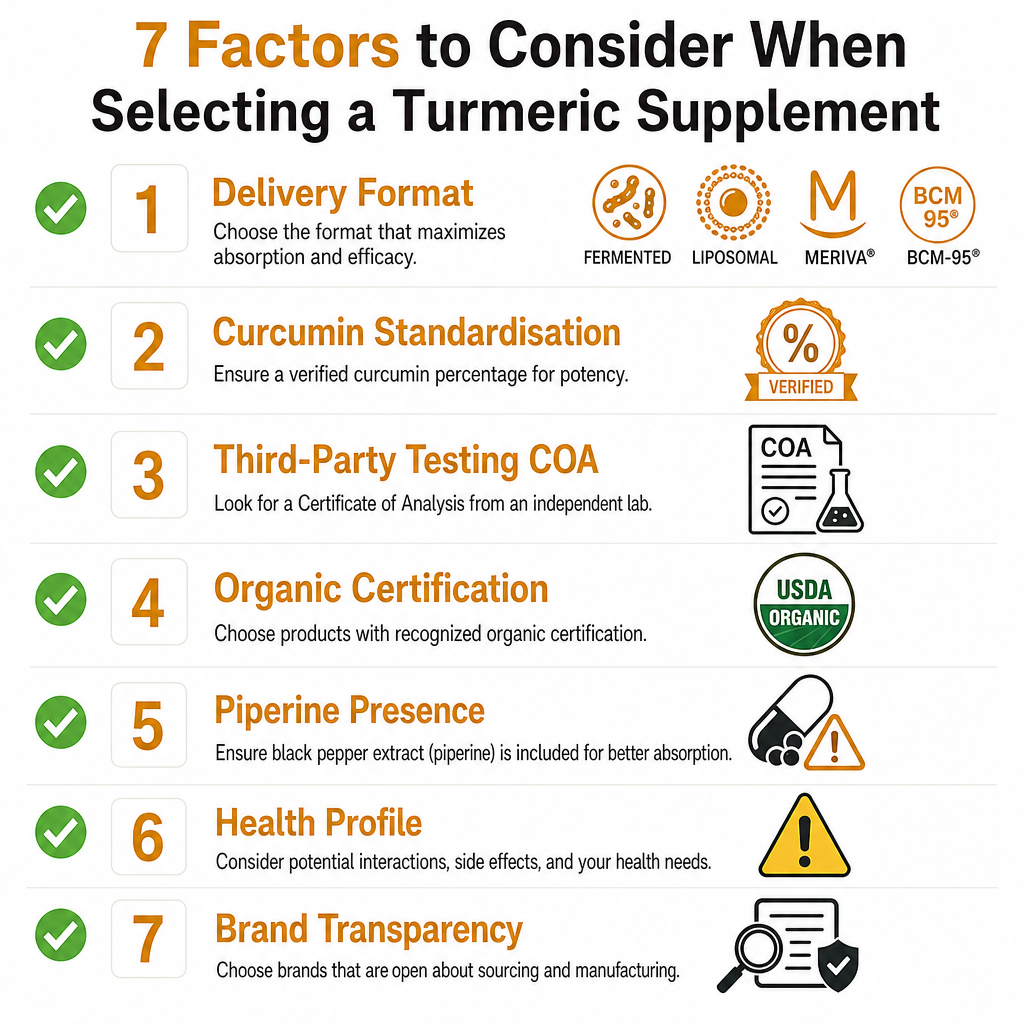
The seven-factor framework for choosing a turmeric supplement — every factor determines either safety or efficacy
Factor 1: Delivery Format — The Bioavailability Decision
This is the single most important factor. Curcumin is fat-soluble with poor water solubility and rapid hepatic metabolism — standard powder or extract delivers minimal systemic absorption regardless of dose. How the curcumin is delivered determines whether it reaches your bloodstream at all.
The formats ranked by bioavailability:
- Liposomal curcumin — phospholipid bilayer encapsulation enables direct cellular uptake, bypassing hepatic first-pass metabolism. Highest bioavailability. Premium price.
- Fermented curcumin — lacto-fermentation converts bound curcuminoids to free absorbable forms and generates new bioactive metabolites. Piperine-free. Gut synergy benefit.
- Meriva® (phosphatidylcholine-bound) — 20+ clinical trials, extensively validated. Excellent choice for joint health specifically.
- BCM-95® — curcumin with essential oils for enhanced absorption, piperine-free. 95% curcuminoid profile.
- Curcumin with piperine — increases absorption ~2,000% through CYP450 inhibition. Effective and affordable. Not suitable if on medications — see Factor 6.
- Standard curcumin extract / turmeric powder — lowest bioavailability. Only appropriate if price is the primary constraint.
Factor 2: Curcumin Standardisation — What the Percentage Actually Means

A label reading “95% curcuminoids” sounds impressive. What it actually means depends on whether:
- The percentage has been independently verified by a third party
- The assay method used is appropriate (HPLC, not colorimetric — colorimetric testing is easily fooled by synthetic dyes)
- The standardisation refers to total curcuminoids (curcumin + bisdemethoxycurcumin + demethoxycurcumin) or curcumin alone
Without independent verification, a “95% curcuminoids” claim is unverifiable marketing. This is where the Certificate of Analysis (COA) from Factor 3 becomes the decisive document.
Factor 3: Third-Party Testing — The Non-Negotiable
A Certificate of Analysis (COA) from an independent laboratory is the single most important document a supplement brand can produce. It should confirm:
- Potency: Verified curcuminoid percentage matching the label
- Heavy metals: Lead, arsenic, cadmium, mercury below action levels
- Microbiological safety: Free from pathogens
- Adulterants: No synthetic colorants detected
If a brand cannot or will not provide a COA when asked, that is a definitive red flag. Transparency costs nothing — reluctance to share test results signals something to hide.
Certifiers worth recognising: NSF International, USP Verified, Informed Sport, Eurofins. Brand-commissioned testing from unnamed labs carries less weight than testing from named, accredited independent laboratories.
Factor 4: Organic Certification and Source Transparency
Certified organic status does three things relevant to supplement quality:
- Prohibits synthetic pesticide use on the turmeric crop
- Requires supply chain traceability — you can trace the material back to its source
- Significantly reduces deliberate synthetic dye adulteration risk, as organic certification auditors would detect it
Source transparency matters independently of organic status. A brand that can tell you specifically where their turmeric is grown — India (certain regions), Sri Lanka, Indonesia — is demonstrably more accountable than one that sources from “various suppliers.” Bangladesh-origin turmeric carries documented elevated lead risk; this is not discrimination, it is documented epidemiology from the Harvard Environmental Health Perspectives study.
Factor 5: Piperine Presence — The Medication Interaction Question
Black pepper extract (piperine) is effective at boosting curcumin absorption — up to 2,000% — through CYP450 liver enzyme inhibition. That same inhibition also slows the metabolism of many common medications, raising drug plasma levels to potentially dangerous ranges.
If you take any of the following, choose a piperine-free formulation:
- Blood thinners (warfarin, apixaban, rivaroxaban)
- Immunosuppressants (tacrolimus, cyclosporine)
- SSRIs or antidepressants
- Statins (atorvastatin, simvastatin)
- Diabetes medications
Piperine-free alternatives with strong bioavailability: fermented curcumin, liposomal, Meriva, BCM-95. Full drug interaction detail: drug interaction guide and turmeric side effects guide.
Factor 6: Who Should Be Cautious — Health Profile Considerations
⚠️ Consult your doctor before starting turmeric supplementation if you:
- Take prescription blood thinners — curcumin has independent antiplatelet effects
- Are pregnant or breastfeeding — supplemental doses have insufficient safety data
- Have gallstones or bile duct obstruction — curcumin stimulates bile production
- Are scheduled for surgery within 2 weeks — discontinue curcumin pre-operatively
- Have iron deficiency — curcumin can inhibit iron absorption at high doses
- Take immunosuppressants — CYP450 interaction risk applies regardless of piperine
For most healthy adults — particularly the 40–65 age group dealing with chronic inflammation, joint stiffness, and metabolic changes — turmeric supplementation at appropriate doses is well-tolerated and beneficial. The clinical evidence is robust: see our complete guide to turmeric’s health applications.
Factor 7: Brand Transparency — The Trust Test
Beyond certificates and certifications, brand transparency is a qualitative signal worth trusting your instincts on. Ask three questions:
- Can they tell you where it’s grown? A named region or farm = accountable sourcing. “Various international suppliers” = commodity pool with unknown origin.
- Do they publish test results proactively? Brands confident in their product post COAs publicly. Brands with something to hide require you to ask — and sometimes still don’t deliver.
- Are their claims falsifiable? “May support” is regulatory language. Brands making specific mechanistic claims should be able to point to the specific formulation studies that back them, not just generic curcumin research.
Robert’s Current Recommendation
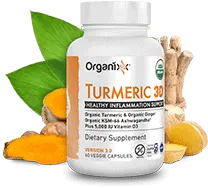
Organixx Turmeric 3D — Passes All 7 Factors
I apply this framework to every supplement I recommend. Turmeric 3D is the only product I currently use daily that meets all seven without qualification:
- ✓ Format: Genuine fermented curcumin (Factor 1)
- ✓ Standardised: Verified curcuminoid content (Factor 2)
- ✓ Third-party tested: Independent COA available (Factor 3)
- ✓ Certified organic: Traceable, clean sourcing (Factor 4)
- ✓ Piperine-free: Safe with medications (Factor 5)
- ✓ Safe profile: KSM-66 + D3 — no problematic additives (Factor 6)
- ✓ Transparent brand: Sourcing and testing published (Factor 7)
Also see: Meriva curcumin reviews | Best liposomal turmeric | BCM-95 guide | Nootropics Depot reviews
Robert’s full curated list: Benable — Best Curcumin Supplements 2026
? Complete the Picture — Essential Reading
- Turmeric Adulteration Guide — The safety case for buying certified and tested
- Turmeric vs Curcumin — Why form and standardisation determine whether anything works
- Fermented Turmeric — The bioavailability and gut-health case for fermented formats
- Turmeric Side Effects — Complete safety and interaction guide
- What Is Turmeric Good For? — The full evidence hub
- Turmeric for Inflammation — The core clinical mechanism
You haven’t talk of BCM-95 vs standardized Any benefts?
Hi Marcie,
You can follow the menu links, and find our details and highlights of BCM 95 as appose to the stanardized version of Turmeric.