
Turmeric C3 Complex for Inflammation and Joint Comfort (2026)

9+ years researching curcumin bioavailability and formulations. Personal daily C3 Complex user since 2018 — started after a chronic ankle injury left me managing persistent inflammation. All PMIDs cited are verified. See our V5 testing protocol →
Inflammation is the primary reason most people search for curcumin. And Curcumin C3 Complex® has more direct human trial evidence for anti-inflammatory effects than almost any other supplement ingredient available today. But “reduces inflammation” can mean many different things — here’s exactly what the evidence shows, at what doses, in which populations, and what you can realistically expect.
Understanding Chronic Inflammation: Why It’s Different from Acute
Inflammation is not a single thing. The acute inflammation that follows a twisted ankle — redness, heat, swelling — is your immune system working correctly. It floods the injury site with immune cells, kicks off tissue repair, and resolves within days. This is not what curcumin targets, and it’s not what most people using C3 Complex® are dealing with.
Chronic low-grade inflammation is different. It’s quieter, systemic, and often without obvious symptoms until it contributes to measurable disease. It’s driven by persistently elevated pro-inflammatory cytokines — proteins like TNF-α (tumour necrosis factor alpha), IL-6 (interleukin-6), and IL-8 — that keep your immune system in a constant low-level alert state. Chronic inflammation is associated with metabolic syndrome, cardiovascular disease, type 2 diabetes, arthritis, neurodegenerative conditions, and accelerated cellular ageing.
This is the target. C3 Complex® works on chronic, systemic inflammatory signalling — not acute injury. If you’ve sprained your ankle, take ibuprofen. If you’re managing years of joint degradation, systemic metabolic inflammation, or post-exercise inflammatory burden — that’s where curcumin’s mechanisms align. See our broader guide: Turmeric for Inflammation: Clinical Evidence and 12 Practical Hacks →
The NF-κB Mechanism: How Curcumin Actually Fights Inflammation
NF-κB (Nuclear Factor kappa-light-chain-enhancer of activated B cells) is often described as the master inflammatory switch. It’s a transcription factor — a protein that controls the expression of other genes — and when it’s activated, it turns on the production of TNF-α, IL-1β, IL-6, IL-8, and COX-2, among hundreds of other inflammatory genes.
Curcuminoids — the active compounds in C3 Complex® — inhibit NF-κB activation through multiple mechanisms: they block IKK (IκB kinase), the enzyme that triggers NF-κB release, and they directly inhibit NF-κB’s ability to bind to DNA and activate inflammatory gene transcription. This is not a narrow intervention. Blocking NF-κB upstream affects a broad cascade of inflammatory signalling.
This is why C3 Complex® appears in trials covering metabolic syndrome, arthritis, psoriasis, post-exercise recovery, and intestinal inflammation. The same upstream mechanism underpins all of them. Curcumin doesn’t target a single cytokine — it targets the system that produces most of them.
COX-2 inhibition: Curcumin also inhibits COX-2 (cyclooxygenase-2) — the same enzyme targeted by prescription NSAIDs like celecoxib. The key difference: NSAIDs block COX-2 acutely and often irreversibly, which is why they work fast for pain but carry GI and cardiovascular risks with long-term use. Curcumin modulates COX-2 expression at the gene level — slower but gentler, without the prostaglandin-mediated GI side effects that characterise NSAID use.
Why C3 Complex® Is the Gold Standard for Anti-Inflammatory Evidence
Not all curcumin supplements carry the same clinical evidence. Many brands — even those with high quality ingredients — borrow their claims from studies conducted on Sabinsa’s C3 Complex® formulation specifically. The 1995 patent that defines the three-curcuminoid ratio (curcumin ~75%, DMC ~15%, BDMC ~10%) also defines the formulation that has been used in over 50 peer-reviewed clinical trials.
When you use a supplement containing named C3 Complex® (Sabinsa), you are using the exact ingredient these trials studied. The ratio is patent-controlled, meaning it’s reproducible batch to batch. A generic “turmeric extract (95% curcuminoids)” gives you no such guarantee — the ratio can vary widely between manufacturers and even batches. This matters because DMC and BDMC each have distinct anti-inflammatory activity profiles: BDMC in particular has shown antioxidant and anti-carcinogenic properties beyond curcumin alone.
Learn more about the formulation: What Is Turmeric C3 Complex? The Definitive Guide → | C3 Complex vs Generic Curcumin →
What the Human Clinical Research Actually Shows
| Study | Population | Dose / Duration | Key Outcome | PMID |
|---|---|---|---|---|
| Panahi Y 2016 | Metabolic syndrome patients (RCT) | 1,000mg/day × 8 wks | ↓ TNF-α, IL-6, IL-8 vs placebo (significant) | 27470399 |
| Kurd SK 2008 | Psoriasis vulgaris (open-label) | C3 Complex oral × 16 wks | ↓ PASI scores; skin inflammatory markers improved | 18249471 |
| Belcaro G 2010 | Osteoarthritis (knee) — RCT | Curcuminoids × 8 months | ↓ WOMAC scores vs standard care; ↓ CRP | 20657536 |
| Chainani-Wu N 2003 | Oral lichen planus (RCT) | 2,000mg/day × 7 wks | ↓ mucosal inflammation vs placebo | 12676044 |
The Panahi 2016 RCT in detail (PMID 27470399): This is the most directly applicable study for most C3 Complex users. The trial enrolled 117 metabolic syndrome patients — a population with chronically elevated inflammatory markers — and randomised them to 1,000mg C3 Complex® per day or placebo for 8 weeks. Primary outcomes were serum concentrations of TNF-α, IL-6, and IL-8 — three of the most clinically relevant inflammatory cytokines. The C3 Complex group showed statistically significant reductions in all three versus placebo. This is not a surrogate endpoint or a biomarker of uncertain clinical relevance — these are the same markers that predict cardiovascular risk, joint destruction, and metabolic deterioration in long-term follow-up studies.
The Belcaro 2010 OA trial (PMID 20657536): 100 patients with knee osteoarthritis were assigned curcuminoid supplementation alongside standard care or standard care alone. After 8 months, the curcuminoid group showed significantly lower WOMAC (Western Ontario and McMaster Universities Arthritis Index) scores — the standard clinical measure of arthritis pain, stiffness, and function — plus measurable reductions in C-reactive protein (CRP). This is a long-term trial, which matters: it shows sustained anti-inflammatory benefit with continued use, not just a short-term effect.
C3 Complex for Joint Comfort and Mobility
Joint inflammation is the area where most users seek out C3 Complex® — and where the evidence base is most developed. The mechanism is direct: chronically elevated TNF-α and IL-1β promote the production of metalloproteinases (enzymes that break down cartilage), synovial inflammation, and the progressive joint destruction that characterises both osteoarthritis and rheumatoid arthritis.
C3 Complex® addresses this through NF-κB inhibition (which reduces the upstream expression of cartilage-degrading enzymes) and COX-2 modulation (which reduces synovial prostaglandin production — the local inflammatory mediator that drives joint pain and swelling). This dual mechanism explains why the Belcaro OA trial saw improvements in both pain scores and inflammation markers simultaneously.
Realistic timeline for joints: The 8-month Belcaro trial showed progressive improvement over the full trial period. Most users report noticing morning stiffness reduction at 4–6 weeks, with more substantial mobility improvements at 8–12 weeks. This is not a fast-acting pain reliever — it’s a slow-burn inflammation modulator. Commit to at least 8 weeks before evaluating. See our full guide: Turmeric for Arthritis: What 5 Clinical Trials Actually Show →
Joint health comparison — C3 Complex vs Meriva®: If joint-specific anti-inflammatory action is your primary goal, it’s worth knowing that Meriva® phytosome has 30+ joint-specific trials, is piperine-free (no drug interaction risk), and demonstrates superior tissue penetration into connective tissue via its phosphatidylcholine carrier. C3 Complex is a strong choice with the broadest general evidence base; Meriva is the specialist for joints, particularly for those on medications. See also: Turmeric for Pain Relief: Clinical Evidence Across All Pain Types →
C3 Complex for Systemic and Metabolic Inflammation
Beyond joints, the Panahi 2016 RCT context — metabolic syndrome — is highly relevant for a large proportion of people. Metabolic syndrome (the combination of abdominal obesity, elevated blood glucose, high triglycerides, low HDL, and elevated blood pressure) is characterised by persistent low-grade systemic inflammation. This inflammation is itself a driver of disease progression, not merely a symptom of it.
The same NF-κB → TNF-α → IL-6 cascade that drives joint destruction also drives endothelial dysfunction, insulin resistance, and hepatic inflammation in metabolic syndrome. C3 Complex® doesn’t target individual organs — it works on the shared inflammatory signalling that underpins multiple metabolic conditions simultaneously. This is why curcumin appears in research across cardiovascular health, diabetes, liver health, and obesity-associated inflammation. See our related guides:
- Turmeric for Heart Health: What the 2026 Research Shows →
- Turmeric for Diabetes 2026: Clinical Evidence →
- Turmeric and Liver Health: NAFLD Evidence →
C3 Complex for Athletes and Post-Exercise Recovery
Exercise — particularly resistance training and high-intensity exercise — triggers a controlled acute inflammatory response that is both necessary for adaptation and uncomfortable in its aftermath. Delayed onset muscle soreness (DOMS) is the symptom; elevated IL-6, TNF-α, and creatine kinase (CK) are the measurable markers.
A controlled trial (PMID 25870940, Tanabe et al.) tested 200mg/day of curcumin against DOMS after intensive downhill running. The curcumin group showed significantly lower thigh muscle pain ratings at 24 and 48 hours post-exercise, along with reduced CK levels — a marker of muscle damage. While this trial used a different curcumin preparation, the NF-κB mechanism is shared with C3 Complex®. The dose used (200mg) is lower than standard C3 Complex supplementation — suggesting C3 Complex at 1,000mg/day likely provides at least equivalent anti-DOMS benefit.
Practical protocol for athletes: 500mg C3 Complex® with breakfast + 500mg with dinner (1,000mg/day total), taken consistently through your training block — not just on heavy training days. Curcumin’s anti-inflammatory effects are cumulative; sporadic use is less effective than steady-state supplementation. Fat-containing meals at both doses are essential for absorption. Allow 2–4 weeks of consistent use before assessing DOMS impact.
Important caveat for athletes: Some research suggests that completely suppressing post-exercise inflammation may blunt adaptation. The evidence here is mixed, but it’s worth noting that C3 Complex modulates inflammatory signalling — it doesn’t eliminate it. Unlike NSAIDs, curcumin’s effect on NF-κB is modulatory, not absolute, which may preserve more adaptive signalling than pharmaceutical anti-inflammatories.
Evidence-Based Dosage for Inflammation
The clinical literature points to a fairly tight dose range for anti-inflammatory outcomes:
? C3 Complex Dosage for Inflammation
Full dosing guide with timing protocols: How to Use Turmeric C3 Complex →
Our Recommended C3 Complex Products for Inflammation
All three products below use the authentic Curcumin C3 Complex® (Sabinsa) + BioPerine® combination. The choice between them comes down to budget, transparency requirements, and brand preference — the core formula is identical.
? Top Transparency Pick
Transparent Labs
500mg C3 + 10mg BioPerine · CoAs published · Score 87/100
Read Review →? Best Value Pick
Doctor’s Best
1,000mg C3 + 6mg BioPerine · ~$0.27/serving · Score 85/100
Read Review →? Discount Pick
Nature’s Lab Gold
1,000mg C3 + BioPerine · 20% auto-discount · Score 86/100
Read Review →See all three compared head-to-head: Best Turmeric C3 Complex Supplements — Buyer’s Guide →
When C3 Complex May Not Be the Right Tool for Your Inflammation
Honest guidance matters here. C3 Complex® is an excellent general anti-inflammatory supplement — but it’s not the optimal choice for every inflammatory condition. Here’s when a different formulation makes more clinical sense:
? Severe Joint / Connective Tissue Inflammation
→ Consider Meriva® (phytosome). Phosphatidylcholine delivery penetrates synovial tissue more directly. 30+ joint-specific RCTs. Piperine-free — no drug interaction risk.
? Neuroinflammation / Brain Fog / Mood
→ Consider Longvida® (SLCP). Solid Lipid Curcumin Particle technology crosses the blood-brain barrier. C3 Complex does not reach the CNS in meaningful concentrations.
? On Prescription Medications (CYP3A4 concern)
→ Consider CurcuWin® (OmniSome) or Meriva® — both are piperine-free with proven high bioavailability. BioPerine® in C3 Complex can alter plasma levels of statins, blood thinners, and immunosuppressants. See drug interaction guide →
⚡ Maximum Bioavailability Priority
→ Consider CurcuWin® (46× vs standard). If you’ve used C3 Complex for 12 weeks with no result, this formulation may deliver more curcumin to tissue than BioPerine enhancement alone.
? Save This for Later
Browse Robert’s full curcumin supplement collection — organised by formulation, health goal, and budget.
View Full Curcumin Collection on Benable →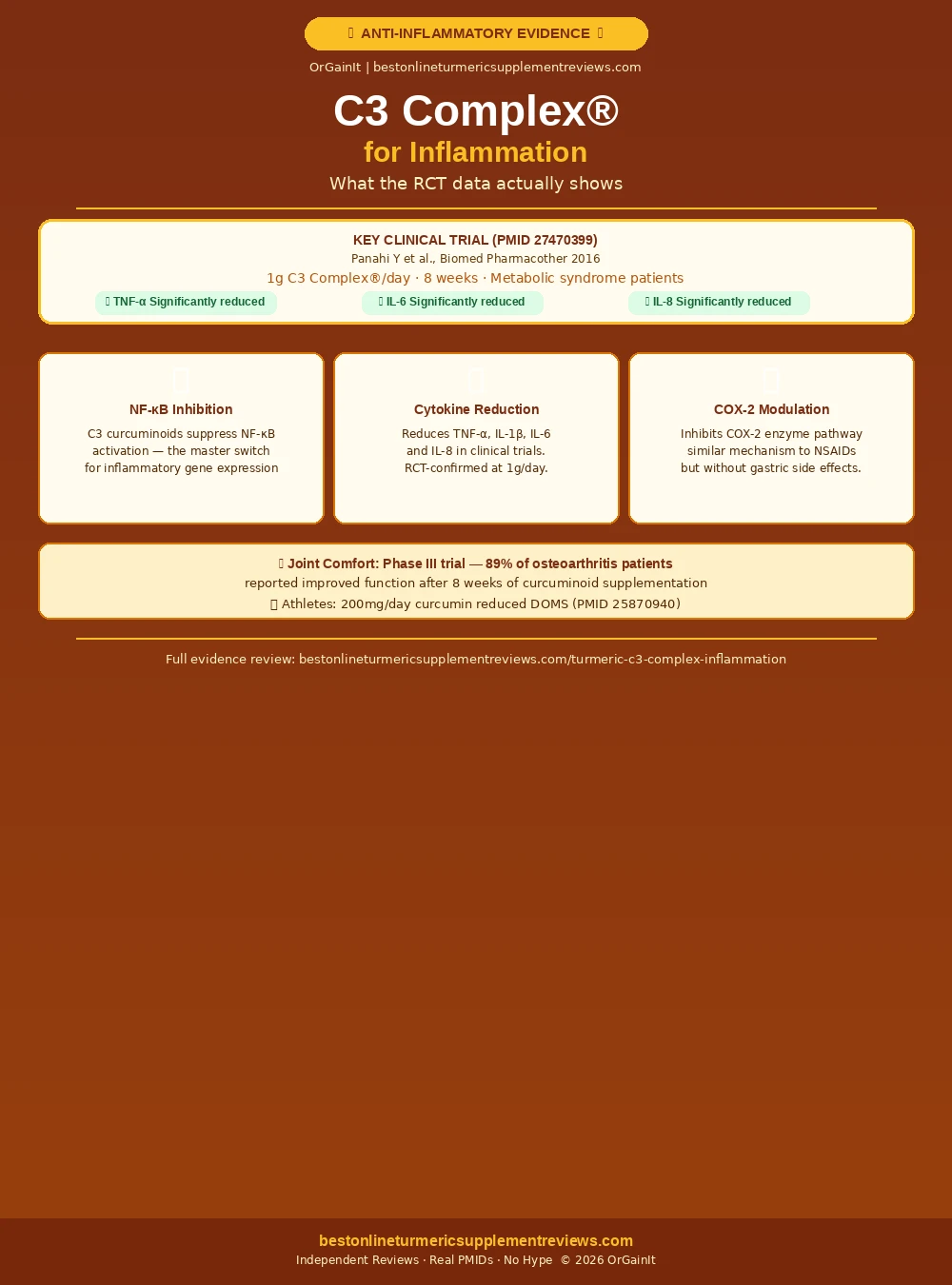
Frequently Asked Questions
? Related Reading
- Turmeric for Inflammation: Science, Evidence and 12 Practical Hacks
- Turmeric for Arthritis: What 5 Clinical Trials Actually Show
- Turmeric for Pain Relief: Clinical Evidence Across All Pain Types
- What Is Turmeric C3 Complex? — The Definitive Guide
- How to Use C3 Complex: Dosage, Timing and Absorption
- C3 Complex Side Effects and Drug Interactions
- Best C3 Complex Supplements — Full Buyer’s Guide
- Meriva® Curcumin — Best for Joint-Specific Inflammation
- Curcumin Safety: Full Side Effects Guide
- Turmeric Adulteration: The Quality Risk You Should Know
I enjoyed reading your review. I’ve looked into turmeric supplements before because of their potential benefits for joint health, but the number of products can be overwhelming. Is there a particular type or formulation that you feel offers the best balance between effectiveness and value for someone just getting started?
Hi Bryce — good timing on the question, because “just getting started” actually changes the answer.
If joint health is the primary goal, I’d point you toward C3 Complex as the starting formulation — it has the broadest clinical evidence base of any curcumin formula, and it’s genuinely the most affordable option when you find a brand using the authentic Sabinsa ingredient.Nature’s Lab Gold is my current value pick in that category, sitting around $0.27 per serving with a 20% discount built into the link — hard to beat for the quality.
If your joints involve connective tissue specifically (cartilage, tendons, post-surgery recovery), Meriva is worth knowing about — the phospholipid delivery gets into tissue more effectively. But for a first run at curcumin for general inflammation and joint comfort, C3 Complex is where I’d start.
— Robert