
What Is Synthetic Curcumin? The Complete Truth (2026)
Quick Answer
Synthetic curcumin is curcumin made in a laboratory from petroleum-derived chemicals, rather than extracted from the turmeric plant. It is not a dietary supplement — it is an industrial chemical used in research, as a lab reference standard, and in cosmetics. In the supplement market, synthetic curcumin appears almost exclusively as an illegal adulterant hidden inside “natural” turmeric products. A 2026 scoping review found that roughly 22% of tested turmeric supplements contain undeclared ingredients or synthetic adulterants (Gafner et al., 2026).
⚕️ Medical Disclaimer: The information on this page is for educational and informational purposes only and is not intended as medical advice, diagnosis, or treatment. Always consult a qualified healthcare professional before starting any new supplement regimen, especially if you have a medical condition, take prescription medications, or are pregnant or nursing. Curcumin supplements can interact with blood thinners, diabetes medications, and other drugs. Do not stop or modify prescribed treatments without consulting your healthcare provider. Full disclaimer.
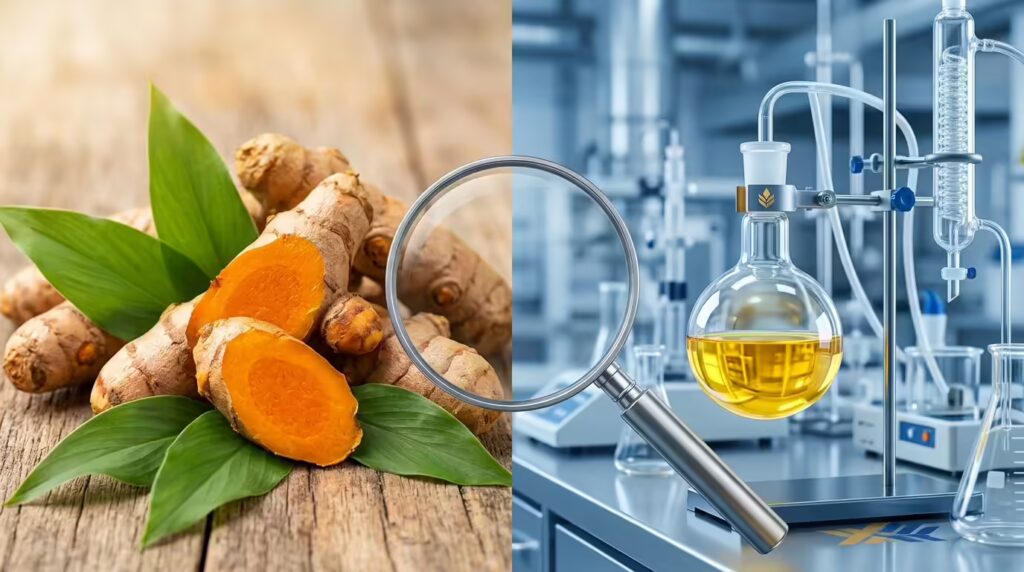 In this guide, I’m going to give you the complete, honest answer. You’ll learn exactly what synthetic curcumin is, how it’s made, where it’s actually used (and where it isn’t), how to tell it apart from real turmeric, and — most importantly — why it has no place in your supplement routine. I’ve spent 9+ years researching turmeric and curcumin, personally testing 15+ supplements, and sending samples for independent analysis. I’m not a doctor, and I’ll remind you to consult yours, but I’ve read the studies and the lab reports so you don’t have to.
Here’s the bottom line up front: synthetic curcumin is not a supplement. It is an industrial chemical — and in the supplement world, it appears almost exclusively as an illegal adulterant hidden inside “natural” turmeric products. Once you understand that, everything else falls into place.
What Is Synthetic Curcumin?
Synthetic curcumin is curcumin that is manufactured in a laboratory through chemical synthesis, rather than extracted from the rhizome of the turmeric plant (Curcuma longa). Chemically, it is identical in molecular structure to natural curcumin — which is precisely why it is so hard to detect and so dangerous as an adulterant.
The key distinction is origin. Natural curcumin comes from a plant and carries the biological signature of living things. Synthetic curcumin is built from petroleum-derived (fossil fuel) starting materials in an industrial process. As the supplement company NOW Foods explained when it announced its testing program, synthetic curcumin is “derived from petrochemicals” and can be produced “at a much lower cost” than the real thing.
That cost difference is the entire reason synthetic curcumin exists in the supplement market. It is cheap to make, chemically indistinguishable from natural curcumin in most routine tests, and can be used to stretch or replace expensive turmeric extract while the label still says “natural.” this is explicitly why I attempt to warn folks of buying turmeric from aliexpress and other what seems to be cheap well hyped products.
How Is Synthetic Curcumin Made?
The chemical synthesis of curcumin has been known for over a century — it was first achieved in 1913 by Lampe and Melobedzka, shortly after the structure of curcumin was determined (Kotha & Luthria, 2019, Molecules, PMID 31412624). Modern industrial synthesis typically starts from petroleum-derived aromatic compounds and builds the curcumin molecule through a series of chemical reactions.
This is where the safety concerns begin. Industrial chemical synthesis can leave behind trace residues — including harsh solvents and, in some cases, benzene and other petrochemical byproducts. When synthetic curcumin is made to industrial or cosmetic grade, it is not held to food-grade or pharmaceutical-grade purity standards. There is no requirement that it be free of these residues, because it was never intended to be eaten.
The Two Real Forms of Synthetic Curcumin
To understand synthetic curcumin, you have to understand that it exists in two very different contexts — and only one of them is legitimate.
Form 1: The industrial/lab chemical (legitimate). In laboratories and industry, synthetic curcumin is a legitimate tool. It is used as an analytical reference standard — a known, pure sample used to calibrate testing equipment. It is also used in research and drug development, where scientists study synthetic curcumin derivatives as potential drug candidates. In this context, it is a chemical, not a food.
Form 2: The illegal adulterant (the problem). In the supplement market, synthetic curcumin is used to deceive. Because it is cheap and chemically similar to natural curcumin, unscrupulous manufacturers add it to “natural” turmeric extract to cut costs. This is illegal — it is an undeclared ingredient, and it is not approved for use in dietary supplements. This is the form that should concern you.
Where Synthetic Curcumin Is Actually Used (The Medical & Industrial Truth)
Let me be precise about the medical industry, because this is where a lot of confusion lives. Synthetic curcumin is not an approved medicine, and it is not a dietary supplement. Its legitimate uses are confined to research and industry:
- Drug discovery and development. Synthetic curcumin derivatives are actively studied as investigational drug candidates for conditions including diabetes, cancer, obesity, and malaria. For example, a 2025 review in Applied Research examined synthetic curcumin derivatives for diabetes and cancer management (Adeleye et al., 2025), and a 2024 computational study in the International Journal of Molecular Sciences evaluated synthetic curcumin derivatives as potential anti-obesity drug candidates (Moetlediwa et al., 2024, PMID 38473849). These are research-stage compounds — none is an approved drug.
- Analytical reference standards. Laboratories use synthetic curcumin as a known reference to calibrate instruments and verify test results.
- Cosmetics and skincare. Synthetic curcumin is sometimes used in topical products as a stable antioxidant — a cosmetic ingredient, not something you ingest.
The critical takeaway: in every legitimate medical or industrial use, synthetic curcumin is a chemical tool, not a consumer product. There is no approved pharmaceutical made from it, and the FDA does not recognize a synthetic copy of a botanical as a dietary ingredient. If you see “synthetic curcumin” sold as a supplement, you are not looking at a legitimate product category — you are looking at either a misunderstanding or a deception.
The 4-Tier Market Spectrum: From Real Turmeric to Fake
To understand where synthetic curcumin sits, it helps to see the whole market as a spectrum of four tiers:
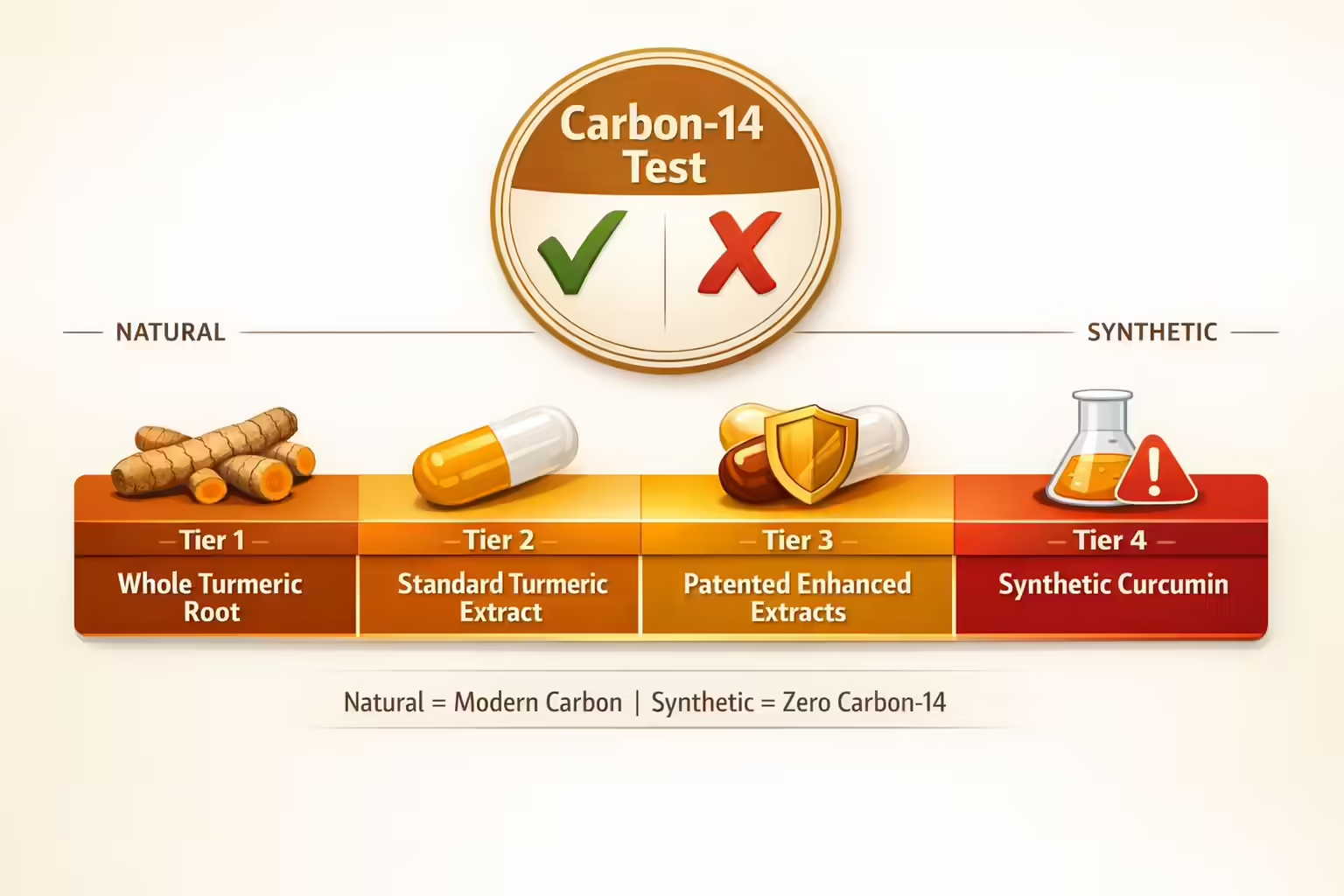
| Tier | What it is | Carbon profile | Consumer intent |
|---|---|---|---|
| 1. Whole turmeric root | The actual plant, ground or whole | Modern (natural) | Cooking, traditional use |
| 2. Standard turmeric extract | Curcuminoids extracted from the plant | Modern (natural) | Supplement use |
| 3. Patented enhanced extracts | Natural curcumin in bioavailable forms (C3 Complex, Meriva, Longvida) | Modern (natural) | Supplement use, clinically studied |
| 4. Synthetic curcumin | Lab-made from petrochemicals | Zero (fossil) | Industrial use — or illegal adulteration |
Tiers 1–3 are all natural. Tier 4 is the outlier — and the only tier that should never be sold as a supplement. The problem is that some manufacturers quietly move Tier 4 product into Tier 2 or 3 bottles.
The Carbon-14 Test: The Industry’s “Gotcha”
Here’s the elegant scientific fact that makes synthetic curcumin detectable: natural curcumin contains carbon-14, and synthetic curcumin does not.
Carbon-14 is a radioactive isotope of carbon that is constantly created in the upper atmosphere and absorbed by living plants through photosynthesis. Every plant — including turmeric — carries a small, measurable amount of modern carbon-14. Petroleum, by contrast, is millions of years old, and all of its carbon-14 has long since decayed to zero.
So when a lab measures the carbon-14 content of a turmeric supplement, it gets a clear answer: if the curcumin contains modern carbon, it came from a plant. If it contains zero carbon-14, it came from fossil fuels — meaning it is synthetic. This radiocarbon dating method was developed at the University of Georgia’s Center for Applied Isotope Studies and pioneered for curcumin testing by the supplement company Sabinsa (Nutritional Outlook). A leader in innovation and creator of Curcumin C3 Complex and their latest advanced formulation C3 Reduct.
This is the industry’s “gotcha” — a test that synthetic curcumin cannot pass, no matter how chemically identical it looks.
The 22% Adulteration Problem
The Carbon-14 test isn’t just a theoretical curiosity. It has been used to expose a real, widespread problem.
In 2021, NOW Foods sent 23 turmeric supplements purchased from unknown Amazon sellers to the University of Georgia for radiocarbon testing. The results were alarming: 4 of the 23 products were spiked with “fossil fuel derived organic carbon” — meaning they contained synthetic curcumin. The flagged brands were Vitpro, Me First Living, Eagle, and Primal Harvest. In total, 12 of the 23 products failed testing in some way (NOW Foods press release).
This is not an isolated incident. A 2026 scoping review by the Botanical Adulterants Prevention Program (BAPP), published in Pharmaceutical Biology, analyzed 2,235 turmeric products and found that roughly 22% of turmeric dietary supplements were adulterated — with synthetic curcumin identified as the most common adulterant in supplements, and the highest prevalence found in Europe and North America (Gafner et al., 2026, PMID 41452918).
In plain terms: if you buy an unverified turmeric supplement, there is roughly a 1-in-5 chance it contains something it shouldn’t — and synthetic curcumin is the most common culprit.
Why There Is No Safe Dose
You will not find a recommended dosage for synthetic curcumin, and that is not an oversight. It is because no safe dose exists.
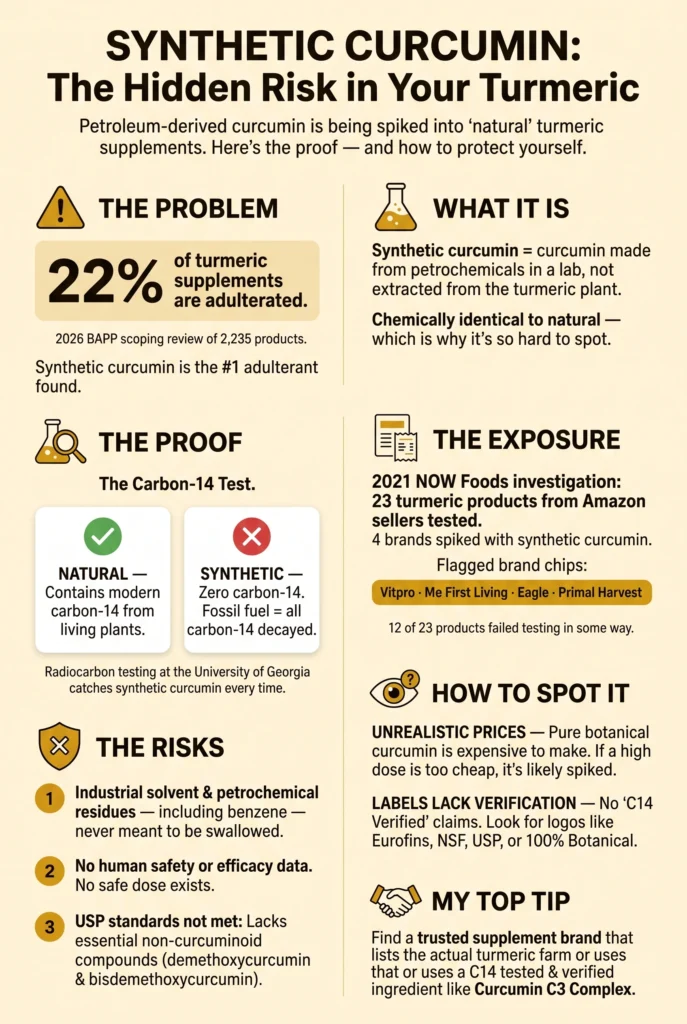 Synthetic curcumin has never been studied in humans as a supplement. It has no human safety data, no efficacy data, and no established dose. What it does have is a set of serious concerns:
- Industrial residues. Synthetic curcumin made to industrial or cosmetic grade can carry trace residues of harsh solvents and petrochemical byproducts, including benzene — none of which belong in something you swallow.
- Hepatotoxicity risk. In December 2025, the United States Pharmacopeia (USP) Dietary Supplements Admission Evaluation Liaison Expert Committee recommended adding a cautionary label to turmeric and curcuminoid monographs regarding rare liver problems (Akhtar et al., 2026, Pharmaceutical Biology, PMID 42364655). This safety signal applies to curcuminoids generally, and it is a reason to be cautious — not a reason to gamble on an unregulated synthetic version.
- No regulatory status. The FDA does not recognize synthetic curcumin as a dietary ingredient. It is not GRAS (generally recognized as safe) for supplement use in the way natural curcuminoids are.
The honest answer to “how much synthetic curcumin should I take?” is: none. There is no legitimate dose, because there is no legitimate supplement use.
How to Tell If Your Turmeric Is Synthetic
Here is the uncomfortable truth: you cannot 100% prove whether a supplement contains synthetic curcumin without a laboratory test. The Carbon-14 test is definitive, but it requires specialized equipment. No home test can give you a guaranteed answer.
What you can do is dramatically reduce your risk:
- Buy from brands that publish third-party testing. Look for supplements tested by independent organizations like USP, NSF International, or ConsumerLab, and for brands that publish their own radiocarbon or adulteration testing results. A leading brand I see taking this very seriously is Nootropics Depot.
- Avoid unknown sellers and unbranded products. The brands flagged in the NOW Foods testing — Vitpro, Me First Living, Eagle, and Primal Harvest — were all purchased from unknown Amazon sellers. Buying from a reputable, established brand with transparent testing is your first line of defense.
- Choose clinically studied, patented extracts. Natural extracts like C3 Complex, Meriva, and Longvida have published research and established supply chains. They are far less likely to be adulterated than generic “turmeric extract.”
- Be skeptical of suspiciously cheap products. Synthetic curcumin exists because it is cheap. If a “95% curcumin” supplement is priced far below the market, ask why.
What to Buy Instead
The good news is that you don’t need synthetic curcumin — and you never did. The real, studied compound is natural curcumin, and it is widely available in verified forms.
If you’re looking for a turmeric supplement, prioritize natural, clinically studied extracts with third-party testing. The most well-researched formulations include C3 Complex (standardized curcuminoids), Meriva (a phytosome formulation studied for joint health), and Longvida (a formulation studied for brain and cognitive health). Look for the USP, NSF, or ConsumerLab seal, and buy from established brands that publish their testing.
I’ve written detailed guides on these verified natural options, and I’ll link them throughout this article. The short version: real turmeric is the hero here. Synthetic curcumin is the villain — and you deserve the real thing.
Frequently Asked Questions
What is synthetic curcumin?
Synthetic curcumin is curcumin manufactured in a laboratory from petroleum-derived chemicals, rather than extracted from the turmeric plant. It is chemically identical to natural curcumin but comes from fossil fuels. It is not a dietary supplement — it is an industrial chemical, and in the supplement market it appears almost exclusively as an illegal adulterant.
How does synthetic curcumin work?
Synthetic curcumin does not “work” as a supplement because it is not a supplement. In legitimate contexts, it works as a chemical: as an analytical reference standard in labs, and as a starting point for research into drug candidates. In the supplement market, it works only as a cheap filler that mimics natural curcumin on routine tests.
What are its key properties?
Synthetic curcumin’s key properties are chemical identity with natural curcumin (which makes it hard to detect) and a fossil-fuel origin (which makes it detectable by carbon-14 testing). It has zero carbon-14, whereas natural curcumin carries modern carbon from photosynthesis.
Why does it have a longer shelf life than natural curcumin?
This is a marketing claim that deserves scrutiny. Synthetic curcumin is a purified, isolated chemical, and purified compounds can be more stable than whole-plant extracts that contain oils and other components that degrade. However, this is not a benefit for consumers — a longer shelf life in a chemical does not make it safe or appropriate to consume, and there is no authoritative source establishing this as a meaningful supplement advantage.
What health claims are made about it?
Some sellers claim synthetic curcumin offers the same benefits as natural curcumin at a lower cost. This is misleading. The health benefits associated with curcumin come from research on natural curcumin. Synthetic curcumin has no human supplement safety or efficacy data, and it is not approved for use as a dietary ingredient.
Is synthetic curcumin safe?
There is no evidence that synthetic curcumin is safe to consume as a supplement, and there are reasons for concern, including potential industrial solvent residues and the general hepatotoxicity caution the USP has raised for curcuminoids. Because it has never been studied in humans as a supplement, there is no basis for a safe dose.
How can I tell if my turmeric is synthetic?
You cannot 100% prove it without a laboratory carbon-14 test. To reduce your risk, buy from established brands that publish third-party testing, look for USP/NSF/ConsumerLab seals, choose clinically studied natural extracts, and avoid unknown sellers and suspiciously cheap products.
What should I buy instead?
Buy natural, clinically studied turmeric extracts with third-party testing — such as C3 Complex, Meriva, or Longvida — from reputable brands. Real turmeric is the studied, safe, and effective choice. Synthetic curcumin has no place in your supplement routine.
References
- Gafner S, et al. Turmeric adulteration: a scoping review. Pharmaceutical Biology. 2026;64(1):87–107. PubMed
- Akhtar N, et al. Turmeric and curcuminoid safety review. Pharmaceutical Biology. 2026;64(1):866–901. PubMed
- Kotha RR, Luthria DL. Curcumin: Biological, Pharmaceutical, Nutraceutical, and Analytical Aspects. Molecules. 2019;24(16):2930. PubMed
- Moetlediwa MT, et al. Evaluating the Therapeutic Potential of Curcumin and Synthetic Derivatives: A Computational Approach to Anti-Obesity Treatments. Int J Mol Sci. 2024;25(5):2603. PubMed
- Adeleye OA, et al. Overcoming Curcumin’s Limitations: Synthetic Derivatives in Diabetes and Cancer Management. Applied Research. 2025;4. Wiley
- NOW Foods. NOW Tests Curcumin/Turmeric Extract Sold on Amazon. Press release
- Nutritional Outlook. Curcumin suppliers guaranteeing natural curcumin (not synthetic) using carbon dating. Article