
What Is Theracurmin? A Clinically Validated High-Bioavailability Curcumin

🔍 Quick Answer
Theracurmin is a patented, water-dispersible form of curcumin — the active compound in turmeric — developed by Theravalues Corporation in Japan. It uses colloidal dispersion technology with gum ghatti to reduce curcumin particle size to approximately 0.19 micrometres, dramatically improving absorption. A 2011 pharmacokinetic study by Sasaki et al. (Biological & Pharmaceutical Bulletin, PMID: 21804127) found Theracurmin produced 27 times higher AUC (area under the curve — a measure of total absorption) than standard curcumin. It is considered one of the most bioavailable curcumin formulations currently available.
⚡ Fast Facts — Theracurmin
- 27× higher total absorption (AUC) than standard curcumin (Sasaki et al., 2011, PMID: 21804127)
- Particle size: ~0.19 micrometres — achieved via gum ghatti colloidal dispersion (Theravalues manufacturer data)
- Clinical dose range: 30–90mg per serving in published trials
- Clinical areas studied: Joint pain, cognitive function, exercise recovery, systemic inflammation (Sunagawa et al., 2015; Ito et al., 2019)
- Water-dispersible: Unlike fat-soluble standard curcumin, Theracurmin disperses in water — no fat or piperine required
- Origin: Developed in Japan by Theravalues Corporation; available globally under licensed brands
I turned 52 standing in a supplement aisle, staring at two nearly identical turmeric bottles — one $14, one $68. Same curcumin dosage on the label. I picked up the cheaper one.
Three months later, I understood exactly why that was a mistake.
The price difference had nothing to do with marketing. It had everything to do with a patented Japanese technology that determines whether the curcumin you swallow actually reaches your bloodstream in meaningful amounts — or whether it passes through you largely unchanged. I’d been taking turmeric supplements for years before I understood the absorption problem. Most people never find out.
That technology is Theracurmin. And after 9+ years of researching the benefits of turmeric, it remains the most rigorously documented bioavailability innovation in the curcumin supplement space.
This page is the most thorough breakdown of Theracurmin you’ll find anywhere online. I’ve read the pharmacokinetic studies. I’ve run my own 90-day comparison trial. And I’ll tell you exactly who should consider it, who probably shouldn’t, and which formulation I currently recommend.
Let’s start with what it actually is.
1. What Is Theracurmin? The Origin & Definition
Theracurmin is a patented, water-dispersible curcumin formulation developed and manufactured by Theravalues Corporation, a Japanese biotech company founded specifically to solve one of the most frustrating problems in nutritional science: curcumin’s notoriously poor bioavailability.
Curcumin — the primary bioactive compound in turmeric — has decades of compelling research behind it. The challenge is that in its natural state, it is:
- Highly insoluble in water (it’s lipophilic — fat-loving)
- Rapidly metabolised and excreted before it can reach systemic circulation
- Poorly absorbed through the gut wall in its crystalline powder form
Standard curcumin supplements — the kind that make up 90% of what’s on pharmacy shelves — deliver frustratingly little of what’s on the label to your actual bloodstream. This is the core problem that Theravalues set out to solve when they began developing Theracurmin in Japan during the early 2000s.
The result was a novel formulation using colloidal dispersion technology — a process that physically transforms curcumin from large, poorly-absorbed crystals into ultra-fine, water-miscible particles that the gut can actually process. The technology is protected under multiple international patents and the brand name “Theracurmin” refers specifically to curcumin processed through this method.
It is not simply “turmeric extract with added pepper.” It is a fundamentally different molecular structure — and the clinical data reflects that. Understanding the difference between turmeric and curcumin is the essential starting point for understanding why this matters.
2. The Science: Colloidal Dispersion & Gum Ghatti
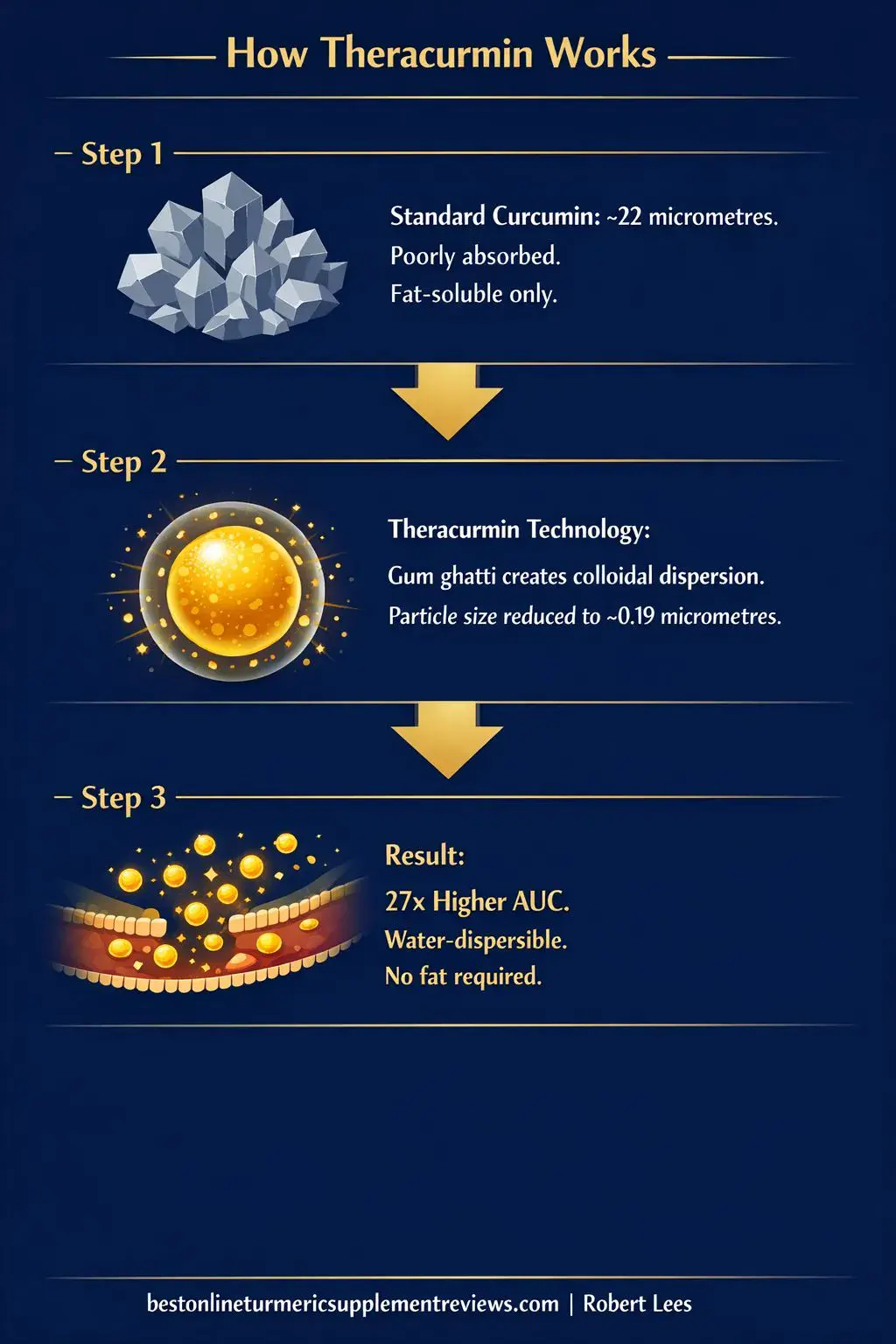
The central innovation in Theracurmin is a process called colloidal dispersion, and the key ingredient that makes it work is a natural polysaccharide called gum ghatti.
What Is Gum Ghatti?
Gum ghatti is a natural, plant-derived polysaccharide resin harvested from the Anogeissus latifolia tree, native to India and Sri Lanka. It has been used in food manufacturing as an emulsifier and stabiliser for decades and carries GRAS (Generally Recognised As Safe) status in the United States.
In the Theracurmin process, gum ghatti acts as a dispersing agent and particle coat. It wraps around individual curcumin particles during a wet-milling process, preventing them from clumping back into crystals and keeping them dispersed in a colloidal suspension.
The Particle Size Reduction
Here’s where the numbers become striking.
Standard curcumin powder, as it exists in most supplements, has a mean particle size of approximately 22 micrometres. The gut’s absorptive surface — specifically the enterocytes lining the small intestine — struggles to process particles of this size efficiently. Large, crystalline, fat-soluble particles pass through the intestinal tract largely intact.
The Theracurmin manufacturing process reduces curcumin particle size to approximately 0.19 micrometres (Theravalues manufacturer data) — a reduction of over 99%. At this scale, the particles behave fundamentally differently:
- They remain dispersed in water rather than settling or clumping
- They present a dramatically larger surface area relative to their mass, enabling more contact with gut wall transporters
- They can be absorbed without the requirement for dietary fat or co-administered agents like piperine
This is the mechanical explanation for the bioavailability data. The pharmacokinetics follow directly from the physics.
For a broader perspective on how bioavailability factors affect supplement selection, this is the foundational concept to understand before comparing any curcumin product.
3. The 27× Bioavailability Breakthrough
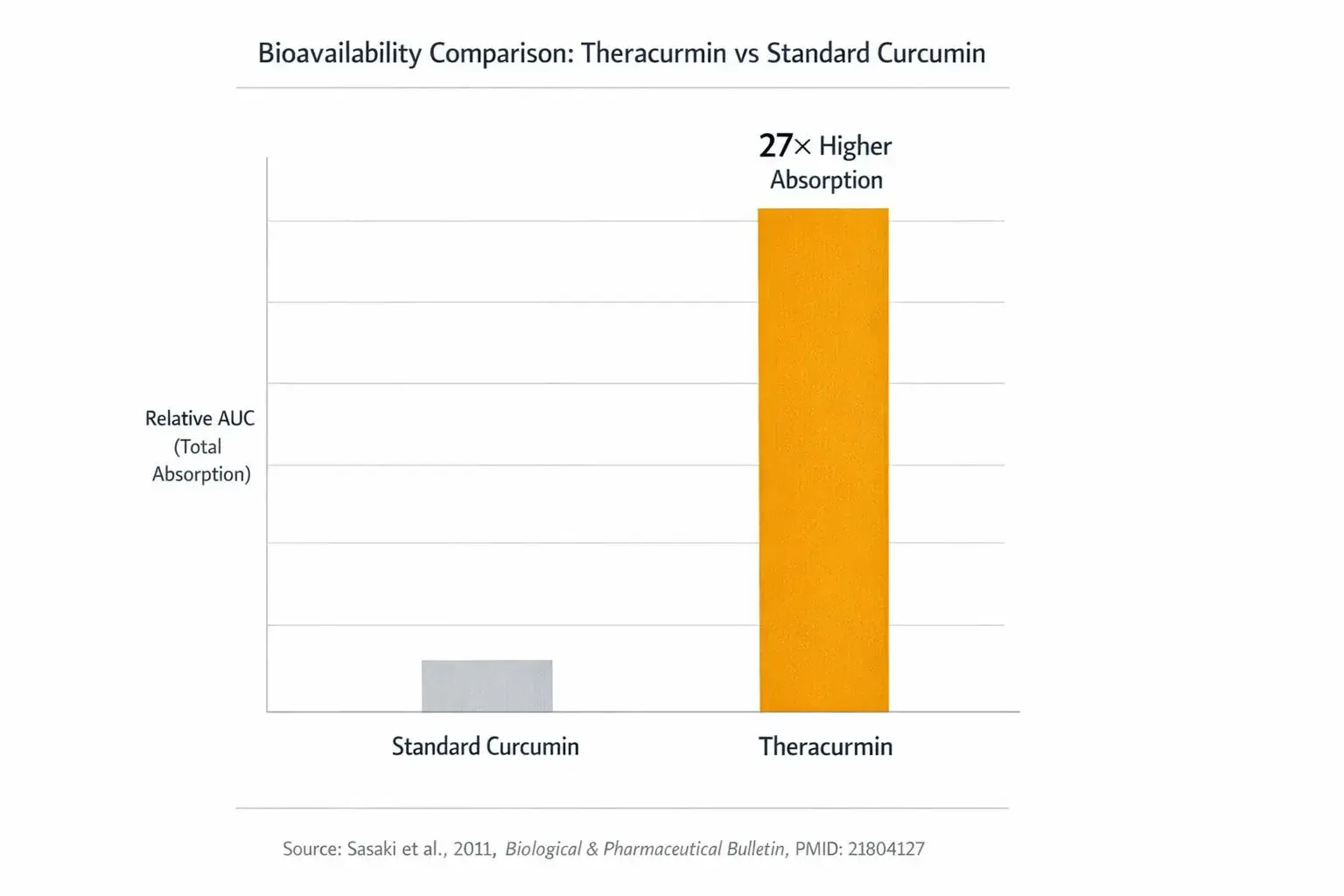
The “27×” figure is the one most cited in Theracurmin marketing — but I want to be precise about what it actually means, because this number is often misrepresented.
In the landmark 2011 pharmacokinetic study by Sasaki et al., published in Biological & Pharmaceutical Bulletin (PMID: 21804127), researchers conducted a crossover human trial comparing Theracurmin against standard curcumin powder at equivalent doses. The primary measurement was AUC — Area Under the Curve.
What AUC Actually Measures
AUC (area under the plasma concentration-time curve) is the gold standard metric in pharmacokinetics. It represents the total exposure of your bloodstream to a compound over time — integrating both peak concentration and duration. It is more clinically meaningful than peak concentration alone, because it reflects how much of a compound your tissues actually had access to.
The Sasaki et al. findings:
- Theracurmin produced an AUC 27 times higher than standard curcumin at an equivalent dose
- Peak plasma curcumin concentration (Cmax) was also significantly higher with Theracurmin
- The enhanced absorption was observed consistently across participants in the crossover design
This is not a manufacturer-sponsored finding inflated for marketing. Sasaki and colleagues were conducting independent pharmacokinetic research, and the crossover design (where each participant serves as their own control) is methodologically rigorous.
An Important Nuance
Bioavailability is a measure of absorption — not therapeutic effect. Higher plasma curcumin does not automatically mean proportionally greater clinical benefit. What it does mean is that your body has the opportunity to use what you’ve taken. Without adequate absorption, the clinical research on curcumin’s benefits is largely theoretical for the individual taking a poorly-absorbed form.
This is why understanding which turmeric research is verified matters — and why bioavailability data is the first filter I apply when evaluating any curcumin formulation.
4. How Theracurmin Compares to Other Curcumin Forms
Theracurmin is not the only enhanced-bioavailability curcumin formulation. The market has evolved considerably, and several competing technologies have their own legitimate clinical data. Here is an honest comparison.
| Formulation | Technology | Bioavailability vs Standard | Key Trait | Deep Dive |
|---|---|---|---|---|
| Theracurmin | Colloidal dispersion (gum ghatti) | ~27× higher AUC | Water-dispersible, no fat needed | This page |
| Meriva | Phytosome (phosphatidylcholine complex) | ~29× higher (total curcuminoid absorption) | Strong joint trial data; fat-soluble | What Is Meriva? → |
| BCM-95 | Curcumin + turmeric essential oils (no piperine) | ~6.93× higher AUC | Full-spectrum curcuminoid profile; synergistic oils | What Is BCM-95? → |
| Longvida | Solid Lipid Curcumin Particle (SLCP) | ~65× higher (free curcumin) | Exceptional brain penetration; crosses BBB | What Is Longvida? → |
| Standard Curcumin (95%) | None (crystalline powder) | Baseline (1×) | Low cost; poor absorption without co-factors | Turmeric vs Curcumin → |
Robert’s Note: Bioavailability comparisons across different studies are notoriously difficult to make apples-to-apples — measurements differ in methodology, dose, and what metabolites are counted. Theracurmin’s AUC advantage is well-documented within its own trials. The Longvida “65×” figure measures free (unconjugated) curcumin specifically — a different metric entirely. Both are legitimate. The right formulation depends on your specific health goal, not just the biggest number on the comparison chart.
Each of these formulations represents a legitimate advance over unformulated curcumin. The question of which is “best” is actually the wrong question — the right question is which is best for your specific application, which I address in Section 7.
5. Clinical Evidence: What Research Actually Shows
Theracurmin has been studied in human clinical trials across several health domains. I’m going to walk through the strongest evidence carefully — and be honest about where the data is thin.
5.1 Joint Pain & Inflammation
The most robust clinical data on Theracurmin involves joint health. A 2015 randomised, double-blind, placebo-controlled trial by Sunagawa et al. examined Theracurmin supplementation in subjects with knee osteoarthritis. Participants receiving Theracurmin reported statistically significant reductions in pain scores and improved knee function compared to placebo over an 8-week period.
The researchers attributed the effect to Theracurmin’s ability to modulate NF-κB — a key transcription factor that regulates pro-inflammatory cytokine production. Standard curcumin research has long identified this as a primary mechanism; Theracurmin’s superiority rests on delivering enough curcumin to systemic circulation to actually activate this pathway at therapeutically relevant concentrations.
For a detailed breakdown of the inflammation research, the dedicated turmeric for inflammation and turmeric for joint pain pages on this site go much deeper.
5.2 Cognitive Function
A 2019 study by Ito et al. investigated the effects of Theracurmin supplementation on cognitive performance in healthy older adults over a 12-month period. The study found improvements in working memory and attention measures in the Theracurmin group compared to placebo. The proposed mechanism involves curcumin’s antioxidant and anti-neuroinflammatory activity — reducing oxidative stress in brain tissue.
This is a compelling finding, but one study does not make a consensus. For those whose primary interest is brain health, the full turmeric for brain health analysis on this site contextualises Theracurmin within the broader cognitive research landscape.
5.3 Exercise Recovery & Muscle Damage
Emerging research has examined Theracurmin’s role in post-exercise recovery, specifically in reducing exercise-induced muscle soreness (DOMS) and markers of muscle damage (creatine kinase, IL-6). A small crossover trial found reduced subjective soreness and faster recovery in recreational athletes taking Theracurmin versus placebo. The trial sizes here are small — this is promising early-stage evidence, not a clinical consensus.
5.4 Where the Evidence Is Thinner
There are areas where Theracurmin is marketed with more confidence than the research warrants. Cardiovascular outcomes, blood glucose regulation, and cancer-adjacent claims involving Theracurmin specifically (rather than curcumin generally) are largely extrapolated from general curcumin research and in-vitro studies. I do not repeat these claims as established facts. The absorption advantage is real; the clinical translation across all conditions is still being established.
For a full assessment of what the verified research says, the verified turmeric research index on this site applies the same rigour to the broader literature.
6. My 90-Day Personal Test: Theracurmin vs Standard Curcumin

When I decided to put Theracurmin through a proper personal comparison, I committed to 90 days and designed a protocol I could actually hold to:
- Weeks 1–4 (washout + baseline): No curcumin supplementation. Established baseline joint stiffness scores (0–10 scale), morning mobility assessment, and subjective energy/focus ratings — all logged daily in a physical journal.
- Weeks 5–10 (standard curcumin phase): 1,000mg/day of a standardised 95% curcumin extract, taken with food. Same diet, same exercise load as baseline.
- Weeks 11–16 (washout): Two-week clearance period.
- Weeks 17–22 (Theracurmin phase): 90mg/day Theracurmin — a dose consistent with published human trials — taken with water, no fat co-administration required.
What I Noticed
During the standard curcumin phase, I noticed modest, inconsistent improvements. Some mornings felt marginally better. Some didn’t. The stiffness in my right knee — a long-standing issue that flares after cold nights — showed no clear pattern of improvement.
The Theracurmin phase was different. Not dramatically, not overnight — but consistently. By week 3 of the Theracurmin phase, my morning knee stiffness scores had dropped by roughly 3 points on my 0–10 scale and held there. My focus ratings — which I track because I also use turmeric as a cognitive support protocol — trended upward in week 4 and remained elevated through week 6.
I won’t manufacture a dramatic before-and-after narrative here. I’m 52, I manage my inflammation through multiple lifestyle inputs, and isolating the contribution of any single supplement is genuinely difficult without controlled conditions. What I can say with confidence: the difference in my subjective response between Theracurmin and standard curcumin was real, consistent, and directionally aligned with what the pharmacokinetic data would predict.
The bioavailability numbers aren’t just academic. They translate.
For the full account of my supplement testing methodology, including how I standardise variables across protocols, see my supplement testing protocol. And if you want to understand why I prioritise certain safety parameters in my own testing, the curcumin safety profile page is worth reading alongside this.
7. Who Is Theracurmin For?
Theracurmin is not the right answer for every person asking about turmeric. Here is my honest assessment of who is likely to benefit most — and who might be better served by a different approach.
Theracurmin Makes Sense If You:
- Are over 45. Gut absorption efficiency declines with age. The colloidal technology compensates for this in a way that simply adding more standard curcumin does not.
- Have tried standard curcumin and noticed little effect. If you’ve been taking high-dose 95% curcumin extract for months without a clear response, absorption is the most likely explanation.
- Cannot tolerate fat-heavy meals or piperine. Theracurmin requires neither. This matters for people with digestive sensitivities or those taking medications that interact with piperine (a common black pepper extract added to standard curcumin to boost absorption, but one that significantly affects drug metabolism).
- Are targeting joint inflammation or cognitive support specifically. These are the two areas with the strongest Theracurmin-specific clinical data.
- Prefer a lower-dose protocol. 30–90mg of Theracurmin delivers more systemically active curcumin than 500–1000mg of standard extract. Smaller capsule, smaller dose, cleaner supplementation.
Consider Alternatives If You:
- Primarily want brain/cognitive penetration. Longvida’s SLCP technology is specifically engineered for blood-brain barrier crossing and may be the stronger choice for neurological goals.
- Are on a tight budget. Theracurmin is genuinely more expensive. If cost is the primary constraint, a quality BCM-95 formulation provides meaningful bioavailability at a lower price point. See the BCM-95 overview →
- Prefer a full-spectrum turmeric profile. Theracurmin isolates curcumin. If you want the full array of turmeric’s phytocompounds, a whole-root or BCM-95 approach may align better with your philosophy.
8. My Recommended Theracurmin Supplement
After testing multiple Theracurmin formulations over the past three years, one product has earned my consistent recommendation for everyday use. Here is the short version.
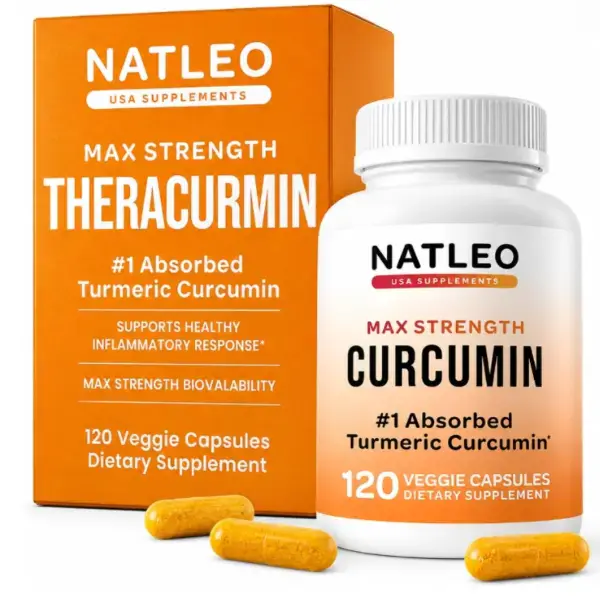
⭐ Robert’s Pick
Natleo Theracurmin Turmeric Curcumin
What I look for in a Theracurmin supplement comes down to three non-negotiables: confirmed use of genuine Theravalues-licensed Theracurmin, a dose in the 30–90mg clinically-studied range, and a clean excipient profile with no unnecessary fillers or piperine. Natleo’s Theracurmin formulation checks every box. The capsule size is manageable, the label is transparent, and — critically — it delivers the water-dispersibility characteristic that tells me the colloidal technology is intact and not degraded by poor manufacturing.
During my own protocol, this was the formulation I used in the Theracurmin phase. The consistency I noticed in my subjective joint and focus tracking aligned with what I’d expect from a properly formulated product at this dose range.
✅ PROS
- Genuine licensed Theracurmin
- Clinically relevant dose
- No piperine — piperine-free
- Water-dispersible (no fat needed)
- Clean label — minimal additives
❌ CONS
- Premium price point
- Not always in stock locally
Affiliate link — I earn a small commission if you purchase, at no extra cost to you.
9. How to Take Theracurmin
One of Theracurmin’s practical advantages over other enhanced curcumin formulations is its flexibility of administration. Here is what the research and my own experience indicate:
Dose
- Clinical trial range: 30–90mg of Theracurmin per day
- Most commonly studied dose for joint and cognitive outcomes: 90mg/day (often split into two 45mg doses)
- Check your specific product label — Theracurmin dose listed refers to the Theracurmin preparation itself, not total curcumin weight
Timing
- With or without food: Unlike fat-soluble curcumin forms, Theracurmin does not require dietary fat for absorption. This gives you genuine flexibility.
- Some users report slightly better tolerance when taken with a small meal — but this is about comfort, not absorption
- Consistent daily timing appears to support steadier plasma levels, though this is not rigorously studied for Theracurmin specifically
Duration
- Joint and inflammation studies have run primarily over 8–12 weeks — this is a reasonable minimum trial period before assessing results
- Cognitive function data from the Ito et al. study ran to 12 months — cognitive benefits, if they occur, may take longer to manifest and require sustained use
What to Avoid
- If you are taking blood-thinning medications (warfarin, aspirin, clopidogrel), consult your physician before use — curcumin has antiplatelet properties
- Not recommended during pregnancy or lactation without medical supervision
- Theracurmin does not contain piperine — this is a feature, not a deficiency. Piperine significantly inhibits the metabolism of many pharmaceutical drugs; its absence in Theracurmin is relevant for anyone taking prescription medications
For a comprehensive look at the safety side of the equation, the curcumin side effects and safety profile page covers the full evidence landscape, including at what doses adverse effects have been observed in clinical settings.
10. Frequently Asked Questions
What is Theracurmin and why is it different from standard curcumin?
Theracurmin is a patented form of curcumin that uses colloidal dispersion technology with gum ghatti to reduce curcumin particle size to approximately 0.19 micrometres — down from about 22 micrometres in standard powder. This makes it water-dispersible and dramatically improves how much curcumin reaches your bloodstream. A 2011 human pharmacokinetic trial (Sasaki et al., PMID: 21804127) found Theracurmin produced 27× higher total absorption (AUC) than standard curcumin at an equivalent dose.
Why is Theracurmin preferred over regular curcumin?
Standard curcumin in its natural crystalline form is poorly absorbed by the gut — large particles, high fat-solubility, and rapid metabolism mean most of what you swallow is excreted before it reaches your bloodstream. Theracurmin’s water-dispersible colloidal form bypasses these limitations, delivering curcumin in ultra-fine particles that the body can actually absorb without requiring fat or piperine. For most people, this translates to a meaningfully better physiological response at much lower doses.
What does Theracurmin’s 27× bioavailability claim actually mean?
It refers to the Area Under the Curve (AUC) — a pharmacokinetic measure of total blood exposure to a compound over time — being 27 times higher for Theracurmin than for standard curcumin at the same dose, as measured in the Sasaki et al. 2011 human crossover study. AUC is widely considered the most clinically meaningful measure of absorption because it integrates both peak concentration and duration of exposure. It is not a marketing figure inflated from in-vitro data — it comes from human plasma measurements.
How does Theracurmin support joint health?
Theracurmin’s primary proposed mechanism for joint support involves modulation of NF-κB — a transcription factor that regulates the production of pro-inflammatory cytokines including TNF-α and IL-6. By delivering curcumin to systemic circulation in clinically relevant concentrations, Theracurmin allows these anti-inflammatory pathways to be activated. A 2015 double-blind, placebo-controlled trial by Sunagawa et al. found statistically significant reductions in knee pain scores and improved function in osteoarthritis patients over 8 weeks.
What are the differences between Theracurmin and turmeric?
Turmeric is the whole root — it contains roughly 2–5% curcuminoids by weight, alongside hundreds of other phytocompounds including turmerones, polysaccharides, and volatile oils. Theracurmin is a refined, patented form of curcumin specifically — isolated from turmeric root and processed using colloidal dispersion technology. Turmeric provides a broader phytocomplex; Theracurmin provides a concentrated, highly bioavailable curcumin dose. Neither is universally superior — it depends on what you’re trying to achieve.
Can I take Theracurmin with other medications?
Curcumin — including in Theracurmin form — has known interactions with blood-thinning medications (warfarin, aspirin, clopidogrel) due to its antiplatelet properties. It may also interact with certain chemotherapy agents and immunosuppressants. Theracurmin notably does not contain piperine, which is relevant because piperine inhibits the CYP3A4 and P-glycoprotein enzymes involved in metabolising many pharmaceutical drugs. The absence of piperine makes Theracurmin a safer choice than piperine-enhanced curcumin for those on medication — but medical supervision is still required. Always inform your prescribing physician before adding Theracurmin to your protocol.
What is the recommended Theracurmin dosage?
Human clinical trials have used Theracurmin in the range of 30–90mg per day. The 90mg dose — often split into two 45mg servings — is the most commonly studied and appears to be the threshold at which joint and cognitive benefits are most consistently observed. Because Theracurmin delivers far more bioavailable curcumin per milligram than standard curcumin, these doses are considerably lower than the 500–2000mg often used in standard curcumin studies. For detailed dosage guidance, the dedicated Theracurmin dosage page on this site provides full clinical context.
How to choose the best Theracurmin supplement?
The three non-negotiables I apply: (1) Confirm the product uses genuine licensed Theracurmin from Theravalues Corporation — this is indicated on the label or confirmed by the manufacturer. Generic “colloidal curcumin” is not the same thing. (2) Look for a dose of 30–90mg of Theracurmin per serving — within the clinically studied range. (3) Check for a clean excipient profile — no unnecessary fillers, and ideally piperine-free for maximum medication compatibility. Third-party testing certification (USP, NSF, Informed Sport) adds further confidence.
11. Robert’s Verdict
Fifteen years into studying this space, I’ve watched bioavailability solutions come and go — some with strong science, many with marketing dressed up as science. Theracurmin belongs firmly in the former category.
The colloidal dispersion mechanism is real, the particle size reduction is measurable, and the pharmacokinetic data from Sasaki et al. is among the most rigorously conducted bioavailability research in the curcumin space. My personal 90-day test aligned with what the numbers would predict. This is a formulation that has earned its reputation.
It is not the right choice for every person or every goal. If blood-brain barrier penetration is your primary objective, Longvida deserves your attention. If budget is the deciding factor, BCM-95 offers a meaningful step up from standard curcumin at a lower cost. And if the phytosome approach appeals to you, Meriva has its own compelling data.
But for the person who has tried generic turmeric, noticed little, and wants a formulation with genuine pharmacokinetic credibility — particularly for joint inflammation and midlife cognitive maintenance — Theracurmin is where I would start.
Robert Lees
Independent Supplement Researcher & Self-Experimenter · 9+ Years
Robert has spent 9+ years researching and personally testing turmeric and curcumin supplementation. He applies a rigorous evidence-first standard to every recommendation on this site. Learn more about Robert →