
Turmeric C3 Complex Side Effects, Safety & Drug Interactions (2026)

9+ years researching curcumin safety, bioavailability, and drug interactions. Personal experience managing anti-inflammatory supplementation alongside GP-monitored health goals. All PMID references verified against PubMed. See our V5 testing protocol →
Curcumin C3 Complex® is one of the most-studied supplement ingredients in clinical literature, and its safety record is well-established across 50+ peer-reviewed trials. But well-studied does not mean risk-free — and the BioPerine® piperine that makes C3 Complex absorb properly also creates a drug interaction mechanism that every person on prescription medication needs to understand before using it. This page covers the full safety picture: what’s been observed in trials, what to watch for, who should avoid it, and what to use instead if BioPerine is a concern.
Is Turmeric C3 Complex Safe?
For healthy adults not on CYP3A4-metabolised medications: yes, and the evidence base for this is substantial. C3 Complex® at 500–1,500mg/day has been used in multiple randomised controlled trials without serious adverse events. The formulation has US GRAS (Generally Recognised As Safe) status. Health Canada has granted approved health claims for C3 Complex for anti-inflammatory and antioxidant activity. The WHO’s acceptable daily intake (ADI) for curcumin is 0–3mg/kg body weight, but supplement safety trials have administered doses well above this without adverse findings in healthy adults.
The nuance arrives with two specific factors: the BioPerine® (piperine) that makes C3 Complex absorb — which has a clinically relevant drug interaction profile — and the broader quality landscape of curcumin products generally, where adulteration and contamination risks make ingredient sourcing a legitimate safety consideration. Both are addressed in detail below.
Common Side Effects — What the Clinical Evidence Shows
| Side Effect | Frequency | Dose-Related? | Management |
|---|---|---|---|
| GI upset / nausea | Common (early) | ✅ Yes | Always take with a fat-containing meal — reduces significantly. Split 1,000mg across 2 meals rather than taking together. |
| Yellow/orange stools | Very common | ✅ Yes | Harmless — curcumin pigment passing through the GI tract. No action needed. Informs you the capsule is dissolving properly. |
| Loose stools / diarrhoea | Uncommon (at >1,000mg) | ✅ Yes | Reduce dose. Usually resolves within 1–2 days of dose reduction. If persistent, discontinue and consult a doctor. |
| Headache | Uncommon (high doses) | ✅ Yes (>3g/day) | Not typically reported at 500–1,000mg/day doses. If occurring at standard doses, review timing and hydration. |
| Yellow skin/fingernails | Rare (very high doses) | ✅ Yes | Transient skin yellowing from curcumin pigment deposition. Resolves on discontinuing. Not a sign of liver damage. |
| Contact skin reaction | Rare | ❌ Idiosyncratic | Contact dermatitis reported in turmeric-sensitised individuals. Oral sensitivity is rare but possible in those with existing turmeric skin reactions. |
The pattern across clinical trials is consistent: mild GI effects are the most common side effect at standard doses, are dose-dependent, and resolve on reducing dose or ensuring the capsule is taken with food. Serious adverse events have not been reported in trials using 500–1,500mg/day of C3 Complex® in healthy adult populations.
BioPerine® and CYP3A4 — The Most Important Safety Consideration
This is the section that most supplement brands omit or bury in fine print. BioPerine® (piperine from black pepper) is what makes C3 Complex® absorb properly — by inhibiting CYP3A4 (cytochrome P450 3A4), a liver enzyme responsible for the first-pass metabolism of approximately 60% of all prescription medications. This is not a theoretical concern: multiple clinical studies confirm that piperine meaningfully increases plasma concentrations of drugs metabolised by CYP3A4.
The mechanism works both ways. The same inhibition that allows more curcumin to survive hepatic clearance (which is why BioPerine® increases curcumin AUC by up to 2,000%) also prevents the liver from clearing your medication at its normal rate — causing that medication to accumulate to higher plasma levels than your prescribing doctor accounted for.
⚠️ Medication Classes That Interact with BioPerine® (CYP3A4 Substrates)
? High Priority — Consult Doctor
- Anticoagulants: Warfarin (Coumadin) — CYP interactions can shift INR unpredictably, increasing bleeding risk
- Statins: Atorvastatin, simvastatin, lovastatin — elevated plasma levels increase myopathy risk
- Immunosuppressants: Tacrolimus, cyclosporine — narrow therapeutic window, dangerous if elevated
- Antivirals: Ritonavir, saquinavir, many HIV medications — complex interaction profile
- Chemotherapy: Several agents — discuss with oncologist before any supplement use
? Worth Discussing with Prescriber
- Antidepressants: Some SSRIs, tricyclics — variable CYP interaction profile
- Benzodiazepines: Alprazolam, diazepam — CYP3A4 substrate
- Calcium channel blockers: Amlodipine, felodipine — used for blood pressure
- Antifungals: Some azole antifungals — complex interaction
- Some antibiotics: Erythromycin class — CYP3A4 substrate
This list is not exhaustive. If you take any prescription medication, ask your pharmacist whether it is metabolised by CYP3A4, CYP1A2, or UGT enzymes before using BioPerine-containing supplements.
Practical guidance: This does not mean that people on these medications cannot use curcumin. It means that if you want to use C3 Complex® with BioPerine® alongside these medications, you need your prescriber or pharmacist involved. Many people do exactly this, with appropriate monitoring. Alternatively — if piperine is a concern — use a piperine-free formulation. Both options exist and are covered below.
Curcumin’s Own Safety Profile (Independent of BioPerine)
Curcumin itself (independent of piperine) also has mild pharmacological effects worth knowing about:
Antiplatelet activity: Curcumin inhibits platelet aggregation through thromboxane B2 suppression and reduced collagen-induced clumping. At food-level quantities, this is insignificant. At supplement doses (500–1,000mg+), the antiplatelet effect is mild but clinically relevant in people on anticoagulants or scheduled for surgery. The standard guidance is to stop curcumin supplementation 2 weeks before elective surgery to eliminate this variable from your surgeon’s assessment.
Bile stimulation: Curcumin stimulates gallbladder contraction and bile secretion — which is actually beneficial for liver health and digestion in people with healthy bile systems. However, for people with gallstones or bile duct obstruction, stimulating bile flow can cause spasm and pain, or in severe cases, worsen an obstruction. If you have diagnosed gallstones, avoid high-dose curcumin supplementation without medical supervision.
Iron absorption: Curcumin has chelating properties — it can bind dietary iron, reducing its absorption from food. This is generally inconsequential for people with adequate iron status. For people with iron-deficiency anaemia or who rely on dietary iron (particularly vegans and vegetarians with high requirements), separate curcumin supplementation timing from iron-rich meals by at least 2 hours.
Blood glucose: Curcumin has mild insulin-sensitising and glucose-lowering effects demonstrated in several trials. For most people, this is a benefit. For people on diabetes medications (insulin, metformin, sulfonylureas), it introduces a mild additive glucose-lowering effect — not dangerous in itself, but worth monitoring via blood glucose testing when starting supplementation.
The Adulteration Risk: Why Ingredient Source Matters for Safety
Beyond the pharmacological safety profile of C3 Complex® itself, there’s a broader quality safety issue in the curcumin supplement market that affects anyone buying turmeric or curcumin products: adulteration and contamination.
Curcumin is historically one of the most adulterated spices and supplement ingredients globally. Consumer Reports and independent testing organisations have found products containing lead chromate (used to enhance the yellow colour of turmeric powder), synthetic curcumin dyes (metanil yellow), and other adulterants in commodity-grade turmeric sourced from uncontrolled supply chains. This is not a rare fringe problem — it’s an industry-wide challenge in sourcing.
Using Curcumin C3 Complex® from Sabinsa specifically — and choosing brands that name Sabinsa as the ingredient supplier — provides meaningful protection from adulteration because Sabinsa operates a controlled supply chain with proprietary sourcing and quality control that generic commodity curcumin manufacturers don’t. This is one of the underappreciated safety arguments for patented ingredient suppliers. Full context: Turmeric Adulteration: The Quality Risk in the Supplement Market →
Who Should Avoid Turmeric C3 Complex (with BioPerine)
? AVOID or use only under direct medical supervision:
- Gallstones / bile duct obstruction: Bile-stimulating effect of curcumin can cause spasm or worsen obstruction
- Pre-surgery (within 2 weeks): Mild antiplatelet effect — stop 2 weeks before any elective procedure
- Warfarin / anticoagulant users: Both curcumin (antiplatelet) and piperine (CYP3A4 inhibition affecting warfarin) can affect INR — requires monitoring
- Known turmeric/curcumin allergy: If you react to topical turmeric, oral sensitivity is possible
⚠️ Use with CAUTION — consult doctor/pharmacist first:
- Any CYP3A4 substrate medication (see full list above)
- Diabetes medications: Mild additive blood glucose lowering — monitor glucose when starting
- Pregnancy: Insufficient safety data at supplement doses. Food-level turmeric is considered safe; therapeutic doses are not established
- Breastfeeding: Insufficient safety data for therapeutic-dose curcumin
- Iron deficiency anaemia: Time supplementation away from iron-rich meals
- Active bleeding disorders: Mild antiplatelet effect — discuss with haematologist
✅ Generally SAFE for:
- Healthy adults not on prescription medications
- People with general inflammatory concerns using standard doses (500–1,000mg/day)
- People who have discussed supplementation with their GP and received clearance
- Long-term daily use (6–12+ months) at evidence-based doses
Piperine-Free Alternatives: If BioPerine Is a Concern
If you need curcumin but BioPerine® drug interactions make C3 Complex® unsuitable for your situation, several high-bioavailability piperine-free alternatives exist with strong clinical evidence:
29× Absorption
Meriva® Phytosome
Phosphatidylcholine delivery · Piperine-free · 30+ joint RCTs · Best for joints and medication users
See Meriva Reviews →46× Absorption
CurcuWin® OmniSome
Highest bioavailability human trial · Piperine-free · General anti-inflammatory
See CurcuWin Reviews →65× Free Curcumin
Longvida® SLCP
Crosses blood-brain barrier · Brain/mood/cognition · Piperine-free
See Longvida Guide →Long-Term Use Safety: What the Evidence Shows
Clinical trials have followed participants taking curcuminoids daily for up to 12 months without serious adverse events at doses of 500–1,000mg/day. No carcinogenicity, genotoxicity, or cumulative organ toxicity signals have emerged in long-term studies conducted on C3 Complex® or curcuminoids generally.
The hepatoprotective effect of curcumin is well-documented — multiple animal and human studies show curcumin as liver-protective, not liver-toxic. The rare reported cases of turmeric-associated liver injury in medical literature have predominantly involved very high doses, unidentified adulterants (including pyrrolizidine alkaloids in some cases), or pre-existing liver pathology — not standard C3 Complex supplementation at evidence-based doses.
The most important long-term safety monitoring consideration remains the BioPerine® drug interaction risk — not curcumin itself. If you are on any prescription medication and take C3 Complex daily long-term, ensure your prescribing doctor knows you are supplementing with piperine-containing curcumin. Annual medication reviews are a natural opportunity to confirm this remains appropriate. For a broader safety overview: Curcumin Side Effects: The Full Safety Picture →
Signs You Should Stop Taking C3 Complex and Seek Medical Advice
? Stop C3 Complex and consult a doctor if you experience:
- Jaundice (yellowing of skin or whites of eyes that is not cosmetic from curcumin pigment — true jaundice is deeper and associated with other symptoms)
- Severe or persistent abdominal pain — particularly upper right quadrant, which may indicate biliary involvement
- Unusual bruising or prolonged bleeding — particularly if you are on any anticoagulant medication
- Rapid changes in medication side effects — if you notice increased statin muscle soreness, unusual medication effects, or INR changes (for warfarin users), stop the supplement and contact your prescriber immediately
- Allergic reaction — hives, facial swelling, difficulty breathing after taking curcumin supplement (seek emergency care immediately)
- Significant unexplained fatigue or dark urine — while curcumin is not hepatotoxic at standard doses, any supplement can be inappropriate for a specific individual
? Transparency Pick (87/100)
Transparent Labs
500mg C3 + 10mg BioPerine · COAs publicly available · No proprietary blend
Read Review →? Discount Pick (86/100)
Nature’s Lab Gold
1,000mg C3 + BioPerine · 20% auto-discount · Direct supplier link
Read Review →? Value Pick (85/100)
Doctor’s Best
1,000mg C3 + 6mg BioPerine · Best cost-per-serving · 20+ year track record
Read Review →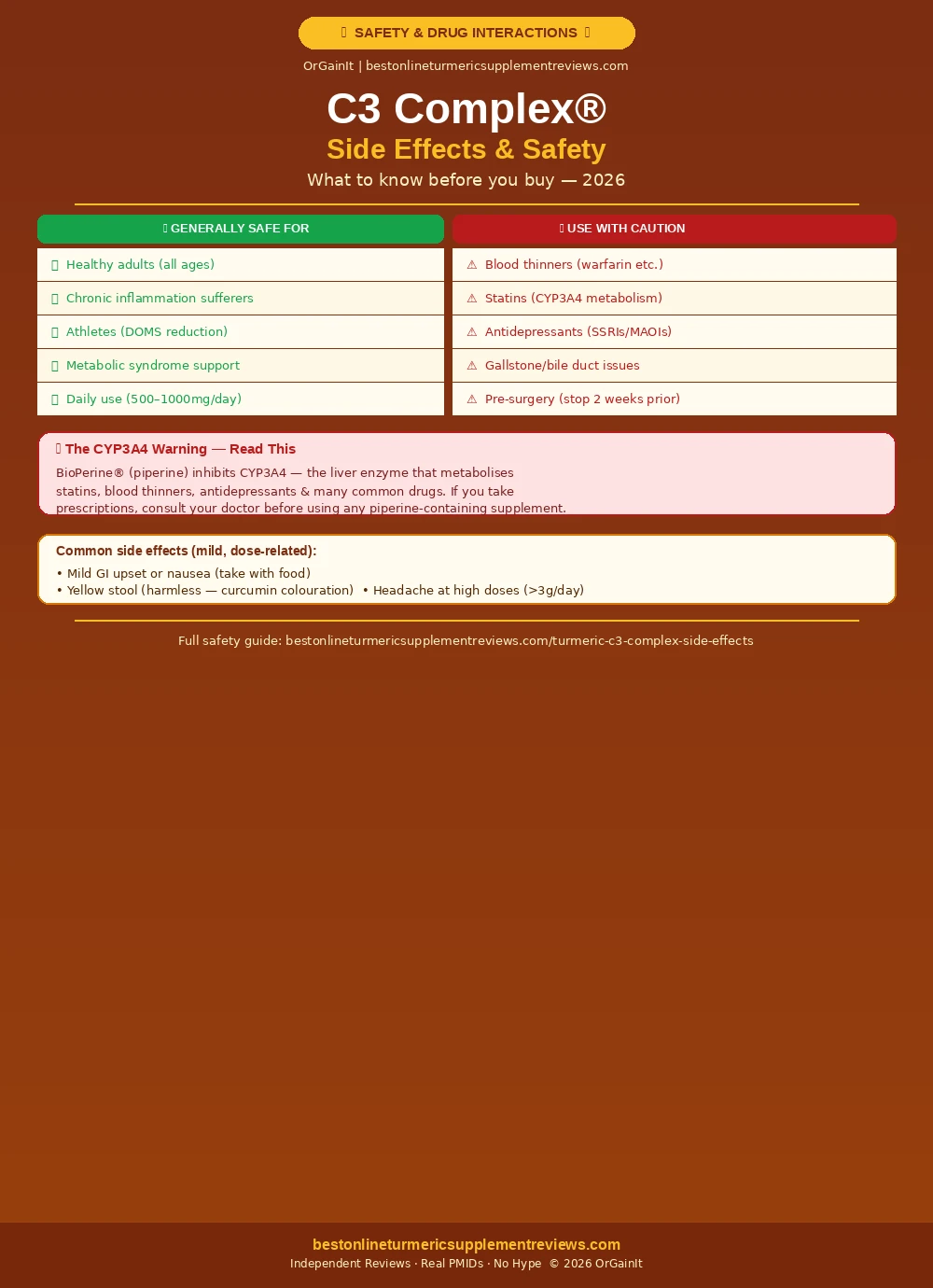
? Save This for Later
Browse Robert’s full curcumin supplement collection — organised by formulation, health goal, and budget.
View Full Curcumin Collection on Benable →Frequently Asked Questions
? Related Reading
- Turmeric Side Effects: The Full Picture Including Adulteration Risks
- Turmeric Adulteration: The Hidden Quality Risk in Supplements
- What Is Turmeric C3 Complex? — The Definitive Guide
- How to Use C3 Complex: Dosage, Timing and Absorption
- C3 Complex for Inflammation: RCT Evidence and Dosage
- C3 Complex vs Generic Curcumin — Full Comparison
- Best C3 Complex Supplements — Full Buyer’s Guide
- Meriva® Curcumin — Piperine-Free Alternative for Medication Users
- Longvida® Curcumin — Piperine-Free, Brain-Penetrating
- Our V5 Review Protocol — How We Evaluate Every Product