
Turmeric C3 Complex vs Curcumin: What’s the Actual Difference? (2026)

9+ years researching curcumin bioavailability. I made the mistake of using generic curcumin for the first two years of my supplement journey — and wondering why it wasn’t doing much. Understanding the formulation science changed my results. See our V5 testing protocol →
Walk into any supplement store and you’ll find two types of curcumin products: those claiming “Curcumin C3 Complex® (Sabinsa)” and those claiming “Turmeric Extract (95% Curcuminoids).” Both may list 500mg per capsule. Both may claim 95% purity. Both may even cite the same clinical trials. So what’s actually different — and does it matter?
The answer involves a 1995 patent, three distinct bioactive compounds, and the critical question of whether clinical evidence from one formulation can legitimately be applied to a different one. Spoiler: it cannot. And most supplement brands hoping to ride the curcumin research wave without using the actual studied ingredient are counting on consumers not knowing this.
Turmeric, Curcumin, and Curcuminoids: Getting the Vocabulary Right
These terms are often used interchangeably in marketing — they shouldn’t be. Here’s the hierarchy:
? The Turmeric Compound Hierarchy
The whole plant. Contains 2–5% curcuminoids by weight, plus essential oils (turmerones), starch, fibres, and other phytochemicals. Used in cooking. Insufficient curcuminoid concentration for therapeutic supplementation — you’d need grams of raw powder.
The family of three related phenolic compounds extracted from turmeric root: curcumin (the dominant compound), demethoxycurcumin (DMC), and bisdemethoxycurcumin (BDMC). These are the compounds with anti-inflammatory, antioxidant, and other clinical evidence. Supplements labelled “95% curcuminoids” report total concentration of all three — but not their ratio.
The most abundant individual curcuminoid — approximately 75% of the curcuminoid total. Often used as a label shorthand for all curcuminoids, which creates significant confusion. When a label says “curcumin,” it may mean the full curcuminoid extract — or it may mean the isolated curcumin fraction specifically.
A standardised, patented curcuminoid extract with a controlled ratio across all three compounds: curcumin 75–81%, DMC 15–19%, BDMC 2.2–6.5%. The “C3” refers to the three curcuminoids. This is the ingredient used in 50+ clinical trials — the name on the label is the guarantee that the ratio was maintained.
What “95% Curcuminoids” Actually Means on a Generic Label
A supplement listing “Turmeric Extract (95% Curcuminoids)” is telling you that the extract has been standardised to contain 95% curcuminoids by weight — meaning 95% of the extract’s dry weight is curcuminoids rather than starch, fibres, or other plant matter. This is a purity statement, not a composition statement.
It tells you almost nothing about the ratio of curcumin to DMC to BDMC. A batch of “95% curcuminoids” could be 92% curcumin and near-zero DMC and BDMC — still technically 95% curcuminoids total. Another batch from the same manufacturer might have a completely different ratio because it came from a different turmeric harvest region. The ratio isn’t controlled because there is no patent requiring it to be.
This variability matters clinically. DMC and BDMC are not inert compounds. BDMC (bisdemethoxycurcumin) has demonstrated distinct antioxidant activity and anti-carcinogenic properties separate from curcumin’s profile. If your generic 95% extract contains near-zero BDMC, you are missing one of the three bioactive components the C3 Complex trials actually studied. You’re not getting the research — you’re getting part of it, in an unknown proportion, from an unspecified source.
This is the adulteration adjacent problem — even without intentional fraud, variable raw material quality can produce legitimate-looking products with inconsistent active compound profiles. For more on quality risks in the curcumin market: Turmeric Adulteration: The Hidden Quality Risk →
What C3 Complex® Actually Controls: The Three Curcuminoids
Sabinsa’s 1995 patent covers the process for maintaining a controlled three-curcuminoid ratio across production batches. Every batch of C3 Complex® must meet the specification: curcumin 75–81%, DMC 15–19%, BDMC 2.2–6.5%. The “C3” doesn’t stand for anything catchy — it literally refers to the three controlled curcuminoids.
| Curcuminoid | C3 Complex® Range | Primary Activity | Generic Extract Guarantee |
|---|---|---|---|
| Curcumin | 75–81% | Primary NF-κB inhibitor, anti-inflammatory, antioxidant, anti-cancer signalling | ❌ None — can dominate the extract |
| Demethoxycurcumin (DMC) | 15–19% | Synergistic anti-inflammatory, complementary pathway modulation, enzyme inhibition | ❌ None — variable between batches |
| Bisdemethoxycurcumin (BDMC) | 2.2–6.5% | Antioxidant activity, stability, anti-carcinogenic pathways (distinct from curcumin) | ❌ None — often near-zero in cheap extracts |
The practical implication: when Panahi et al. conducted their landmark 2016 RCT (PMID 27470399) using C3 Complex® and found significant reductions in TNF-α, IL-6, and IL-8, they were studying a product with this exact ratio. A trial of generic 95% curcumin with unknown DMC and BDMC proportions would not necessarily replicate these findings. The clinical evidence belongs to the formulation, not to the curcuminoid class in general.
C3 Complex vs Generic 95% Curcumin — Full Head-to-Head
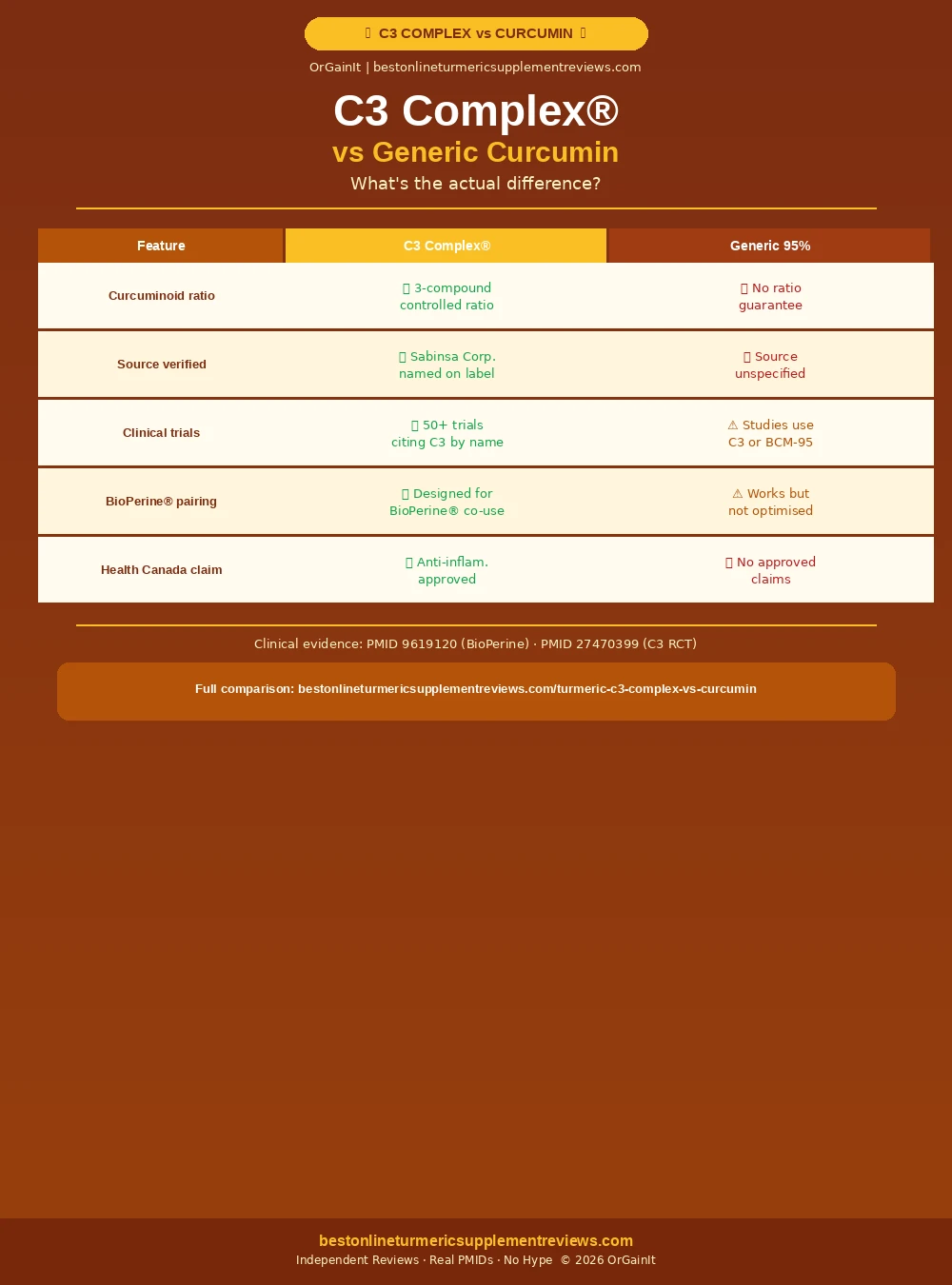
| Feature | C3 Complex® (Sabinsa) | Generic 95% Curcumin |
|---|---|---|
| Curcuminoid ratio controlled | ✅ All 3 ratios patented | ❌ Total % only |
| Ingredient source named on label | ✅ Sabinsa Corp. (NJ, USA) | ❌ Often unspecified origin |
| Named in clinical trials | ✅ 50+ peer-reviewed trials | ⚠️ Borrows C3 research |
| Health Canada approved claims | ✅ Anti-inflammatory, antioxidant | ❌ No approved claims |
| Batch-to-batch consistency | ✅ Patent specification enforced | ❌ Varies by harvest/manufacturer |
| Origin traceability | ✅ Sabinsa supply chain | ❌ Often unknown (India/China spot market) |
| Adulteration risk | ✅ Lower — controlled supply chain | ❌ Higher — commodity sourcing |
| Price | ⚠️ Premium ingredient cost | ✅ Cheapest option available |
The BioPerine® Absorption Equation — and Why Source Matters Here Too
Both C3 Complex® and generic curcumin face the same fundamental bioavailability challenge: curcumin is fat-soluble and rapidly metabolised by the liver before reaching systemic circulation. Without an absorption enhancer, oral bioavailability is estimated at 1–3%. This is well-established and is the reason that essentially all serious curcumin products include either piperine, a phospholipid complex, or a lipid-based delivery technology.
BioPerine® is Sabinsa’s patented black pepper piperine extract — also standardised to 95% piperine. The landmark study that established the 2000% AUC increase (PMID 9619120, Shoba G et al., Planta Medica 1998) used BioPerine® specifically — not generic black pepper extract. This is important because piperine content in generic black pepper extracts can vary widely between manufacturers, and the bioavailability study cannot be assumed to generalise to unstandardised sources.
C3 Complex® was designed to pair with BioPerine® — both are Sabinsa products, and the combined C3 + BioPerine system is what most clinical trials used. This is a purpose-built pair, not a convenient combination. Importantly, even with BioPerine®, you should take C3 Complex with a fat-containing meal — curcumin’s fat-solubility means dietary fat drives intestinal absorption before piperine handles the hepatic metabolism step. Both mechanisms are additive. Full protocol: How to Use Turmeric C3 Complex →
BioPerine® drug interaction warning: Piperine inhibits CYP3A4 — the liver enzyme that metabolises approximately 60% of prescription medications. This is not a theoretical concern. If you take statins, blood thinners, antidepressants, immunosuppressants, or antivirals, discuss piperine use with your doctor before starting. If you need to avoid piperine: Meriva® (phytosome, 29×) and CurcuWin® (OmniSome, 46×) are both piperine-free with strong bioavailability evidence.
C3 Complex vs Other High-Bioavailability Formulations
C3 Complex® + BioPerine® is not the only approach to solving curcumin’s bioavailability problem — it’s the approach with the deepest clinical history. Here’s how it compares to the other patented formulations on the market:
| Formulation | Bioavailability vs standard | Piperine-Free | Clinical Trials | Best Target |
|---|---|---|---|---|
| C3 Complex® + BioPerine® | ~20× (AUC) | ❌ No | 50+ | General anti-inflammatory, metabolic, accessible price |
| CurcuWin® (OmniSome) | 46× (human) | ✅ Yes | 10+ | Max bioavailability, medication users |
| Meriva® (Phytosome) | ~29× (plasma) | ✅ Yes | 30+ joint | Joint/connective tissue, medication users |
| BCM-95® (Biocurcumax) | ~7× (plasma) | ✅ Yes | 20+ | Full-spectrum (turmerones retained) |
| Longvida® (SLCP) | 65× free curcumin | ✅ Yes | 15+ | Brain/CNS, crosses blood-brain barrier |
| Generic 95% Curcumin | 1–3% baseline | Variable | 0 (own) | Budget — evidence not directly applicable |
Which Should You Choose? — The Honest Decision Guide
✅ Choose C3 Complex® + BioPerine® if:
- You want the formulation with the deepest, most directly applicable clinical evidence base
- Budget matters — C3 Complex is more cost-accessible than many alternatives
- Your goal is general anti-inflammatory support (systemic, metabolic, general wellbeing)
- You are not on prescription medications that use the CYP3A4 pathway
- You can take it consistently with fat-containing meals
? Choose Longvida® if:
- Your primary goal is cognitive support, brain health, or mood regulation
- C3 Complex does not meaningfully cross the blood-brain barrier — Longvida does
? Choose Meriva® if:
- Joint health is your specific priority — Meriva has 30+ joint-focused trials
- You take medications (warfarin, statins, SSRIs) — Meriva is piperine-free
- Phosphatidylcholine delivery for tissue penetration is relevant to your condition
⚡ Choose CurcuWin® if:
- Maximum bioavailability is the priority — 46× vs standard curcumin in a human trial
- You’ve used C3 Complex for 12 weeks without results and want to try a different delivery system
- You take medications and need a piperine-free option with high absorption
Our Recommended C3 Complex Products
? Transparency Pick (87/100)
Transparent Labs
500mg C3 + 10mg BioPerine · COAs published publicly · No proprietary blend
Read Full Review →? Discount Pick (86/100)
Nature’s Lab Gold
1,000mg C3 + BioPerine · 20% auto-discount built into Robert’s link
Read Full Review →? Value Pick (85/100)
Doctor’s Best
1,000mg C3 + BioPerine · ~$0.27/serving · 20+ year track record
Read Full Review →Full comparison: Best Turmeric C3 Complex Supplements — Buyer’s Guide →
? Save This for Later
Browse Robert’s full curcumin supplement collection — organised by formulation, health goal, and budget.
View Full Curcumin Collection on Benable →Frequently Asked Questions
? Related Reading
- Turmeric vs Curcumin: The Most Important Difference (2026)
- What Is Turmeric C3 Complex? — The Definitive Guide
- Best C3 Complex Supplements — Full Buyer’s Guide
- C3 Complex for Inflammation: RCT Evidence and Dosage
- How to Use C3 Complex: Dosage, Timing and Absorption
- C3 Complex Side Effects and Drug Interactions
- Turmeric Adulteration: Quality Risks in the Supplement Market
- What Is BCM-95® Curcumin? The Full Science Guide
- Meriva® Curcumin — Best for Joints and Medication Users
- Curcumin Safety: Side Effects and Who Should Be Cautious