
How to Use Turmeric C3 Complex: Dosage, Timing & Absorption (2026)

9+ years researching curcumin bioavailability. I took C3 Complex suboptimally for the first year — wrong timing, no fat, wondering why it wasn’t working. The protocol on this page is what I’ve settled on after reading every relevant RCT. See our V5 review protocol →
Curcumin C3 Complex® is one of the most evidence-backed supplement ingredients available — but most people take it suboptimally. Wrong timing, wrong meal pairing, wrong dose escalation, or no consistency are the most common mistakes. This guide covers exactly how the clinical trials dosed C3 Complex®, why both BioPerine® and dietary fat matter simultaneously, and what realistic results look like on a week-by-week basis.
Why “Take With Food” Is Not Generic Advice for C3 Complex
Most supplement labels say “take with food” as a standard GI-protective instruction. For C3 Complex®, “take with food” is a bioavailability instruction — and the type of food matters significantly. Curcumin is fat-soluble, meaning it dissolves into dietary fat in the gut before being transported via the lymphatic system. Without sufficient dietary fat in the same meal, even BioPerine®-enhanced absorption is substantially lower than it could be.
A 2014 study by Krishnakumar et al. demonstrated that solid lipid nanoparticle delivery increased curcumin bioavailability specifically because of fat-mediated lymphatic transport — the same mechanism that makes dietary fat relevant for standard capsule supplementation. You don’t need to eat a high-fat meal, but 10–20g of fat from a natural source (eggs, avocado, nuts, olive oil, full-fat yoghurt) alongside your C3 Complex capsule is the practical minimum.
The two-mechanism model: Think of absorption as a two-step problem. Step 1 (gut → lymph): dietary fat enables curcumin to enter the lymphatic system rather than being trapped in the gut lumen. Step 2 (lymph → systemic circulation): BioPerine® inhibits glucuronidation in the liver, preventing curcumin from being metabolised before it reaches the bloodstream. Fat and piperine address different bottlenecks. You want both working together, which is why “take with food” is specific advice, not a formality.
Recommended Dosage: What the Clinical Evidence Uses
The clinical literature for C3 Complex® uses doses ranging from 500mg/day (antioxidant support, mild conditions) to 1,500mg/day (higher inflammatory load, active conditions). The most commonly cited effective dose across randomised controlled trials is 1,000mg/day — equivalent to two standard 500mg capsules split across two meals. This is the dose used in the key anti-inflammatory RCT (PMID 27470399) that demonstrated significant cytokine reduction.
| Daily Dose | Best Use Case | How to Split | Clinical Support |
|---|---|---|---|
| 500mg/day | Antioxidant support, maintenance, new users starting out | 1 capsule with largest meal | Entry-level — supported but lower evidence density |
| 1,000mg/day ⭐ | Standard anti-inflammatory; metabolic support; joint health | 2 × 500mg split: breakfast + dinner | PMID 27470399 — RCT standard, strongest evidence |
| 1,500mg/day | Higher inflammatory burden, active conditions | 3 × 500mg across 3 meals | Used in some trials; not superior to 1,000mg for most |
| >2,000mg/day | Not recommended for self-supplementation | — | GI side effects increase; no additional clinical benefit |
Starting recommendation: Begin at 500mg/day for the first 1–2 weeks, then escalate to 1,000mg/day split across breakfast and dinner. This allows your GI system to adapt and lets you identify any initial sensitivity before committing to the full dose.
Condition-Specific Dosing Considerations
The right dose isn’t just about one-size-fits-all anti-inflammatory support. Here’s how dosing considerations shift across different use cases:
? Chronic Inflammation (General)
1,000mg/day split across 2 fat-containing meals. Minimum 8-week commitment before evaluating. This is the RCT-supported standard dose for cytokine reduction (TNF-α, IL-6, IL-8).
1,000mg/day consistent daily use. The Belcaro OA trial (PMID 20657536) showed progressive improvement over 8 months — commit to the long game. For severe joint inflammation, also consider Meriva® phytosome (30+ joint trials, piperine-free).
⚡ Post-Exercise Recovery
500mg pre-workout (with a light fat-containing snack) + 500mg post-workout with your recovery meal. Start supplementation 2–3 weeks before intensive training blocks for best effect — curcumin’s anti-inflammatory mechanisms require established plasma levels.
? Metabolic / Blood Sugar Support
1,000mg/day with meals. The Panahi 2016 metabolic syndrome RCT specifically used this dose. Note: curcumin has mild glucose-lowering activity — if you take diabetes medication, monitor blood glucose more closely when starting supplementation.
❤️ Cardiovascular / Liver Support
1,000mg/day. C3 Complex for cardiovascular and liver benefits is supported by the same cytokine-reduction and NF-κB inhibition mechanisms. Consistent long-term use (3–6 months) is where maintenance benefits are most observable.
Timing: When to Take C3 Complex Through the Day
The most important timing rule is simple: take with a fat-containing meal. Beyond that, the time of day is genuinely flexible. Here are the most common protocols:
| Protocol | Dose Split | Best For | Recommended? |
|---|---|---|---|
| Breakfast + Dinner ⭐ | 500mg + 500mg | Most people — maintains more stable plasma levels | ✅ Yes |
| Lunch + Dinner | 500mg + 500mg | Those who skip breakfast or eat lightly in AM | ✅ Yes |
| Single Dose (Dinner) | 1,000mg together | Those who find split dosing inconvenient | ⚠️ Acceptable |
| Fasted / Empty Stomach | Any dose | Not recommended for C3 Complex | ❌ Avoid |
The BioPerine® Interaction: Why Two Mechanisms Are Better Than One
BioPerine® (standardised piperine) works by a completely different mechanism than dietary fat — and both are needed for optimal C3 Complex absorption. Understanding why requires a quick tour of curcumin’s pharmacokinetics.
After entering the gut, curcumin faces two barriers. First, it needs to be absorbed across the intestinal wall — which is where fat-solubility matters. Dissolved in dietary fat, curcumin enters the lymphatic system via chylomicrons (fat transport particles) rather than being excreted directly. This significantly increases the amount reaching portal circulation.
Second problem: even once in portal circulation, curcumin faces rapid glucuronidation — a liver metabolic process that converts curcumin into inactive metabolites before it enters systemic circulation. This is where BioPerine® acts. Piperine inhibits glucuronidation, specifically via CYP1A2 and UGT enzymes, allowing more unmodified curcumin to pass through into the bloodstream. The landmark Shoba 1998 study (PMID 9619120) demonstrated a 2,000% AUC increase with 20mg of piperine alongside 2g of curcumin — purely from reducing this hepatic first-pass clearance.
The practical takeaway: Fat handles intestinal absorption; BioPerine® handles hepatic clearance. Take C3 Complex with a fat-containing meal and let the BioPerine® in the capsule do the rest. Do not take on an empty stomach and do not add extra black pepper (the BioPerine® already in the capsule is standardised and dosed correctly).
Important — drug interactions: Piperine’s CYP3A4 inhibition is the same mechanism that affects drug metabolism. If you take statins, blood thinners, antidepressants, or immunosuppressants, the same effect that improves curcumin absorption will also affect your medication’s plasma levels. Discuss this with your prescriber. Full guide: C3 Complex Drug Interactions →
When to Expect Results: A Week-by-Week Realistic Timeline
This is the question I get most often — and the one supplement brands answer with the vaguest possible non-commitments. Here’s an honest breakdown based on clinical trial timelines and what I’ve observed in seven years of personal use and reader feedback:
⏱️ Realistic C3 Complex Results Timeline
Antioxidant Activity Begins / GI Adaptation
Curcumin’s antioxidant effects are immediate once absorbed — it begins scavenging reactive oxygen species from the first dose. You may notice mild digestive changes (slightly loose stools, transient nausea) as your gut adapts, particularly if you started at 1,000mg without a ramp-up period. Yellow-tinted stools are normal and harmless — curcumin pigment passing through. No meaningful anti-inflammatory change at this stage.
Early Inflammation Modulation — Subtle Signals
Some users begin noticing subtle changes: slightly less morning joint stiffness, marginally faster post-exercise recovery, better digestive comfort. These are real — curcumin’s NF-κB inhibition is beginning to shift cytokine expression — but they’re not dramatic. If you’re expecting pain-level changes at this stage, you’ll be disappointed. The mechanism works gradually, not acutely.
Primary Anti-Inflammatory Window — RCT Territory
This is the range where the clinical trials see their primary endpoints. The Panahi 2016 RCT (PMID 27470399) showed significant TNF-α, IL-6, IL-8 reductions at 8 weeks. For joint users, morning stiffness reduction and improved mobility are typically noticeable in this window. For metabolic users, if you’ve had CRP tested, you may see a measurable downward shift by week 8.
Cumulative Long-Term Maintenance
Curcumin is not a supplement you take and stop when you feel better — it’s a long-term anti-inflammatory maintenance tool. The Belcaro OA trial (PMID 20657536) showed progressive joint score improvement across 8 months of continuous supplementation. This is where the compounding benefit of consistent inflammation modulation shows up — in reduced baseline discomfort, preserved joint function, and sustained metabolic markers.
Stacking C3 Complex with Other Supplements
C3 Complex® pairs well with a number of complementary anti-inflammatory and health-supporting ingredients. Here are combinations that have clinical or mechanistic rationale — not just marketing synergy claims:
- Omega-3 fatty acids (EPA/DHA): Both curcumin and omega-3s modulate the arachidonic acid pathway and NF-κB signalling. The fat from a fish oil capsule also contributes to curcumin’s fat-soluble absorption. A practical stack that addresses two complementary anti-inflammatory mechanisms.
- Boswellia serrata (AKBA): Boswellia inhibits 5-LOX (5-lipoxygenase), a different inflammatory pathway from curcumin’s COX-2 / NF-κB focus. Curcumin + Boswellia is a well-studied combination for joint health, providing complementary pathway coverage. Many joint-focused supplements combine both.
- Vitamin D: Chronic inflammation is strongly associated with vitamin D insufficiency. Correcting vitamin D deficiency alongside anti-inflammatory supplementation addresses a common underlying driver. Ensure adequate vitamin D status before attributing insufficient response to the C3 Complex itself.
- Magnesium: Magnesium deficiency is linked to elevated inflammatory markers. Ensuring adequate magnesium (300–400mg/day of elemental magnesium) is a sensible baseline for anyone managing inflammatory conditions.
Combinations to be cautious about: Avoid stacking C3 Complex + BioPerine® with other high-piperine products. The drug interaction risk from cumulative piperine is additive. If you’re on any medication, don’t combine multiple piperine-containing supplements without medical review.
How to Store C3 Complex Supplements
Curcuminoids degrade with heat, humidity, and UV light exposure. The standard advice — store in a cool, dry place away from direct sunlight — is genuinely important for C3 Complex, not just a liability disclaimer. Avoid bathroom medicine cabinets (humidity fluctuations with shower steam will degrade quality over time). A kitchen cupboard away from the stove or a bedroom drawer is ideal. Refrigeration is unnecessary unless the manufacturer specifies it, and may introduce moisture on removal. Most C3 Complex products are shelf-stable for 18–24 months at room temperature when stored correctly.
What If It’s Not Working? A Troubleshooting Framework
If you’ve been consistent for 10–12 weeks at 1,000mg/day with fat-containing meals and you’re not noticing any change — don’t simply give up on curcumin. Work through this checklist:
1. Was there actually fat in every meal you took it with?
A black coffee and a piece of toast does not count. Practical minimum: 1 tbsp olive oil, a handful of nuts, half an avocado, or two eggs in the same meal.
2. Were you truly consistent — every day, no significant gaps?
Missing 2–3 days per week effectively resets the steady-state plasma accumulation. Curcumin’s half-life is short — consistency is everything.
3. Is the issue absorption-specific — would a different delivery system help?
Some individuals are poor responders to BioPerine-enhanced absorption. Try CurcuWin® (46× bioavailability) or Meriva® (phytosome) as an alternative delivery system before concluding curcumin doesn’t work for you.
4. Is the underlying condition the right target for C3 Complex?
Brain/cognition → Longvida®. Severe joint inflammation → Meriva®. Skin → CuroWhite®. Not every inflammatory condition responds equally to C3 Complex’s specific mechanisms.
5. Have you had blood work done?
CRP (C-reactive protein) before and after 8 weeks is the clearest objective signal. Sometimes curcumin is measurably working even when you don’t subjectively feel different — particularly for low-grade systemic inflammation where the baseline symptoms are subtle.
Our Recommended C3 Complex Products
? Best Transparency (87/100)
Transparent Labs
500mg C3 + 10mg BioPerine · COAs published · No proprietary blend
Read Review →? Best Discount (86/100)
Nature’s Lab Gold
1,000mg C3 + BioPerine · 20% auto-discount via Robert’s link
Read Review →? Best Value (85/100)
Doctor’s Best
1,000mg C3 + 6mg BioPerine · ~$0.27/serving · Prime eligible
Read Review →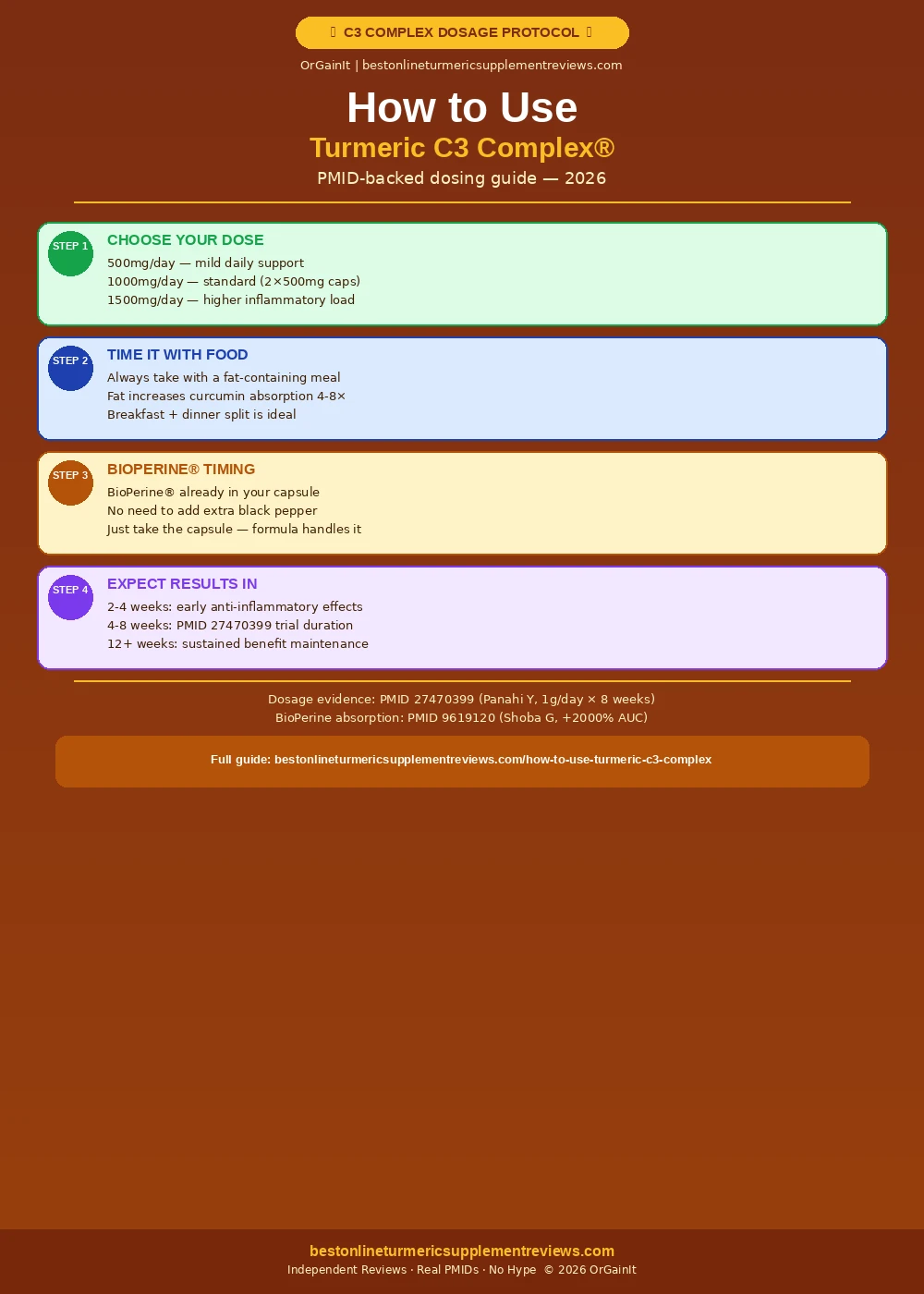
? Save This for Later
Browse Robert’s full curcumin supplement collection — organised by formulation, health goal, and budget.
View Full Curcumin Collection on Benable →Frequently Asked Questions
? Related Reading
- What Is Turmeric C3 Complex? — The Definitive Guide
- C3 Complex for Inflammation: RCT Evidence and Dosage
- C3 Complex Side Effects and Drug Interactions
- C3 Complex vs Generic Curcumin — What’s Actually Different
- Best C3 Complex Supplements — Full Buyer’s Guide
- Turmeric for Inflammation: Science, Evidence and Practical Hacks
- Turmeric for Arthritis: What 5 Clinical Trials Show
- Turmeric for Pain Relief: Clinical Evidence Across All Pain Types
- Curcumin Safety: Full Side Effects and Safety Guide
- Turmeric Adulteration: Quality Risks You Need to Know